

The symbols of the Holy Spirit are the images Scripture and Catholic tradition use to speak about the Third Person of the Trinity: the dove, fire, wind (breath), water, oil (chrism), the seal, the hand of God, the cloud, light, and the finger of God. Each one comes from a specific passage of the Bible — and each can be read in the sacred art of the Church, from the dove above Christ in icons of the Baptism to the tongues of fire in the Pentecost icon.
This guide explains all ten symbols, where they come from in Scripture, and what they mean — so that the next time you look at a Catholic icon, you will know exactly what you are seeing.
The Ten Symbols of the Holy Spirit at a Glance
| Symbol | Scripture | Meaning |
|---|---|---|
| Dove | Matthew 3:16; Genesis 8:8–12 | Peace, purity, the Spirit descending on Christ |
| Fire | Acts 2:3; Luke 3:16 | Purification, zeal, the power of Pentecost |
| Wind / breath | John 3:8; Acts 2:2; Ezekiel 37 | The invisible, life-giving presence of God |
| Water | John 3:5; John 7:37–39 | Baptism, new birth, the life of grace |
| Oil (chrism) | 1 John 2:27; Exodus 30:22–33 | Anointing, consecration, Confirmation |
| Seal | Ephesians 1:13; 2 Corinthians 1:22 | The Spirit as God's mark on the faithful |
| Hand of God | Ezekiel 37:1; Psalm 139 | God's action in creation and salvation |
| Cloud | Exodus 13:21; Matthew 17:5 | God's hidden presence and guidance |
| Light | Psalm 119:105; 2 Corinthians 4:6 | Illumination, guidance, the flame of faith |
| Finger of God | Luke 11:20; Matthew 12:28 | The Spirit at work in Christ's miracles |
These ten are the list that Catholic reference works most often settle on. You will also meet shorter lists of three, four, five, or six symbols, and longer lists of eight or twelve — the differences come from how finely each list separates images that overlap (wind and breath, for example, or fire and light).
The Dove — The Spirit of Peace
The dove is the most recognizable symbol of the Holy Spirit, and the only one directly connected with the Spirit's visible descent: at the Baptism of Jesus, "he saw the Spirit of God descending like a dove and coming to rest on him" (Matthew 3:16).
The image carries the memory of the first dove as well — the one Noah released from the ark, which returned with an olive branch when the waters of the flood had receded (Genesis 8:8–12). Peace with God, and the end of judgment: that is the dove's message in both Testaments.
In Christian art the dove is usually shown in profile with wings spread, often within rays of light or a circular nimbus, and sometimes with an olive branch in its beak. When a dove is pictured with seven rays, the artist is pointing to the seven gifts of the Holy Spirit.
Fire — The Tongues of Pentecost
Fire is the symbol of the Spirit's power. John the Baptist promised that Christ would "baptize you with the Holy Spirit and fire" (Luke 3:16), and at Pentecost the promise was fulfilled: "there appeared to them tongues as of fire, distributed and resting on each one of them" (Acts 2:3).
Fire in Scripture purifies, illuminates, and transforms — and it is never abstract. At Pentecost the fire is not a blaze that consumes the room; it rests on each person, one tongue of flame per head. The Spirit is given to each believer personally.
Red is the liturgical color of fire and of the Spirit, which is why Pentecost vestments and altar hangings are red.
Wind and Breath — The Ruah of God
In Hebrew the word ruah means wind, breath, and spirit at once — and it is the word the Old Testament uses for the Spirit of God. The prophet Ezekiel saw the dry bones come alive when the breath of God entered them (Ezekiel 37:9–10), and Jesus compared the Spirit to the wind: "The wind blows where it wills... so it is with everyone who is born of the Spirit" (John 3:8).
At Pentecost the sound of "a mighty rushing wind" filled the house (Acts 2:2). Wind and breath are the most invisible symbols of the Spirit — you cannot see them, only their effects.
Water — Baptism and New Birth
Water is the symbol of the Spirit's work in Baptism. "Unless one is born of water and the Spirit, he cannot enter the kingdom of God," Jesus told Nicodemus (John 3:5). On the last day of the Feast of Tabernacles He stood and cried out: "If any one thirst, let him come to me and drink... out of his heart shall flow rivers of living water" — and John notes that "this he said about the Spirit" (John 7:37–39).
In art, water is shown in the Jordan of baptismal scenes and in the living fountains of the Psalms.
Oil and Chrism — The Anointing of the Spirit
Oil is the symbol of anointing, and anointing is the sign of the Spirit's gift. In the Old Testament kings, priests, and prophets were anointed with oil; in the Church, the sacred chrism consecrated by the bishop is used in Baptism, Confirmation, and ordination. "The anointing which you received from him abides in you," writes St. John (1 John 2:27).
The olive branch of the dove, the oil of gladness of Psalm 45, the chrism of Confirmation — all speak of the same reality: the Spirit given, not earned.
The Seal, the Cloud, and the Light
The seal is the Spirit as God's mark of ownership on the believer: "you were sealed with the promised Holy Spirit" (Ephesians 1:13). In Confirmation the sacrament itself is called the seal of the Holy Spirit — the gift that marks the Christian as Christ's own.
The cloud is the sign of God's hidden presence: the pillar of cloud that led Israel through the desert (Exodus 13:21), and the bright cloud that overshadowed Christ on the mountain of the Transfiguration (Matthew 17:5). The Spirit is often shown as a cloud from which the hand of God emerges in icons of the Baptism and the Annunciation.
Light is the symbol of illumination: "your word is a lamp to my feet and a light to my path" (Psalm 119:105). The flame above each apostle at Pentecost is a light that does not consume — the Spirit guiding the Church into truth.
The Hand and the Finger of God
The hand of God is one of the oldest images of the Spirit's action: the Psalms and Prophets speak constantly of the "hand of the Lord" that creates, saves, and guides (see Ezekiel 37:1). In icons of the Baptism and the Transfiguration, the hand emerging from the cloud is the Spirit blessing the Son.
The finger of God is the most precise of all: "If it is by the finger of God that I cast out demons," said Jesus, "then the kingdom of God has come upon you" (Luke 11:20). The Spirit is the finger with which God writes and works.
How Many Symbols Are There?
Search for the symbols of the Holy Spirit and you will find lists of three, four, five, six, seven, eight, nine, ten, and even twelve. There is no single definitive number, because Scripture uses all of these images and tradition counts them differently.
The most useful rule of thumb: the four symbols most often named are the dove, fire, wind, and water; the five add oil; the ten add the seal, the hand of God, the cloud, light, and the finger of God. Lists of twelve usually combine these with related biblical images, or count the twelve fruits of the Spirit listed in Galatians 5:22–23 (charity, joy, peace, patience, kindness, goodness, generosity, gentleness, faithfulness, modesty, self-control, chastity).
Reading the Symbols in Catholic Icons
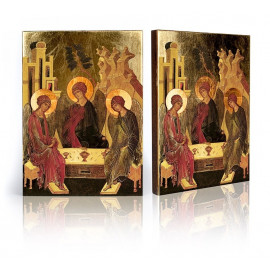
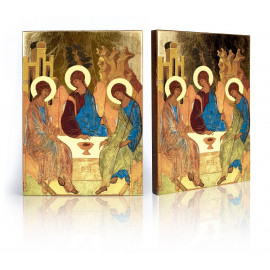
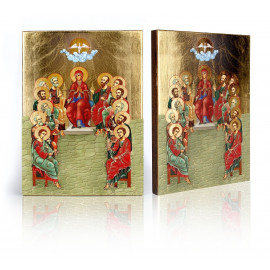
Once you know the symbols, Catholic icons become readable. In an icon of the Baptism of the Lord, the dove above Christ is the Spirit descending, and the hand in the light is the Father's blessing — the whole Trinity at the Jordan. In a Pentecost icon, the tongues of fire over each head are Acts 2:3 made visible. In Rublev's Holy Trinity, the three angels around the chalice show the three Persons in the unity of one sacrifice and one love.
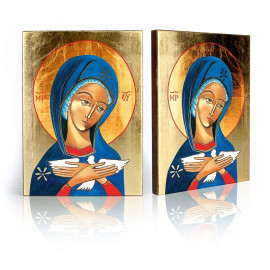
Our Holy Spirit icons bring these subjects together: the Pentecost icon (the Descent of the Holy Spirit), Rublev-style Holy Trinity icons, and the rare Pneumatophora — Our Lady carrying the Holy Spirit. Each is hand-gilded with gold leaf on alder wood, made in Poland, and available in four sizes from $48.
If you are new to icons in general, start with our guide to understanding Catholic icons; if you are choosing for a church, see how to choose icons for a church.
Frequently Asked Questions
Q: What are the five symbols of the Holy Spirit?
A: The five symbols most often listed are the dove, fire, wind (breath), water, and oil (chrism). The first four come from the Baptism of Christ, Pentecost, the breath of God, and the waters of baptism; the oil is the chrism of Confirmation and ordination.
Q: What are the four symbols of the Holy Spirit?
A: The four most common symbols of the Holy Spirit are the dove, fire, wind, and water — drawn from the Baptism of Christ (Matthew 3:16), Pentecost (Acts 2:3), the breath of God (John 3:8), and the waters of baptism (John 3:5).
Q: What is the symbol for the Holy Ghost?
A: The primary symbol of the Holy Ghost — the older English name for the Holy Spirit — is the dove, followed by fire, wind, water, and oil. The dove comes from the Baptism of Christ, when the Spirit descended on Jesus "like a dove" (Matthew 3:16).
Q: What are the seven gifts of the Holy Spirit?
A: The seven gifts of the Holy Spirit, listed in Isaiah 11:2–3, are wisdom, understanding, counsel, fortitude, knowledge, piety, and fear of the Lord. The gifts are distinct from the symbols: the gifts are what the Spirit gives; the symbols are how Scripture pictures the Spirit.
Q: Why is the dove a symbol of the Holy Spirit?
A: The dove symbolizes the Holy Spirit because the Spirit descended on Jesus "like a dove" at His Baptism (Matthew 3:16). The image also recalls Noah's dove, which returned with an olive branch — the sign of peace with God after the flood (Genesis 8:8–12).
Q: What are the twelve symbols of the Holy Spirit?
A: Catholic tradition does not have a fixed list of twelve symbols. Lists of twelve usually combine the ten symbols above with related biblical images, or count the twelve fruits of the Spirit from Galatians 5:22–23 — charity, joy, peace, patience, kindness, goodness, generosity, gentleness, faithfulness, modesty, self-control, and chastity.
Q: Where do we see the Holy Spirit in Catholic art?
A: In Catholic art the Holy Spirit appears as the dove above Christ in icons of the Baptism, as tongues of fire in Pentecost icons, as the third angel of Rublev's Trinity icon, and as the hand of God emerging from a cloud in scenes of the Annunciation and the Transfiguration.
Ready to bring the tradition home? Browse our hand-gilded Holy Spirit icons — the Pentecost icon, the Rublev Trinity, and the Pneumatophora — from $48.
