
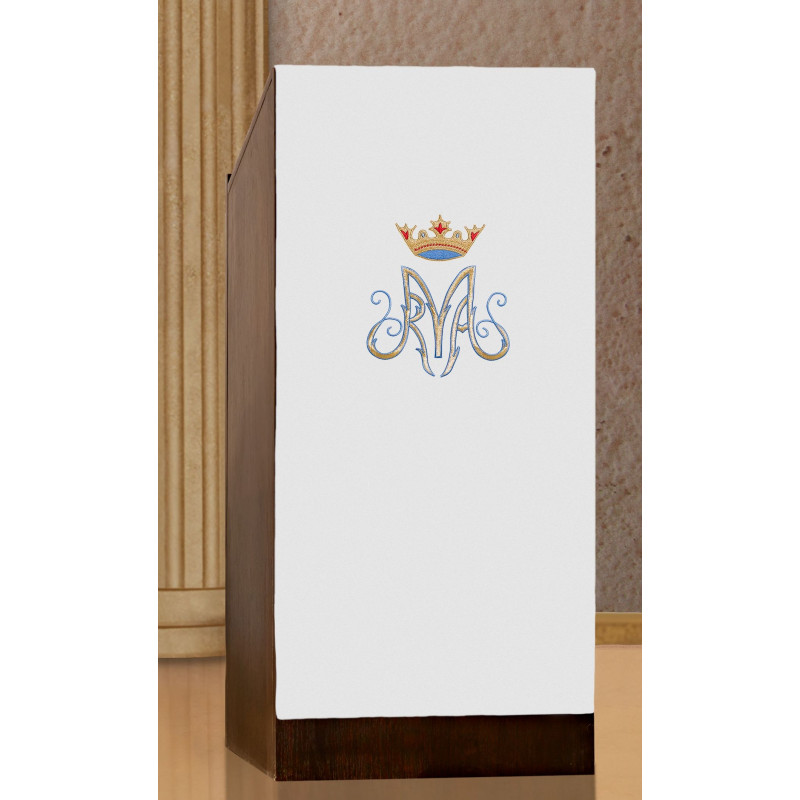


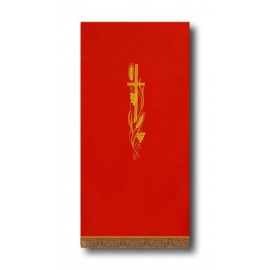


The symbols embroidered on a lectern cover, chasuble, or stole are a visual language. IHS is the Holy Name of Jesus; Alpha and Omega are the beginning and the end; PAX is peace; the dove is the Holy Spirit; the lamb is Christ; and the lily and crown are Marian symbols. Each one tells the congregation something about the feast or the mystery being celebrated.
IHS
IHS is a Christogram based on the first three letters of the name of Jesus in Greek — iota, eta, sigma. It is one of the most common symbols in Catholic art, and it appears on vestments, altar linens, and lectern covers. In the Middle Ages the monogram was popularized by St. Bernardino of Siena, who encouraged its use as a sign of devotion to the Holy Name. On a lectern cover, IHS is a versatile choice: it works for Ordinary Time, Eucharistic celebrations, and the Holy Name of Jesus.
Alpha and Omega
Alpha and Omega are the first and last letters of the Greek alphabet. In the Book of Revelation, Christ says, “I am the Alpha and the Omega, the first and the last, the beginning and the end” (Revelation 22:13). The symbol expresses the eternity of Christ and the fullness of salvation. It is especially suitable for solemnities, Easter, and the seasons that celebrate the kingship of Christ.
PAX
PAX is the Latin word for peace. It recalls the greeting of the Risen Christ — “Peace be with you” — and the peace that the liturgy gives. A PAX monogram is a good choice for Easter, for peace-themed celebrations, and for a sanctuary that wants a simple, legible symbol. It is also a traditional motif on vestments and altar linens.
The Cross
The cross is the central symbol of the Christian faith: the instrument of the Passion and the sign of Christ's victory over death. A simple cross works for any season; a more ornate cross with rays, grapes, or wheat is especially suitable for Lent, Good Friday, and Eucharistic celebrations. On a lectern cover, the cross is often combined with IHS or with the Alpha and Omega.
The Dove
The dove is the traditional symbol of the Holy Spirit, based on the descent of the Spirit at the baptism of Jesus and at Pentecost. A dove motif is especially appropriate for Pentecost, Confirmations, ordinations, and celebrations of the Holy Spirit. It may be shown alone or with rays of light.
The Lamb
The lamb — often the Lamb of God, Agnus Dei — represents Christ, the sacrifice who takes away the sins of the world. It is especially associated with Easter and the Easter season, and it appears on vestments, altar linens, and ambo falls. A lamb motif is a strong choice for the Easter cover in a parish set.
Marian Symbols
Marian symbols include the lily (purity), the crown (Our Lady as Queen), the monogram of Mary, and the rose. They are used for feasts of Our Lady, May and October devotions, shrines, and parishes under a Marian title. A Marian cover is usually a specialist piece in a parish set, added after the green, violet, white, and red covers.
Choosing a Symbol
Choose the symbol after the color and the season. IHS, Alpha and Omega, PAX, and the cross are versatile; the dove, the lamb, and the Marian emblems are more specific. The embroidery should be legible from the congregation, not only from close range. If the sanctuary is visually busy, choose a simpler motif; if it is plain, a richer design can help define the place of the Word.
Our embroidered lectern, pulpit, and ambo covers include all of these motifs, and the same symbolism runs through our chasubles and stoles.
Frequently Asked Questions
Q: What does IHS mean?
A: IHS is a Christogram based on the first three letters of the name of Jesus in Greek. It is a sign of devotion to the Holy Name and one of the most common symbols on Catholic vestments and altar linens.
Q: What does Alpha and Omega mean?
A: Alpha and Omega are the first and last letters of the Greek alphabet. In Revelation, Christ calls himself the Alpha and the Omega — the beginning and the end — a sign of his eternity and the fullness of salvation.
Q: What does PAX mean?
A: PAX is Latin for peace. It recalls the greeting of the Risen Christ and is a traditional motif for Easter and peace-themed celebrations.
Q: What does the dove symbolize?
A: The dove is the symbol of the Holy Spirit, based on the descent of the Spirit at the baptism of Jesus and at Pentecost. It is especially appropriate for Pentecost, Confirmations, and ordinations.
Q: What does the lamb symbolize?
A: The lamb, or Lamb of God, represents Christ as the sacrifice who takes away the sins of the world. It is especially associated with Easter and the Easter season.
Q: Which symbol should I choose for a lectern cover?
A: Choose after the color and the season. IHS, Alpha and Omega, PAX, and the cross are versatile; the dove, the lamb, and Marian emblems are more specific. The motif should be legible from the nave.
Related Reading
Continue with What Is a Pulpit Fall? and Pulpit Scarf Colors and Their Meaning. Browse our embroidered covers.
