

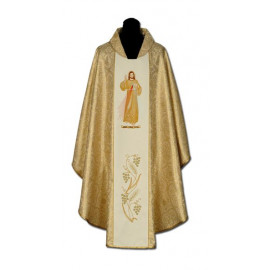
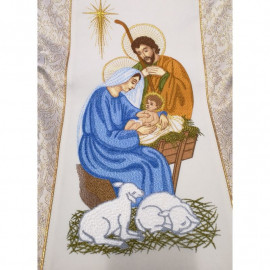
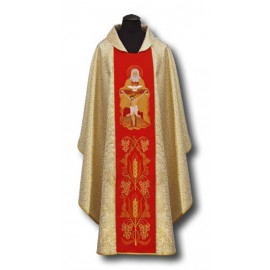
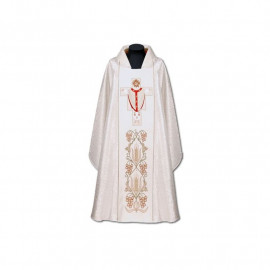
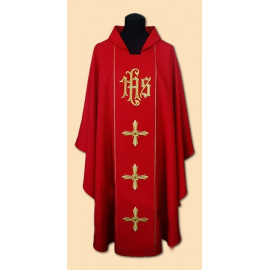
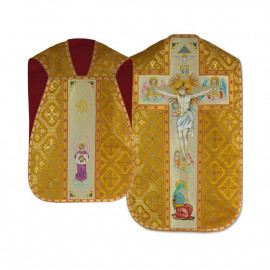
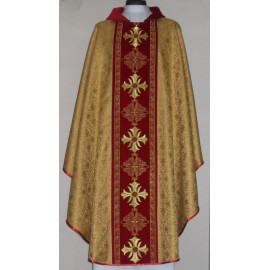
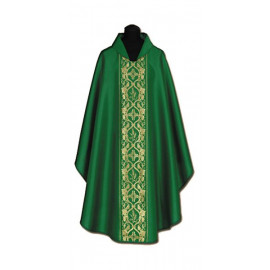
IHS is a christogram formed from the first three letters of the Greek name of Jesus (ΙΗΣΟΥΣ). On a Catholic chasuble, it marks the vestment as a garment of the Eucharist and directs attention to the name of Jesus. In our collection, 31 chasubles carry an IHS motif, often embroidered in gold on the front or back.
What Does IHS Stand For?
The letters IHS are a Latinized form of the Greek ΙΗΣ, the first three letters of ΙΗΣΟΥΣ (Iesous), the Greek name of Jesus. In Latin script the Greek eta (Η) is often written as H, so the monogram appears as IHS. It is sometimes explained as Iesus Hominum Salvator (“Jesus, Savior of mankind”), but that is a later devotional expansion rather than the original derivation.
The monogram is ancient. It appears in early Christian art and in medieval manuscripts, and it became especially associated with the devotion to the Holy Name of Jesus. On a chasuble, it is usually placed on the back and sometimes on the front, often within a cross, a sunburst or a decorative panel.
IHS in Catholic Tradition
The Holy Name of Jesus has its own feast in the Catholic calendar, and the IHS monogram is one of the most recognizable signs of Catholic devotion. It appears on vestments, altar linens, tabernacles, bells and church furnishings. The monogram is not a magic formula; it is a visual invocation of the name that the Church honors in the liturgy.
On a chasuble, the IHS is a liturgical sign. It identifies the garment as a Mass vestment, points to the Eucharist, and reminds the priest and the congregation of the central mystery of the faith. The same logic applies to other embroidered symbols: the Jerusalem cross, the Alpha and Omega, the Lamb of God, and the PAX.
Other Symbols on Chasubles
The Jerusalem cross — a large cross with four smaller crosses in the quarters — appears on 8 chasubles in our collection. It is associated with the Holy Land and the Crusades. The Alpha and Omega (Α and Ω) refers to Christ as the beginning and the end. The Lamb of God (Agnus Dei) points to the sacrifice of Christ. The PAX monogram is a sign of peace.
These symbols are not interchangeable decoration. Each has a history and a meaning, and the choice of motif should suit the vestment and the liturgical context. A simple cross may be more appropriate for a plain daily chasuble; a richer IHS or Jerusalem cross may suit a solemn feast. For a broader glossary, see our article on church embroidery symbols.
How IHS Is Embroidered
IHS on a chasuble may be hand-embroidered, machine-embroidered or woven into the fabric. The technique affects the look, the durability and the price. Gold metallic thread gives a rich, reflective finish but needs careful care; silk or rayon thread gives a softer sheen; a woven monogram is flatter and often more durable.
In our collection, some chasubles use a computer-embroidered belt with an IHS motif, while others have a more elaborate embroidered panel. The product page names the fabric and the motif of the individual model. If the exact technique matters for a parish, check the product description before ordering.
How to Choose a Chasuble with IHS
Start with the liturgical color and the cut. Then decide whether you want the IHS on the back only, on the front and back, or within a larger embroidered panel. A back-only IHS is the classic choice; a front-and-back design is more visible to the congregation. Consider the fabric: gold thread stands out on brocade and velvet, while a tonal monogram is subtler on damask or jacquard.
If the chasuble is intended for a solemn feast, a richer IHS panel may be appropriate. For Ordinary Time, a simpler cross or a smaller monogram may be more versatile. Browse the full chasuble collection, or compare the Roman, Gothic and semi-Gothic styles.
Care of Gold Embroidery
Gold metallic thread can tarnish or snag if handled roughly. Store the chasuble on a wide hanger, avoid sharp folds, and keep it away from prolonged direct sunlight. Most embroidered chasubles are dry clean only; check the care label. If a thread loosens, do not pull it — have it repaired before the embroidery unravels. For more detail, see our guide to caring for embroidered vestments.
Frequently Asked Questions
Q: What does IHS mean on a chasuble?
A: IHS is a christogram based on the first three letters of the Greek name of Jesus (ΙΗΣΟΥΣ). On a chasuble it is a visual invocation of the Holy Name and a sign that the garment is a Mass vestment.
Q: Is IHS the same as JHS?
A: Yes, in many traditions IHS and JHS are variant Latinized forms of the same Greek monogram. The difference is a matter of transliteration and local custom.
Q: Where should the IHS be placed on a chasuble?
A: Traditionally on the back, often within a cross or ornamental panel. Some chasubles also carry the monogram on the front. The placement is a design choice, not a doctrinal requirement.
Q: What other symbols appear on Catholic chasubles?
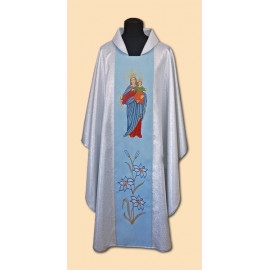
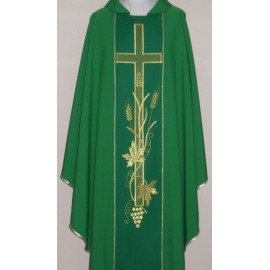
A: Common symbols include the Jerusalem cross, the Alpha and Omega, the Lamb of God, the PAX monogram, wheat and grapes, and floral or Marian motifs.
Q: How do I clean a chasuble with gold embroidery?
A: Most are dry clean only. Store on a wide hanger, avoid sharp folds and direct sunlight, and repair loose threads before they pull. Check the care label on the individual product page.

