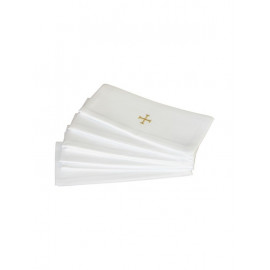
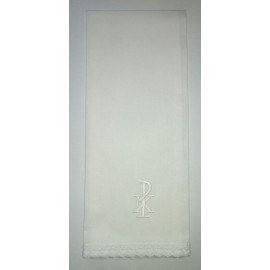
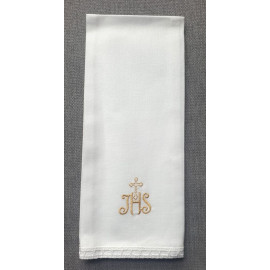
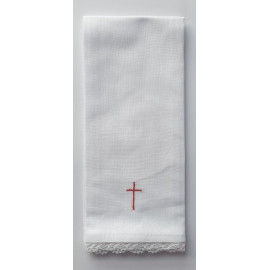
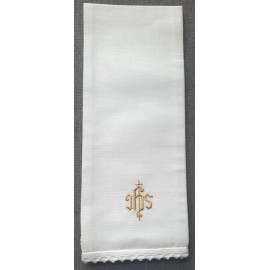
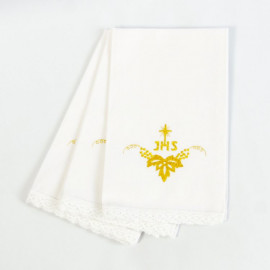
Folding a purificator is the first skill a new sacristan learns — and the one that is hardest to find written down. The purificator is folded in three, twice, so that the embroidered cross ends on the top fold; the folded cloth is then laid over the chalice, with the pall above it. This guide walks through the standard fold, the 3×3 "envelope" that some sacristies prefer, and the ironing that makes both possible.
Why the Purificator Is Folded (and Never Pressed Flat)
A purificator is not a napkin and not a corporal. It is folded because it has two jobs: to lie neatly over the chalice before Mass — under the pall and the chalice veil — and to be unfolded and used at the purification, when the priest wipes the chalice dry. The folds create a cloth that sits cleanly on the cup and opens to a comfortable wiping size; a flat-pressed purificator would neither drape nor open properly.
That is also why the centre of the purificator — the part that touches the chalice — is never pressed into a hard crease. Hard creases crack over time, catch on the rim of the chalice, and wear out the weave exactly where the cloth matters most.
The Standard Fold: Step by Step
- Lay the purificator flat, right side up, with the embroidered cross facing you in the centre.
- Fold the left third of the cloth to the middle.
- Fold the right third over it, so the cloth is now a long strip with the cross centred on top.
- Fold the strip in three: bottom third up, top third down over it.
- Turn the folded square so the embroidered cross faces up — the cloth is ready to lay over the chalice.
Some sacristies fold in half for the last step instead of in three; both are used, and both sit well on a standard chalice. What matters is that the folds follow the same lines every time, so the cloth opens in one motion at the altar.
The 3×3 Envelope Fold
The "fancy" fold many altar guilds teach is the 3×3 envelope: the cloth is folded in three lengthwise, then folded in three across, so that all raw edges are enclosed and the cross sits at the centre of a neat square. It is the fold you will see in altar-guild demonstrations — and it is popular because the folded purificator can be picked up and placed without any loose edge showing. To fold it: complete the standard fold above, then instead of folding the strip in half, fold it in thirds and tuck the final third under, like closing an envelope.
Both folds are correct. The envelope is a little slower to make and a little neater to store; the standard fold opens faster at the purification.
Ironing Before You Fold
A purificator folds well only when it is ironed well. Iron it while still slightly damp, on the reverse side, following the fold lines you intend to use — that is what makes the next fold sit flat. Use a hot iron without steam; never use starch. Starch fills the weave, makes the cloth slippery and less absorbent, and leaves flakes on the chalice. If your purificators are cotton (like ours), they can be washed hot — up to 95 °C — before ironing, which is the easy way to keep them white without bleach.
Folding a Corporal and a Purificator Together
In the sacristy the two linens are usually prepared side by side: the purificator is folded and laid over the chalice, the corporal is folded into its square and carried in the burse. The corporal has its own fold — cross enclosed inside, particles trapped in the folds — which we explain step by step in our guide to what a corporal is and how to fold it.
Storing Folded Purificators
Store folded purificators flat in the sacristy linen drawer, stacked loosely rather than pressed, away from damp and from anything that can transfer colour. A stack of purificators and corporals kept flat in a drawer or a linen box will still fold cleanly months later; one kept crumpled will need re-ironing before every Mass.
Frequently Asked Questions
Q: How do you fold a purificator?
A: Fold it in three lengthwise, then fold the strip in three again so the embroidered cross ends on the top fold. Lay the folded cloth over the chalice, with the pall on top.
Q: What is the fancy way to fold a purificator?
A: The "fancy" fold is the 3×3 envelope: fold in three lengthwise, then in three across, tucking the last third under so all edges are enclosed and the cross sits at the centre. It looks neater in storage and opens just as easily.
Q: Do you fold a purificator in half or in thirds?
A: Both are used. Many sacristies fold in three lengthwise and then in half; others complete a 3×3 envelope. Choose one method and keep it consistent so the cloth always opens the same way at the altar.
Q: Should a purificator be starched?
A: No. Starch makes the cloth slippery and reduces its absorbency — the very quality the purificator exists for. Iron it damp, without starch, and the folds will still sit crisply.
Q: How should purificators be stored?
A: Flat, in a drawer or linen box, stacked loosely, away from damp. Folded purificators stored flat stay ready for Mass; pressed or crumpled ones need re-ironing.
Ready to keep a full set in rotation? See our embroidered purificators — 22 designs in 100% cotton, singles from $7 and three-piece sets from $25.