
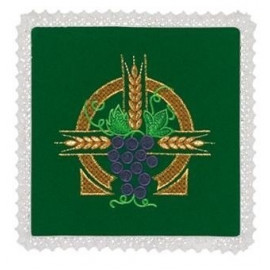
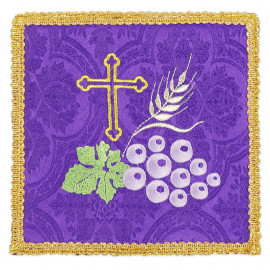
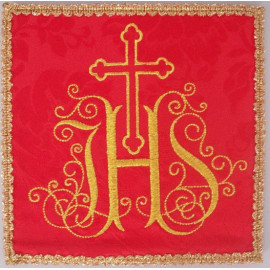
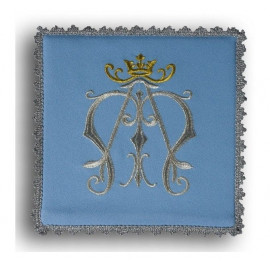
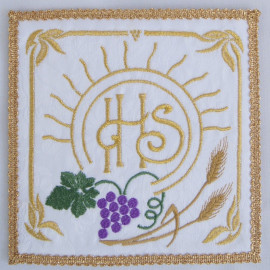
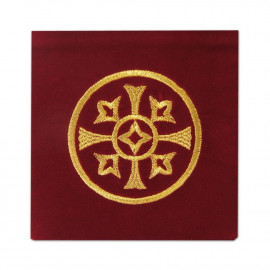
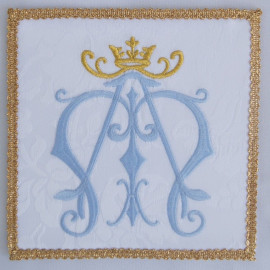
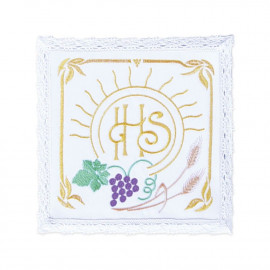
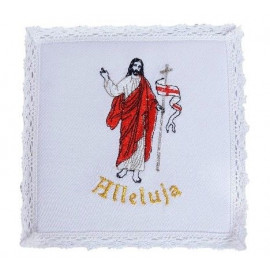
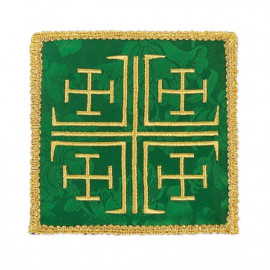
A chalice pall is the small stiffened square of linen that rests on top of the chalice during Mass. It is one of the essential chalice linens, it is embroidered with a cross or a sacred symbol, and it has one practical job: to keep dust, insects, and anything else from falling into the Precious Blood. This guide explains what a chalice pall is, what it is made of, its standard sizes, how it is used at Mass, and how it differs from a funeral pall, a chalice veil, and a purificator.
What Is a Chalice Pall?
The chalice pall (Latin: palla) is a square of linen or cotton — traditionally a card stiffener covered with white linen — that is placed over the mouth of the chalice before the Eucharistic Prayer. It is large enough to cover the opening completely and stiff enough to lie flat on the rim, so it does not slide when the chalice is carried or moved.
The pall belongs to the family of liturgical linens used at every Mass, together with the corporal and the purificator. Because it touches the sacred vessels, it is treated with the same care as the other linens and is usually white — the color of the linen itself — although sacristies often choose a pall in the liturgical color of the day to match the vestments. Our full chalice pall collection covers every color and price point.
What Is a Chalice Pall Made Of?
Every pall is built around a stiffener: historically stiffened card, today often a removable plastic or plexiglass insert. The stiffener is wrapped in fabric — most commonly white linen or cotton, sometimes ecru — and finished with embroidery.
The embroidery on top of the pall is where the tradition lives: a cross, the IHS monogram, the Lamb of God, wheat and grapes, the Jerusalem Cross, a Marian monogram, or the Holy Spirit in the form of a dove. Velvet palls embroidered with gold thread are the most decorative option and are chosen for solemnities and feast days.
What Size Is a Chalice Pall?
Most chalice palls measure about 15 × 15 cm (6 × 6 inches). Larger palls of 18 × 18 cm (7 × 7 inches) fit wide chalices and are the common American size. The rule is simple: the pall must cover the outer rim of the chalice completely and lie flat, with no overhang that could catch on the veil or on the priest's hands.
To choose the right size, measure the outer rim of your chalice with a ruler. If your chalice has a wide bowl or a decorative rim, size up to 7 × 7 inches. When in doubt, a slightly larger pall is safer than a smaller one — a pall that does not cover the opening has no purpose.
How Is the Chalice Pall Used at Mass?
After the gifts are prepared and the chalice has been filled with wine and a little water, the priest places the pall over the chalice. It stays there during the Eucharistic Prayer as a cover, and it is removed when the chalice is needed again — at Communion and during the purification — and set aside on the altar or the credence table.
In the Traditional Latin Mass the chalice is dressed at the credence table before Mass: the purificator, paten, and pall are placed on the chalice, which is then covered with the chalice veil and topped with the burse holding the corporal. When the chalice is unveiled at the Canon, the pall is already in place.
Chalice Pall vs Funeral Pall vs Pallium
All three are called "palls," and they are completely different things:
- Chalice pall — a square of about 6–7 inches that covers the chalice at Mass.
- Funeral pall — a large cloth (typically 8 × 12 feet or more) that covers a casket during a Catholic funeral; it is a symbol of baptismal equality.
- Pallium — the white woolen band worn over the shoulders by archbishops and the Pope, a sign of jurisdiction.
So when a sacristy or a shop talks about "palls" without qualification, it always means chalice palls.
Chalice Pall vs Chalice Veil vs Purificator
These three linens work together at the altar, and they are easy to confuse:
- The pall is the stiffened square that covers the chalice during Mass.
- The chalice veil is the large draped cloth that covers the whole chalice outside the Eucharistic Prayer — before Mass, and in the Traditional Mass until the Canon.
- The purificator is the small white cloth, folded in thirds, used to wipe the chalice after Communion and during the ablutions.
Together with the corporal (the square linen on which the vessels rest) and the burse (the case that holds the folded corporal), they form the chalice linens — the items that appear in our chalice linen sets.
What Color Chalice Pall Should You Use?
Canonically the pall is made of white linen, and white or ecru palls are what most sacristies use every day. In practice many parishes keep palls in several liturgical colors and match them to the day: white for Christmas and Easter, red for Pentecost and martyrs' feasts, green for Ordinary Time, violet for Advent and Lent, rose for Gaudete and Laetare Sundays, black for funerals in the older use, and gold for the most solemn occasions.
Our embroidered palls come in white, ecru, red, green, violet, black, rose, gold, and blue, starting at $16, with velvet palls at $28 and sets of four or six for the whole year.
Choosing and Caring for a Chalice Pall
When choosing a pall, check three things: the size (does it cover your chalice rim?), the insert (is it removable for washing?), and the embroidery (does it suit the vestments of your parish?). A pall is handled every day, so durability matters more than decoration — but there is no reason a working pall cannot also be beautiful.
To care for a pall, remove the insert, hand-wash the cover in lukewarm water with mild detergent, rinse thoroughly, and iron while slightly damp. Never use bleach or starch. If the pall has touched the Precious Blood, rinse it first in a sacrarium or over a drain that goes into the ground, as the Church asks for linens that have been in contact with the Eucharist.
Frequently Asked Questions
Q: What is a pall in the Catholic Church?
A: In the Catholic Church, "pall" most often means the chalice pall — the small stiffened square of linen placed over the chalice during Mass. The word is also used for the funeral pall (a large cloth placed over a casket) and for the pallium worn by archbishops. At the altar, "pall" always means the chalice pall.
Q: What are the five sacred linens?
A: The five sacred linens of the Mass are the fair linen (the altar cloth), the corporal, the purificator, the chalice pall, and the finger towel used at the lavabo. The chalice veil and burse complete the chalice dressing but are counted separately from the five.
Q: What is the cover for the chalice called?
A: The stiffened square that covers the chalice at Mass is called the pall (also chalice pall, chalice cover, or communion pall). The larger draped cloth that covers the whole chalice outside Mass is the chalice veil.
Q: What size chalice pall do I need?
A: Measure the outer rim of your chalice. A standard pall is 15 × 15 cm (6 × 6 in); for wide chalices choose 18 × 18 cm (7 × 7 in). The pall should cover the opening completely and lie flat on the rim.
Q: Can a chalice pall be washed?
A: Yes. Remove the stiffener insert, hand-wash the cover in lukewarm water with mild detergent, rinse well, and iron while damp. Never bleach or starch chalice linens, and rinse linens that have touched the Precious Blood in a sacrarium first.
