


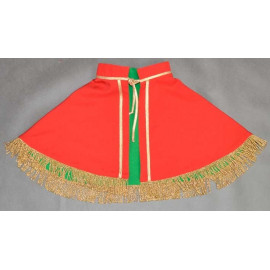
Altar server cape colors follow the liturgical calendar: red for Pentecost and martyrs, white for Christmas and Easter, violet for Advent and Lent, and green for Ordinary Time. Gold and light blue appear on particular feasts. A parish that owns the four core colors can dress its servers for the whole year.
The Four Core Colors
The Church uses color to mark seasons and feasts. The server's cape is matched to the priest's vestments, so the sanctuary reads as a single visual unit. The four colors most parishes need are red, white, violet and green. Our altar server shoulder capes are stocked in all four.
Red
Red is worn at Pentecost, on Good Friday, on Palm Sunday, and on the feasts of martyrs and of the Holy Spirit. It is also used for confirmations and for the feast of the Exaltation of the Holy Cross. A red cape is one of the most-used pieces in a parish set because it covers several major days in the calendar.
White
White is the color of Christmas and Easter, the feasts of the Lord and Our Lady, baptisms, weddings and funerals. It is the most versatile color in the sacristy and the one most often borrowed for special celebrations. A white cape over a white surplice gives a clean, solemn look without adding a second strong color.
Violet
Violet marks Advent and Lent, the two penitential seasons. It is not used on the rose Sundays of Gaudete and Laetare, when rose vestments may be worn. A violet cape is used for roughly a third of the year, so it is worth buying early in a parish's collection.
Green
Green is the color of Ordinary Time, the long stretch between the major seasons. It is the most frequently worn color in many parishes, which makes a green cape a practical first purchase. Green also works well as the second face of a reversible cape paired with red.
Gold and Blue
Gold is used for solemn feasts and may replace white or red where the parish has the option. Light blue is associated with Marian feasts in some places. Neither is part of our current range; if you need a color for a particular feast, contact us and we will tell you what can be made.
Matching the Priest's Vestments
The server's cape should match the celebrant's chasuble or cope, not the altar frontal or the flowers. If the priest wears red, the servers wear red; if he wears white, they wear white. In parishes with several servers, the whole team should be in the same color so the sanctuary does not look pieced together.
Building a Parish Set
Start with the colors used most often: green for Ordinary Time, white for the major feasts, violet for Advent and Lent, red for Pentecost and martyrs. Four one-sided capes per server cover the year. If storage is tight, a reversible green-and-red cape covers the two most common colors outside the major seasons.
Keep the set together in the vestment press and label each cape by color. A simple inventory list — color, quantity, size, condition — saves time on Saturday evening when the sacristy is busy.
Frequently Asked Questions
Q: What color cape should an altar server wear?
A: The same color as the priest's vestments for that Mass. Red for Pentecost and martyrs, white for Christmas and Easter, violet for Advent and Lent, green for Ordinary Time.
Q: Can altar servers wear any color?
A: They should follow the liturgical color of the day. A cape in a color that does not match the celebration looks out of place in the sanctuary.
Q: Is black ever used for altar server capes?
A: Black is not a liturgical color in the ordinary Roman calendar. Some traditional or requiem uses exist, but the four core colors cover normal parish use.
Q: What about gold and blue?
A: Gold is used on solemn feasts and blue on some Marian feasts. They are optional and not part of our current range.
Q: How many colors should a parish buy?
A: Four — red, white, violet and green — cover the year. Add gold or blue only if the parish has a specific need.
Read next: one-sided vs double-sided capes and Latin Mass vestments.

