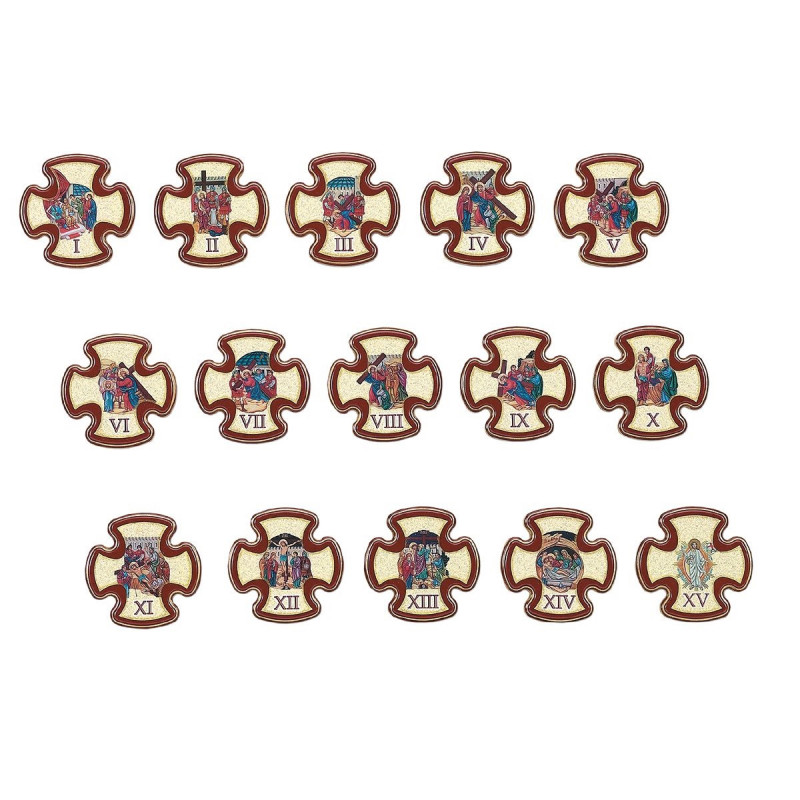
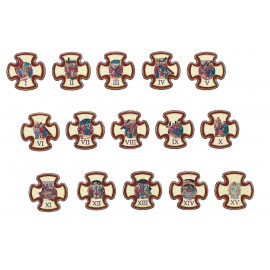
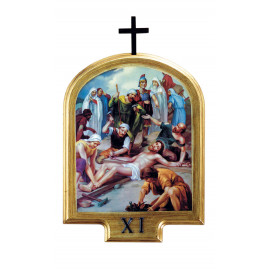


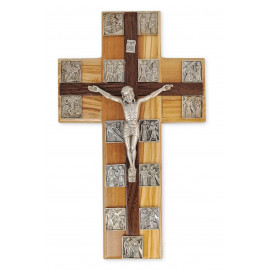
The Stations of the Cross are usually numbered from 1 to 14. The order is not random: it follows the narrative of the Passion from the condemnation of Jesus to the placing of his body in the tomb. This page gives the full list in order, a short explanation of each station, and the reason some sets include a 15th panel.
The traditional list is stable, but the details are not all found in the Gospels. Some stations, such as Veronica and the three falls, belong to the devotional tradition rather than to a single Gospel text. That is why the Stations are best understood as a guided meditation on the Passion, not as a verse-by-verse harmony of the four Gospels.
The 14 Stations in Order
| # | Station | Meaning | Gospel anchor |
|---|---|---|---|
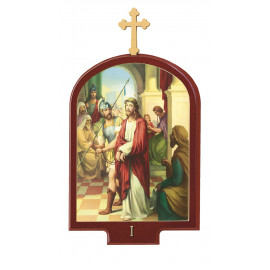
| 1 | Jesus is condemned to death | The innocent Christ accepts the sentence of an unjust court. | Mark 15:15 |
| 2 | Jesus takes up his cross | He embraces the cross and begins the way to Calvary. | John 19:17 |
| 3 | Jesus falls the first time | The weight of the cross and human weakness meet. | Devotional tradition |
| 4 | Jesus meets his Mother | The sorrowful Mother shares the suffering of her Son. | John 19:25–27 |
| 5 | Simon of Cyrene helps Jesus | A bystander is drawn into the cross and shares its weight. | Mark 15:21 |
| 6 | Veronica wipes the face of Jesus | A gesture of compassion leaves an image of the suffering face. | Devotional tradition |
| 7 | Jesus falls the second time | The weakness of the flesh does not stop the mission. | Devotional tradition |
| 8 | Jesus meets the women of Jerusalem | He turns to others even on the way to death. | Luke 23:27–31 |
| 9 | Jesus falls the third time | The final collapse before the ascent to Calvary. | Devotional tradition |
| 10 | Jesus is stripped of his garments | He is deprived of everything, including his clothing. | John 19:23–24 |
| 11 | Jesus is nailed to the cross | The crucifixion begins; the wood becomes an altar. | Luke 23:33 |
| 12 | Jesus dies on the cross | He gives his life and entrusts his spirit to the Father. | John 19:28–30 |
| 13 | Jesus is taken down from the cross | The dead Christ is placed in the arms of his Mother. | Mark 15:42–46 |
| 14 | Jesus is laid in the tomb | The body is buried, and the disciples wait in silence. | John 19:41–42 |
What the First Five Stations Show
The first five stations establish the central conflict. Jesus is condemned by Pilate, takes up the cross, falls under its weight, meets his Mother, and receives help from Simon of Cyrene. The sequence moves from public judgment to intimate encounter: the crowd, the cross, the Mother, the bystander.
Station 1 is the moment of unjust authority. Station 2 is the free acceptance of the cross. Station 3 introduces human weakness. Station 4 places the Passion inside a family bond. Station 5 shows that the cross is not carried alone: Simon is pulled into the story and becomes a model of shared burden.
What the Middle Stations Show
The middle stations move through compassion and collapse. Veronica’s veil, the second fall, the women of Jerusalem, and the third fall create a rhythm of tenderness and exhaustion. The tradition places a woman’s act of mercy at the center of the way, and it lets Jesus speak to the women even as he goes to his death.
Station 8 is especially important for the Gospel narrative: Jesus tells the women not to weep for him but for themselves and their children. It is a call to conversion, not merely a scene of pity. The second and third falls keep the devotion honest about the cost of the journey.
What the Last Stations Show
The last four stations move from the cross to the tomb. Jesus is stripped, nailed, dies, is taken down, and buried. The devotion does not end with a moral lesson; it ends in silence. The tomb is the place where hope is tested and where the Church waits for the resurrection.
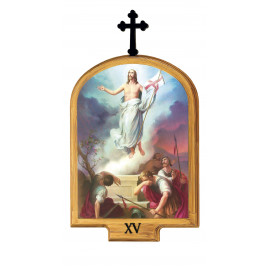
Station 12 is the heart of the Passion. Station 13, the pietà, is a scene of grief. Station 14 is not a resolution but a pause. That is why many sets include a 15th panel: the Resurrection gives the tomb its meaning.
Are All 14 Stations in the Bible?
No. Several stations are based on the devotional tradition rather than a direct Gospel text. Veronica and the three falls are not narrated in the canonical Gospels. The Stations are a liturgical and devotional synthesis, not a chapter-by-chapter Gospel reading.
In 1991, Pope John Paul II introduced a “Scriptural Stations of the Cross” with a different list drawn from the Gospels. It is a legitimate alternative, but it is not the traditional list. If your parish uses a different list, the number and order may differ.
The 15th Station: Resurrection
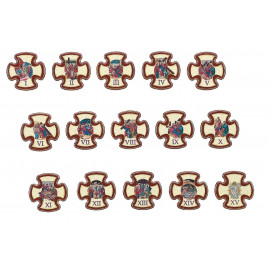
The traditional devotion has 14 stations. Many sets, however, include a 15th panel showing the Resurrection. It is not one of the traditional stations; it is a closing meditation that completes the paschal mystery. A 15-piece set can still be used for the traditional 14 stations, with the Resurrection panel used at the end.
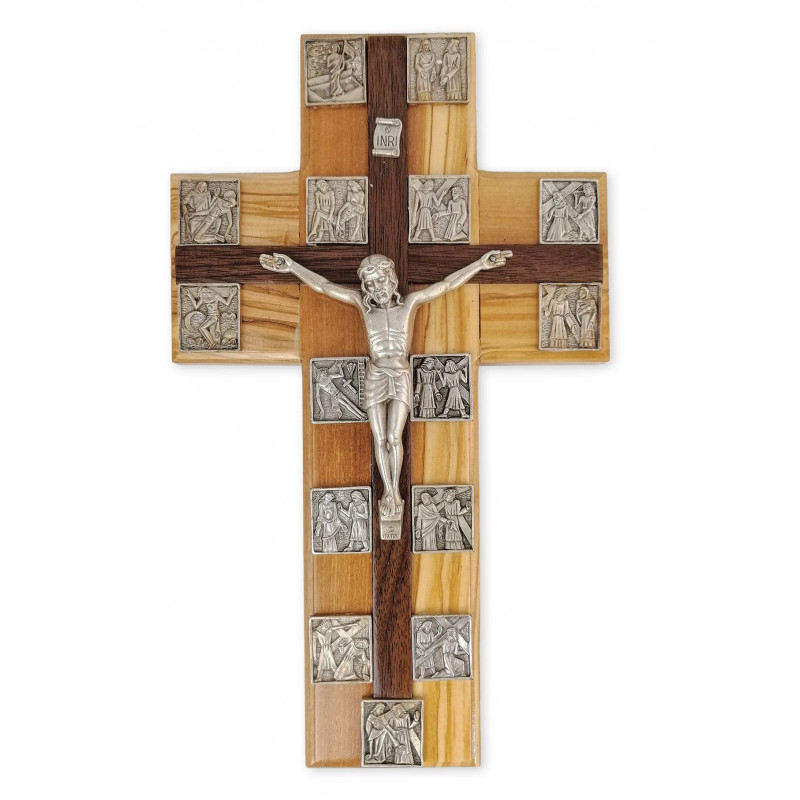
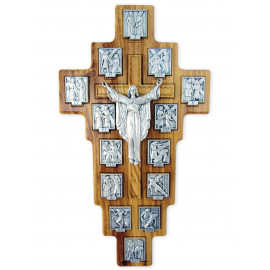
If you are choosing between a 14-piece and a 15-piece set, read our 14 vs 15 stations guide. Our Stations of the Cross collection includes 15-piece MDF sets and Italian wooden wall crosses with the stations in metal relief.
How to Pray the List
At church, the stations are usually marked on the walls, and the leader announces each one. At home, you can use a set of panels, a booklet, or this list. Move slowly, announce the station, pause, and pray. The order matters because it shapes the meditation: condemnation, carrying, falling, encountering, dying, burial, and—for a 15-piece set—resurrection.
For a complete prayer structure, see our Stations of the Cross prayers. For the broader history and meaning, see the complete guide.
Frequently Asked Questions
Q: What are the 14 Stations of the Cross in order?
A: 1) Jesus is condemned; 2) takes up his cross; 3) falls the first time; 4) meets his Mother; 5) Simon helps him; 6) Veronica wipes his face; 7) falls the second time; 8) meets the women of Jerusalem; 9) falls the third time; 10) is stripped; 11) is nailed to the cross; 12) dies; 13) is taken down; 14) is laid in the tomb.
Q: Is Veronica in the Bible?
A: The name and the veil are not found in the canonical Gospels. Veronica is part of the devotional tradition of the Stations, not a directly narrated Gospel episode.
Q: Why are there three falls?
A: The three falls are a devotional tradition that emphasizes the weight of the cross and the weakness of the human body. They are not numbered in the Gospels.
Q: What is the 15th Station of the Cross?
A: The 15th panel usually shows the Resurrection. It is not one of the traditional 14 stations; it is an additional meditation that completes the story.
Q: Are there Scriptural Stations of the Cross?
A: Yes. Pope John Paul II introduced a Scriptural list in 1991. It uses 14 stations drawn from the Gospels, but the list is different from the traditional stations.
Q: Which station is the most important?
A: The devotion does not rank the stations. Station 12, the death of Jesus, is the center of the Passion, but the meaning depends on the whole sequence from condemnation to burial.
Q: Can I pray the Stations in a different order?
A: The traditional order is part of the devotion. If you use a Scriptural list or a parish booklet, follow its order; do not rearrange the traditional stations arbitrarily.
Q: How do I explain the Stations to a child?
A: Use short, concrete language and focus on Jesus’ love and courage. Our guide for kids has a child-friendly list and a 20-minute family version.
Q: Where can I buy a set of the Stations?
A: Our Stations of the Cross collection includes 15-piece laminated MDF sets and Italian wooden wall crosses. All are for indoor wall display.
Conclusion
The 14 Stations in order tell the story of the Passion in a sequence the Church has prayed for centuries. The list is simple enough to memorize and deep enough to meditate on for a lifetime. If you want to pray them at home, choose a set that fits your wall and your space; if you want the full context, read our complete guide.