
The Stations of the Cross are a fourteen-step devotion that follows Jesus from his condemnation to his burial. The prayers are not a single fixed formula: parishes use different booklets, hymns, and reflections. What stays constant is the movement from station to station, the traditional response, and the pause to contemplate the Passion.
This guide gives you a simple structure that works in a church, a chapel, or at home. It includes an opening prayer, the traditional response, a one-line reflection for each station, and a closing prayer. It is not a replacement for your parish booklet; it is a clear framework you can use when you want to pray without one.
What Prayers Are Said at the Stations?
Most celebrations follow the same basic pattern: an opening prayer, a reading or reflection at each station, the traditional response, a moment of silence, and a closing prayer. The exact words vary by parish and by the booklet in use. The traditional response is the one element most Catholics recognize immediately.
At each station the leader announces the station, and the people respond. A short reflection or Scripture passage follows. Then comes a period of silence, the Our Father and Hail Mary (in many traditions), and the acclamation “Lord Jesus, have mercy on us.” The devotion ends with a closing prayer and a blessing.
Opening Prayer
You can begin with the Sign of the Cross and a simple prayer such as this:
Lord Jesus, you walked the way of the cross for us. As we follow your steps from station to station, open our hearts to your suffering and to your love. Give us the courage to carry our own crosses with faith, and the compassion to recognize you in those who suffer. Amen.
In a parish, the opening prayer is usually led by a priest or deacon, or by a lay leader appointed for the devotion. At home, any family member can lead it.
The Traditional Response at Each Station
The most common response is:
We adore you, O Christ, and we bless you, because by your holy cross you have redeemed the world.
The leader may say the first part and the people answer, or everyone may say it together. The words are a profession of faith: the cross is not a defeat but the means of redemption. Some parishes add a short invocation after each reflection, such as “Lord Jesus, have mercy on us.”
A Short Reflection for Each Station
These one-line reflections are deliberately brief. They can be read aloud, used as a starting point for silence, or expanded in your own words. They follow the traditional 14 stations.
| Station | Reflection |
|---|---|
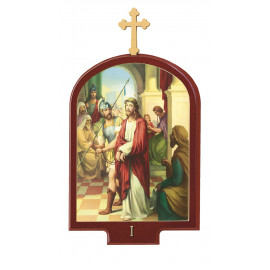
| 1. Jesus is condemned to death | When I am treated unfairly, help me to trust you rather than repay evil with evil. |
| 2. Jesus takes up his cross | Teach me to receive the cross you place in my life, not to run from it. |
| 3. Jesus falls the first time | When I fall, give me the humility to get up and begin again. |
| 4. Jesus meets his Mother | Comfort those who suffer, and let me be a presence of love to them. |
| 5. Simon of Cyrene helps Jesus | Show me the person who needs my help today, and give me the generosity to carry the load. |
| 6. Veronica wipes the face of Jesus | Let me recognize your face in the poor, the sick, and the forgotten. |
| 7. Jesus falls the second time | When I fail again, remind me that your mercy is greater than my weakness. |
| 8. Jesus meets the women of Jerusalem | Give me a heart that grieves with others and does not look away from suffering. |
| 9. Jesus falls the third time | When I am exhausted, hold me up and teach me to depend on you. |
| 10. Jesus is stripped of his garments | Strip away my pride and let me stand before you without pretense. |
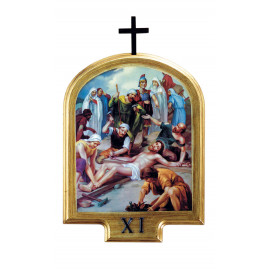
| 11. Jesus is nailed to the cross | Unite my small sacrifices to your sacrifice, for the good of others. |
| 12. Jesus dies on the cross | Thank you for giving your life for me; help me to live for you. |
| 13. Jesus is taken down from the cross | Comfort those who mourn, and teach me to receive the gift of grief. |
| 14. Jesus is laid in the tomb | In the silence of the tomb, increase my hope in the resurrection you promised. |
A Simple Pattern for Each Station
If you want a repeatable structure, use these five movements:
- Announce the station and pause.
- Say the traditional response together.
- Read the reflection or a short Scripture passage.
- Keep silence for a few seconds, then say the Our Father and Hail Mary, or a short invocation.
- Move to the next station without rushing.
The silence matters. The Stations are not a race through fourteen texts; they are a way of accompanying Jesus. A slower pace with fewer words is often more fruitful than a long booklet read quickly.
Closing Prayer
End with the Sign of the Cross and a prayer such as:
Lord Jesus, we have walked with you to the cross and to the tomb. Do not let us remain in grief: keep us close to you, strengthen our faith, and make us witnesses of your resurrection. Amen.
In a parish, the priest or deacon may bless the people. At home, the family can end with the Sign of the Cross.
Praying at Home
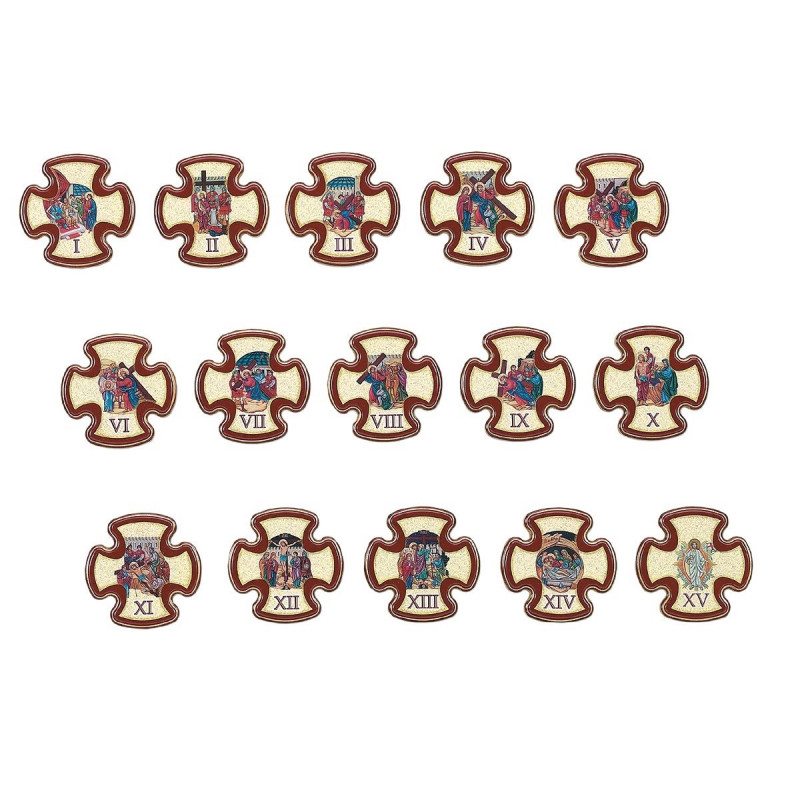
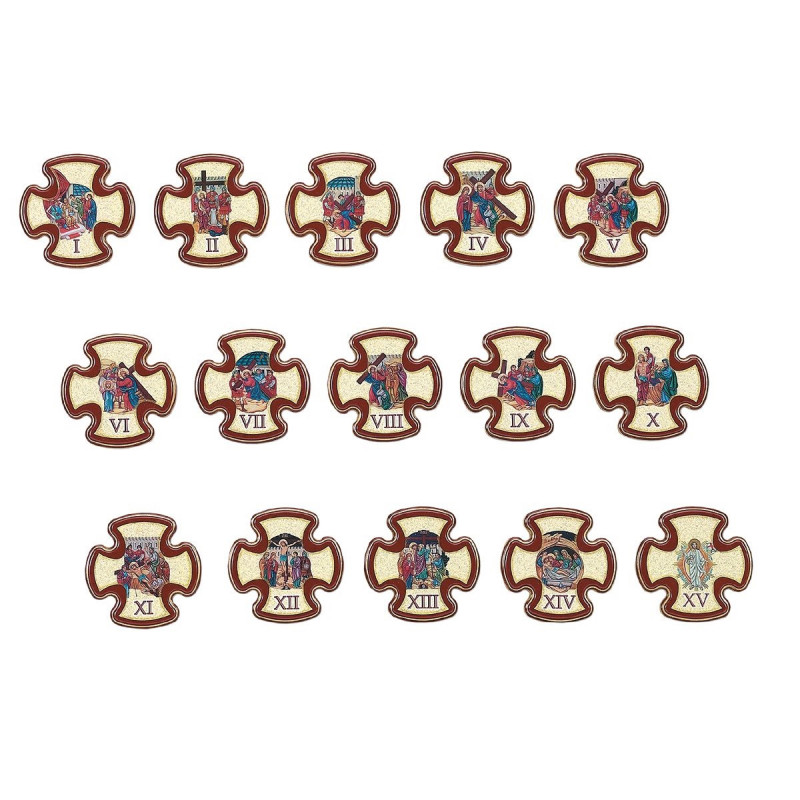
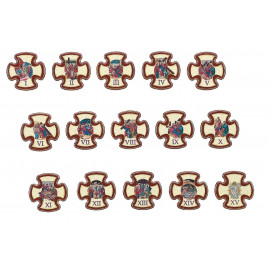
You do not need a church building to pray the Stations. A set of 14 or 15 panels on a wall, a booklet or this list, and a few minutes of quiet are enough. Many families pray the Stations in the living room or in a prayer corner, moving from one panel to the next.
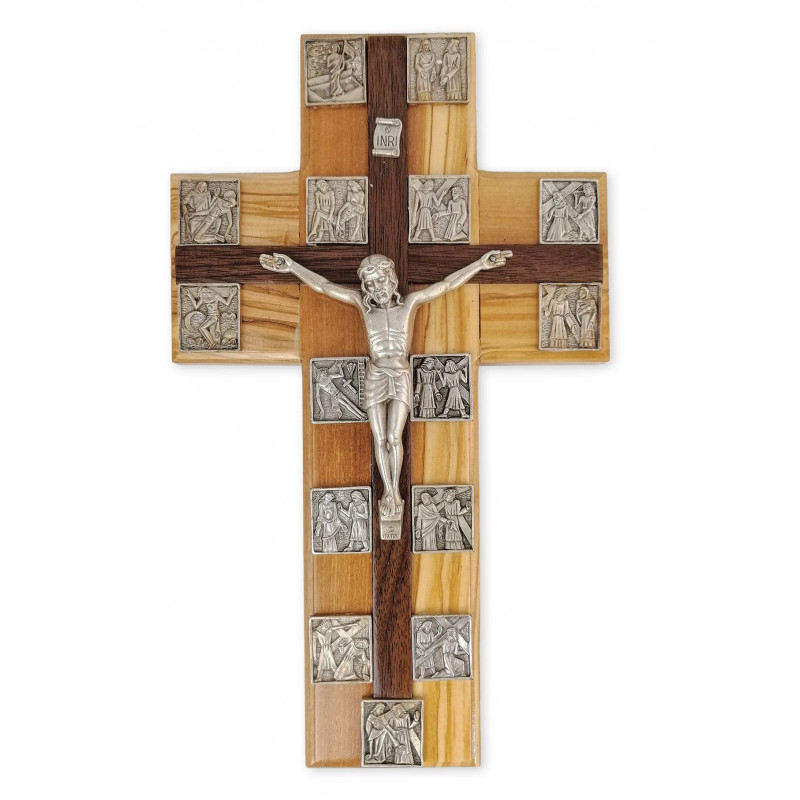
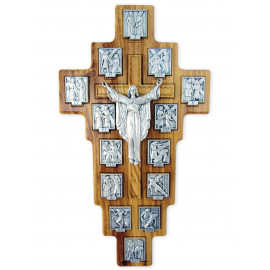
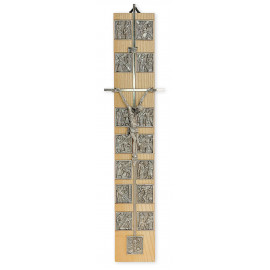
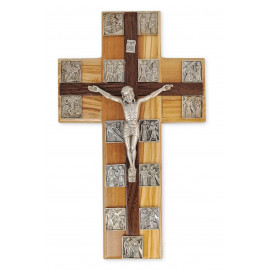
Our Stations of the Cross collection includes Italian wooden wall crosses and laminated MDF sets. The smallest 9.5 × 9.5 cm set fits a narrow wall; the 14.5 × 14.5 cm set is a good middle size for a home. For a larger room or a chapel, the 32 × 24.5 cm and 48 × 34 cm sets are easier to see. Every set is for indoor wall display.
If you are choosing a set for home, see our home display guide. If you want the full list of stations, see the 14 Stations in order.
How Long Does It Take?
A full celebration usually takes 20–30 minutes, depending on the reflections, music, and the number of people. A family version with short reflections can take 10–15 minutes. You can also pray one station a day during Lent, which is especially helpful for children and for busy households.
The length is not the measure of the prayer. A short, attentive Stations is better than a long one rushed to the end.
Frequently Asked Questions
Q: What is the traditional response at each station?
A: “We adore you, O Christ, and we bless you, because by your holy cross you have redeemed the world.” The leader may say it first and the people repeat, or everyone may say it together.
Q: Do you have to say the Our Father and Hail Mary at every station?
A: It is a common custom, not a universal rule. Many parishes say the Our Father and Hail Mary after each reflection; others use a short invocation or silence. Follow the custom of your parish or the booklet you are using.
Q: Can I pray the Stations of the Cross at home?
A: Yes. The Stations are a devotional exercise, not a liturgical function reserved to a church. A family or individual can pray them at home with a set of panels, a booklet, or a simple list.
Q: What do I need to pray the Stations at home?
A: You need a list of the 14 stations, a quiet place, and, if possible, a set of panels or a cross. A booklet is helpful but not essential; this guide gives you a complete structure.
Q: Can I use a 15-piece set for the traditional 14 stations?
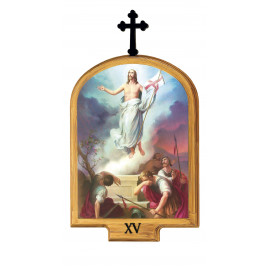
A: Yes. The 15th panel is the Resurrection. You can pray the traditional 14 stations and use the Resurrection panel as a closing meditation, or include it as a 15th station in a private devotion.
Q: What is the closing prayer of the Stations?
A: There is no single mandatory closing prayer. A common conclusion thanks Christ for his Passion and asks for the grace of the resurrection. In a parish, the priest or deacon may add a blessing.
Q: How long does the Stations of the Cross take?
A: A full parish celebration usually takes 20–30 minutes. A short family version can take 10–15 minutes, and praying one station a day spreads the devotion across two weeks.
Q: Can children pray the Stations?
A: Yes. Use short reflections, avoid graphic detail, and focus on Jesus’ love and courage. A 20-minute family version works well for younger children; see our guide for kids.
Q: Are the Stations of the Cross only for Lent?
A: They are most commonly prayed during Lent and on Good Friday, but they can be prayed at any time. Many parishes also celebrate them on Fridays throughout the year.
Conclusion
The prayers of the Stations are simple enough to learn and rich enough to pray for a lifetime. Begin with the Sign of the Cross, follow the traditional response, pause at each station, and end with hope in the resurrection. If you need a set for your church or home, browse our Stations of the Cross collection; for the complete background, read our Stations of the Cross guide.