



In many parishes, as Lent deepens, something quietly changes in the church: the crosses disappear under violet cloth, the statues are wrapped, the images vanish one by one. The custom is called veiling, it belongs to Passiontide, and its purpose is simple — to sharpen the longing for Easter by taking the sacred images away for a time.
What Is Veiled, and When?
The traditional practice covers the crosses and images of the church with violet (purple) cloth beginning with the Fifth Sunday of Lent — the Sunday that opens Passiontide, the last two weeks of Lent. In practice you will see variations:
- Crosses and statues covered from the Fifth Sunday of Lent (Passiontide) until the celebration of the Lord's Passion on Good Friday.
- Some places veil only crosses, leaving images visible; others veil both; some parishes veil from the beginning of Lent.
- The veiling is optional. Since the reforms of 1969 the practice is no longer obligatory — conferences of bishops may permit or recommend it — so the custom varies from diocese to diocese and parish to parish.
If you are unsure what your parish does, the sacristan or liturgy committee will know; many parishes publish their Lenten customs in the bulletin each year.
Why Do Crosses Get Covered?
The veil works by absence. During Lent the Church strips away decoration: no flowers on the altar, no Gloria, subdued music. Veiling the images continues that stripping to its logical end — even the holy images withdraw. The faithful, who see the crucifix every week, suddenly do not; and the absence makes the heart reach for what is gone. The custom also has a Gospel echo: in the Passion accounts, after the confrontation in the temple, "Jesus hid himself and went out of the temple" (John 8:59). Passiontide is the season of the hidden Christ.
When Are the Veils Removed?
The veils come off during the celebration of the Lord's Passion on Good Friday, when the cross is unveiled and venerated by the whole assembly. From that moment the cross is not only visible again but central — carried in procession, lifted up, approached one by one. The statues remain covered in many churches until the Easter Vigil, when the lights, the bells, and the Gloria announce the Resurrection.
A Brief History
Veiling in some form is ancient — references go back centuries in Rome and beyond — and over time the practice hardened into law in the pre-1962 books, which prescribed covering crosses and images from Passiontide. The reformed Missal made it a matter of local custom, which is why the parishes you visit may differ. What has not changed is the symbolism: the veil is not mourning but anticipation.
Veiling at Home
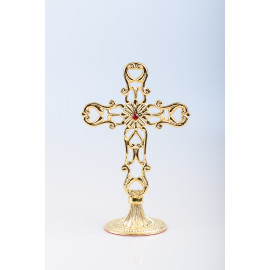
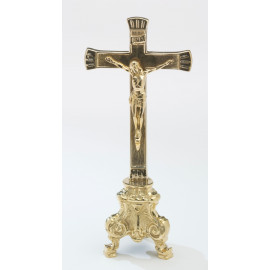
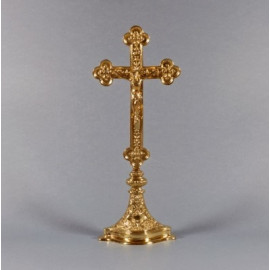
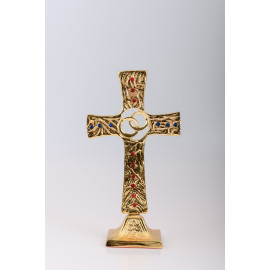
The custom translates beautifully to a home altar: drape a small violet cloth over the home crucifix or the icon during Passiontide, and remove it on Good Friday after the liturgy. It ties the family's prayer corner to what the parish is doing. If you keep a home altar, see How to Set Up a Home Altar; and if your parish or home prays the Stations during Lent, our Stations of the Cross sets and the Stations guide are here. Crosses to veil — or to keep veiled only in spirit — are in our crosses and crucifixes collection.
Frequently Asked Questions
Q: Why are crosses veiled during Lent?
A: To sharpen anticipation: the sacred images withdraw so that the faithful long for them. The custom belongs to Passiontide and echoes the Gospel scene of Jesus hiding himself in the temple.
Q: When are crosses covered with purple cloth?
A: Traditionally from the Fifth Sunday of Lent, which opens Passiontide, until Good Friday. Some parishes begin at the start of Lent; the practice is optional and varies.
Q: What is Passiontide?
A: The final two weeks of Lent, beginning with the Fifth Sunday of Lent — the most intense stretch of the season, focused directly on the Lord's Passion.
Q: What color cloth covers crosses during Lent?
A: Violet (purple), matching the liturgical color of Lent. In practice many parishes use a deep purple; black is not customary for veiling.
Q: Are crosses veiled in every parish?
A: No. Since the liturgical reforms the veiling is optional and governed by local custom, so parishes and dioceses differ. Some veil crosses and images, some only crosses, some not at all.
Q: When are the veils taken down?
A: During the celebration of the Lord's Passion on Good Friday, when the cross is unveiled and venerated. Statues are often uncovered at the Easter Vigil.