Children can pray the Stations of the Cross. The key is to match the language and the length to their age, and to avoid graphic detail that frightens rather than helps. The Stations are a story of love, courage, and hope; children can understand that before they understand the theology of the cross.
This guide gives age-appropriate ways to explain the devotion, a child-friendly list of the 14 stations, a 20-minute family version, and practical advice for choosing a set that works in a home or classroom.
At What Age Can Children Pray the Stations?
Children as young as four or five can follow a very simple version: Jesus is condemned, carries the cross, falls, meets his Mother, and is buried. They do not need the full historical or theological background. What they need is a short, concrete story and a chance to participate.
From about seven to ten, children can understand the sequence and the meaning of each station. They can read a short reflection, answer a question, or place a picture on a wall. Teenagers can handle the harder themes of suffering, injustice, and death, and they can begin to connect the Stations to their own lives.
How to Explain Each Station Simply
| Station | Child-friendly explanation |
|---|---|
| 1. Jesus is condemned | People in power made an unfair decision about Jesus. |
| 2. Jesus takes up his cross | Jesus accepted a hard job because he loves us. |
| 3. Jesus falls the first time | The cross was heavy, and Jesus fell. He got up again. |
| 4. Jesus meets his Mother | Mary stayed close to Jesus when he was hurting. |
| 5. Simon helps Jesus | A stranger helped carry the cross. We can help too. |
| 6. Veronica wipes his face | A kind woman showed Jesus love when others did not. |
| 7. Jesus falls again | Jesus was tired, but he kept going. |
| 8. Jesus meets the women | Jesus cared about other people even while he was suffering. |
| 9. Jesus falls a third time | Jesus was very weak, but he did not give up. |
| 10. Jesus is stripped | Jesus lost his clothes. He was treated without respect. |
| 11. Jesus is nailed to the cross | Jesus was hurt on the cross. We can be quiet and sorry for our sins. |
| 12. Jesus dies | Jesus gave his life for us. This is the saddest part of the story. |
| 13. Jesus is taken down | His friends held him and mourned. |
| 14. Jesus is buried | They placed him in a tomb, and everyone waited. |
A 20-Minute Family Version
Use a set of panels on the wall, a candle, and a simple booklet or this list. Begin with the Sign of the Cross. At each station, read the child-friendly explanation, ask one short question, and keep a few seconds of silence. End with a prayer and the Sign of the Cross.
For younger children, you can pray only five stations at a time and continue the next day. For older children, let them read the station or place a small cross or picture on the wall. The goal is participation, not performance.
What to Soften or Skip
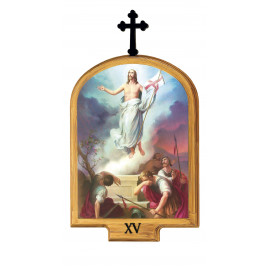
Young children do not need graphic descriptions of the scourging, the nails, or the blood. Focus on the main line of the story: Jesus was treated unfairly, he carried a heavy cross, people helped and hurt him, he died, and his friends waited in hope. The Resurrection panel, if your set has one, is a good way to end on hope.
Do not skip the reality of suffering altogether. Children need to know that Jesus understands pain and that it is okay to be sad. The difference is in the detail and the tone, not in the truth of the story.
Hands-On Activities
Children remember what they do. You can print a simple list of the stations and let them draw one scene each day. You can match a small object to each station, such as a piece of cloth for Veronica or a small stone for the tomb. You can act out the story with figures, or place a sticker on a chart after each station.
In a classroom or parish group, divide the children into pairs and give each pair one station. They can read the explanation, draw a symbol, and explain it to the group. This works well for a 45-minute session and does not require a printed booklet.
Choosing a Child-Friendly Set
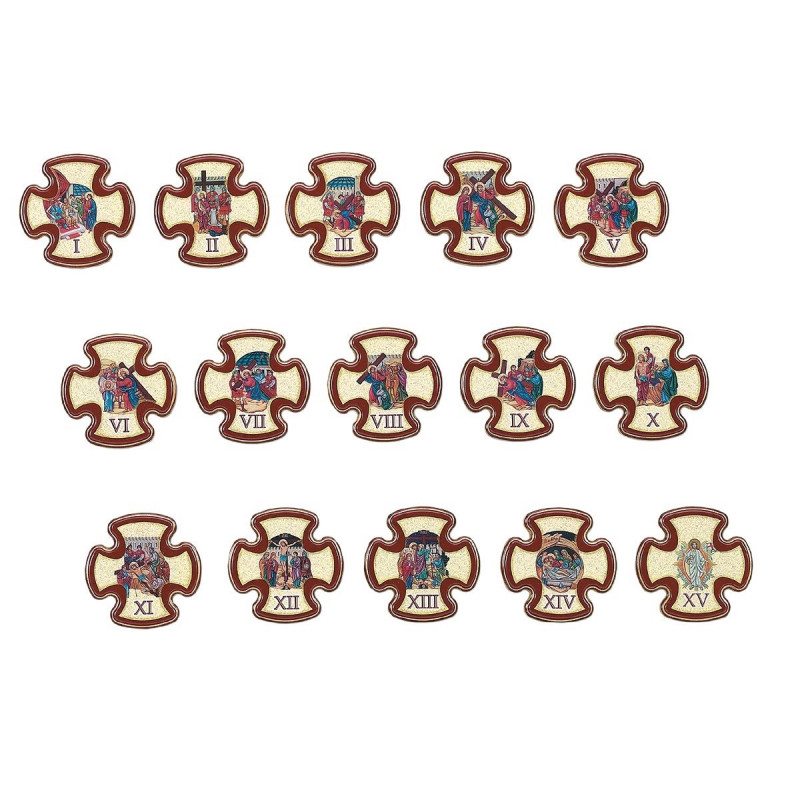
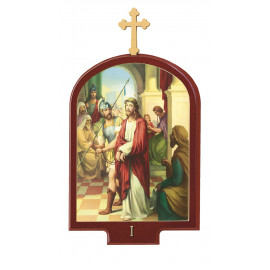
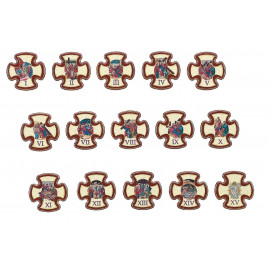
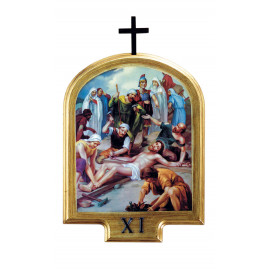
For a home or classroom, smaller panels are easier to handle and hang. Our 9.5 × 9.5 cm set is the most compact; the 14.5 × 14.5 cm set is a good middle size for a family room. Both are laminated MDF and intended for indoor wall display. The larger 32 × 24.5 cm and 48 × 34 cm sets are better for a church or a large hall.
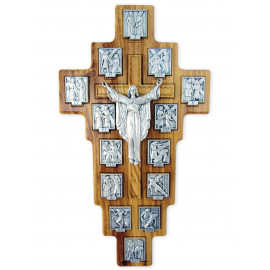
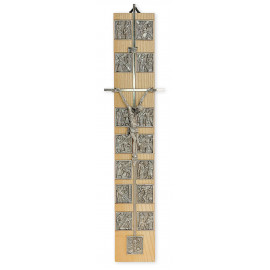
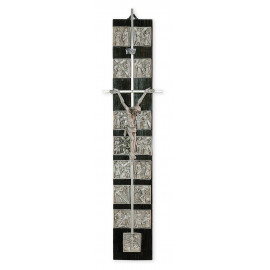
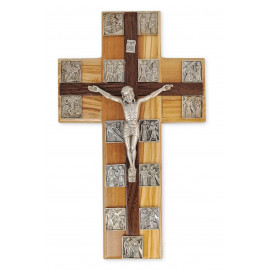
If you want a single wall cross rather than 15 separate panels, the Italian wooden crosses with metal reliefs are compact and easy to hang. They show the stations on one cross, which can be simpler for a small room. Browse the Stations of the Cross collection to compare sizes and prices.
Frequently Asked Questions
Q: At what age can a child pray the Stations of the Cross?
A: Children as young as four or five can follow a very simple version. From seven to ten they can understand the sequence; teenagers can handle the harder themes.
Q: How do I explain the Stations to a young child?
A: Use short, concrete sentences: Jesus was treated unfairly, he carried a heavy cross, people helped him, he died, and his friends waited in hope. Avoid graphic detail.
Q: Can children pray the Stations at home?
A: Yes. Use a set of panels or a simple list, keep the session short, and let the children participate by reading, drawing, or placing a marker.
Q: How long should a children’s Stations service be?
A: About 20 minutes is a good target. For younger children, 10–15 minutes or five stations at a time may work better.
Q: Should children see the crucifixion?
A: They should know that Jesus died for us, but they do not need graphic details. Focus on love, courage, and hope, and end with the Resurrection if your set includes it.
Q: What activities work best for kids?
A: Drawing one station, matching objects, acting out the story, or placing a sticker on a chart. Participation helps children remember the sequence.
Q: Which set is best for a family with children?
A: The 9.5 × 9.5 cm or 14.5 × 14.5 cm laminated MDF set is easy to hang and handle. A wooden wall cross is a compact alternative for a small room.
Q: Can we use a 15-piece set with children?
A: Yes. Pray the traditional 14 stations and use the Resurrection panel as a hopeful ending. The 15th panel is not one of the traditional stations.
Q: Are the Stations only for Lent?
A: They are most commonly prayed in Lent, but families can pray them at any time. A short version works well for Advent, Holy Week, or a family prayer routine.
Conclusion
Children do not need a perfect understanding of the Stations to pray them. They need a clear story, a short rhythm, and an invitation to participate. Start with the child-friendly list, keep the session brief, and let the Resurrection give the story its hope. For the full list, see our 14 Stations in order; for a home set, browse the collection. For the history and prayers, see our complete guide.