
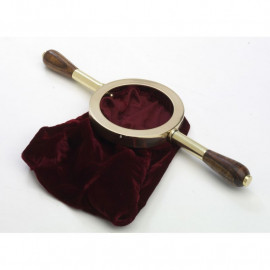
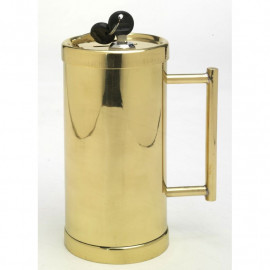
A church offering basket is the receptacle used to take up the faithful's gifts at Mass. Most Catholic parishes call it a collection basket; older books say alms basket or alms basin; and because the moment itself is the offertory, offertory basket is equally correct. In everyday speech people simply say money basket. It holds cash, cheques and offering envelopes during the Preparation of the Gifts. It is not a sacred vessel, and it never touches the Blessed Sacrament.
What Is the Church Donation Basket Called?
All of these names describe the same object, and all of them are in use today:
- Collection basket — the standard American term, and the one most parishes print in their bulletins.
- Offering basket — common in both Catholic and Protestant churches; slightly broader, because "offering" can also mean the bread and wine.
- Offertory basket — named after the part of the Mass during which the collection is taken.
- Alms basket / alms basin — the older Catholic term, still used in England and Ireland. "Alms" are money or goods given to the poor.
- Money basket — informal, but the phrase people actually type into a search box.
- Collection plate — a shallow dish rather than a basket, still used where the collection is passed hand to hand along a row.
- Poor box / mite box — a fixed, locked box near the door or in a chapel, for gifts given outside Mass.
There is no official vocabulary. What the Church regulates is not the word but the purpose: the gifts must be collected honestly and kept apart from the altar.
Where the Collection Sits in the Mass
The General Instruction of the Roman Missal gives the collection a single paragraph (GIRM 73). Money and other gifts for the poor or for the Church, "brought by the faithful or collected in the church, are acceptable; given their purpose, they are to be put in a suitable place away from the Eucharistic table."
Two rules follow from that sentence. The basket is never placed on the altar, because the altar is for the bread and wine. And the collection is not itself the offering of the Eucharist — it accompanies it. In practice the ushers take the collection during the Preparation of the Gifts, usually while the Offertory Chant is sung, and the gifts are then set down on a side table, on the credence table or in the sacristy.
The Order of Mass says the same thing in different words: as the altar is prepared, representatives of the people bring forward the bread and wine, and "in addition to the bread and wine, monetary gifts for the support of the Church and the care of the poor may be brought forward." In many parishes the collection is carried up in the procession and then placed away from the altar; where that is not customary, the ushers take it directly to the sacristy or to a safe.
The Seven Types of Offering Baskets
Parishes choose between seven designs. They differ in capacity, reach and security — not in dignity.
| Type | How the money is held | Where it works best |
|---|---|---|
| Velvet-pocket basket | Open fabric pocket under a metal ring; folds flat | Processions, small and medium congregations, churches that match metalwork |
| Locked money basket | Lockable lid, coin slot, two keys, side handle | Shrines, chapels, weekday Masses, collections counted later |
| Open metal basket | Rigid bowl or tray in brass or silver plate | Formal churches, short pews, immediate emptying |
| Wicker basket with liner | Open weave, removable washable liner | Large American parishes, high volume, low cost |
| Long-handle basket | Any body on a 35–42 inch shaft | Pews longer than about 2.5 m |
| Offering plate or tray | Shallow dish, often stacked | Historic churches, hand-to-hand passing |
| Collection bag or pouch | Fabric or leather on a short handle | Europe, chapels, outdoor and mission Masses |
Two of these are the styles we stock: a velvet-pocket basket with long wooden handles and a brass money basket with a lock, coin slot and two keys. Everything else in the list is included here because sacristans ask about it — a parish replacing a set usually compares all seven before choosing.
Which Type Fits Your Church?
Start with the building, not with the catalogue.
- Long pews (over 2.5 m / 8 ft): a long handle is not optional. Without it the usher has to step into the row, which is slow and distracting.
- Large Sunday congregation: two ushers with medium baskets clear a nave faster than one usher with a very large basket.
- Chapel, shrine or adoration chapel: a locked box. The collection may sit for an hour before it is counted.
- Historic church with brass and silver vessels: polished brass or silver plate, so the collection does not look like an afterthought.
- Mission church or outdoor Mass: something that packs flat — a velvet pocket or a fabric pouch.
What Happens to the Collection After Mass
Good practice is remarkably consistent across dioceses. Two people handle the money at all times; the collection is never left with one person. It is counted in a closed room, in the presence of witnesses, and recorded against the offering envelopes and the loose cash separately. The funds are deposited intact — nothing is taken out for petty expenses on the way to the bank — and the figures are reported to the parish finance council.
None of this is bureaucracy for its own sake. The collection is the ordinary income of most parishes, and the way it is handled is the most visible act of stewardship a parish performs each week.
Frequently Asked Questions
Q: Is it called an offering basket or a collection basket?
A: Both are correct and mean the same thing. "Collection basket" is the usual American term; "offering basket" is broader and also used by other denominations; "offertory basket" refers to the part of the Mass during which it is passed.
Q: What is the difference between an offering basket and a poor box?
A: An offering basket is carried through the church during Mass. A poor box — also called an alms box or mite box — is fixed near the door or in a chapel and receives gifts outside Mass. Both are for the support of the Church and the poor, but only the basket is part of the liturgy.
Q: Do Catholic churches still pass a basket?
A: Yes. The collection during the Preparation of the Gifts remains the norm, though many parishes also offer electronic giving, and some take the collection at the door instead. The GIRM allows money "brought by the faithful or collected in the church".
Q: What is an alms basin?
A: An older name for the collection receptacle, still used in England and Ireland. "Alms" means money or goods given to the poor, which is why the same object can be called an alms basket, an alms basin or an alms dish.
Q: How big should an offering basket be?
A: The opening should accept a standard offering envelope without folding — roughly 20–25 cm (8–10 in) across — and the depth should carry a full pass along a pew. In long naves, handle length matters more than basket size.
Q: Can the collection basket be carried in the procession with the gifts?
A: In many parishes it is. The GIRM requires only that the money be put "in a suitable place away from the Eucharistic table", so the basket is set down on a side table or in the sacristy, never on the altar.
