The offering is the most visible thing ushers do, and the easiest to get wrong. A collection that starts late, rattles, or leaves one person alone with the money undoes an otherwise careful liturgy. This guide sets out the sequence used in parishes with long pews and large Sunday congregations — from the five-minute check before Mass to the handover in the sacristy.
Before Mass: The Five-Minute Check
- Count the baskets. One per usher, plus one spare in the sacristy.
- Check the handles. A loose handle on a long shaft is the most common failure; tighten it before the procession, not during the second reading.
- Check the liners and pockets. A velvet pocket that has been folded on a hard edge will not hang straight.
- Agree the route. Which usher takes which side, and where the two lines meet at the back.
- Agree the signal. A nod from the head usher when the Universal Prayer ends; nobody should be guessing.
The Route Through the Pews
Two ushers normally work a nave: one takes the left-hand block from the front, the other the right-hand block from the back, so the two lines cross in the middle and finish together. In a church with a centre aisle and two side aisles, three or four ushers are faster still.
The rule that matters is that the collection should finish before the gifts reach the altar. If the procession is already at the sanctuary and the ushers are still in the last rows, the route is wrong — split the nave differently next Sunday.
How to Pass the Basket
- Hold the handle, not the rim. The basket stays level; the usher's hand never goes over the opening.
- Pause at each row. A beat longer than feels natural is the right length — people need a moment to open a purse or an envelope.
- Look away. The usher faces slightly down the aisle, not at the giver. The collection is not a moment to be watched.
- Do not comment. No thanks, no remarks, no eye contact that invites explanation.
- Keep the basket moving. If someone is clearly not ready, move on; they can give at the door.
Long Handles and Deep Pews
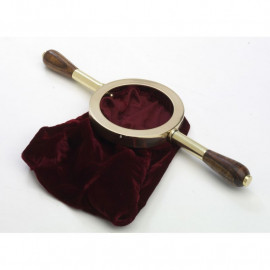
In pews longer than about 2.5 m (8 ft), a long handle is not a convenience — it is what allows the usher to stand in the aisle and reach the middle of the row. Standard long handles run 35–42 inches (89–107 cm), and the basket is tilted very slightly towards the giver so the opening is visible.
Two practical points. First, extend the handle before the collection, not in front of the congregation. Second, keep the basket close to the floor as you walk between rows; a long handle with a swinging basket at chest height is the classic way to catch someone's shoulder.
Two Ushers, Never One
Every set of parish financial guidelines says the same thing: no single person should be alone with the collection. Two ushers walk to the sacristy together, two ushers count together, and the money is never left in a vestibule, a car or an office drawer. Where the collection is large, a third person records the figures.
This is not suspicion of ushers. It protects them. A counted collection with two signatures is a collection nobody has to defend.
The Handover After Mass
The baskets go to a closed room — sacristy, parish office or counting room — and are emptied onto a table, not into a bag. Notes and coins are counted separately; offering envelopes are checked against the parish register; cheques are listed. The total is recorded and signed by both counters, and the funds are deposited intact at the bank.
Baskets are then wiped, the liners checked and the whole set stored in the same place every week. A basket that lives on a shelf in the sacristy lasts for years; one that lives in a cupboard under a pile of hymnals does not.
Common Mistakes
- Starting the collection after the gifts have reached the altar.
- One usher covering both sides of a long nave.
- Ushers talking in the aisle during the collection.
- Leaving the baskets on a bench while the counters have coffee.
- Using a wicker basket with a torn liner, which drops coins on the floor.
- Polishing a lacquered brass basket with abrasive cream until the lacquer is gone.
Frequently Asked Questions
Q: When should ushers start collecting the offering?
A: At the beginning of the Preparation of the Gifts, normally after the Universal Prayer and while the Offertory Chant is sung. The collection should finish before the gifts are placed on the altar.
Q: How many ushers should collect the offering?
A: At least two, and enough that the collection finishes before the procession reaches the sanctuary. In a long nave, four ushers with medium baskets are faster than two with large ones.
Q: Why do some collection baskets have long handles?
A: To reach the middle of a pew without stepping over the congregation. Handles of 35–42 inches (89–107 cm) are standard in American parishes with long pews.
Q: Should ushers count the money?
A: They may, but never alone. Parish practice is that two people count together in a closed room and both sign the record; the funds are then deposited intact.
Q: What should an usher wear when collecting?
A: Whatever the parish's usher ministry has agreed — usually a jacket, or a badge and tie. The point is to look like part of the liturgy rather than a volunteer who has just arrived.
Q: Can a woman be an usher?
A: Yes. In most dioceses ushers and greeters are lay ministries open to any confirmed Catholic, and the practical requirements are the same: punctuality, discretion and a steady hand with a long handle.