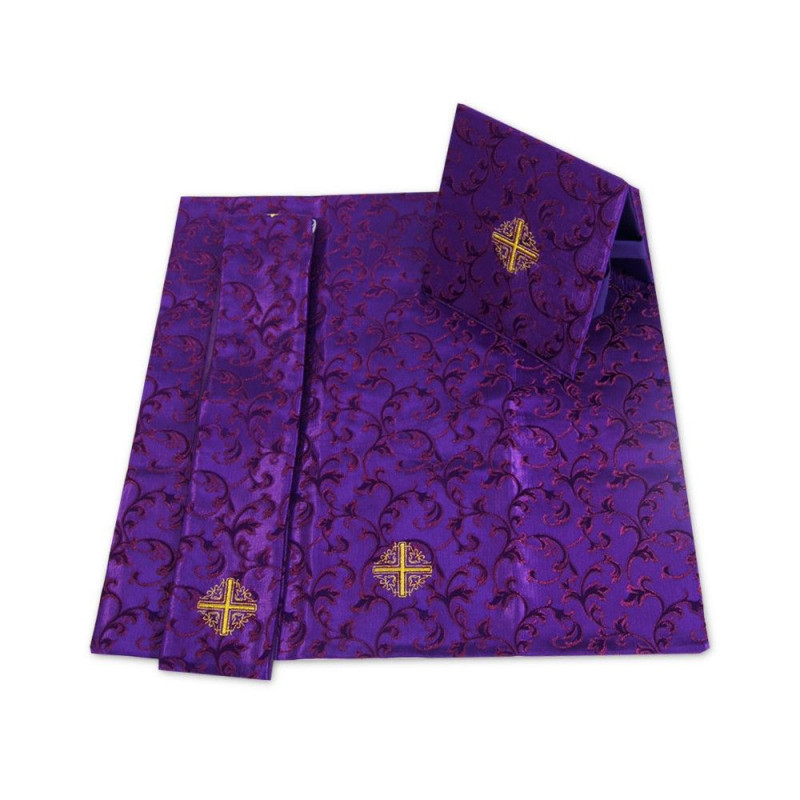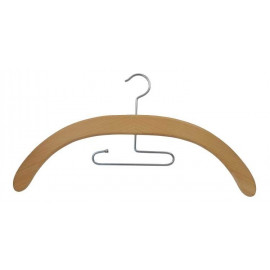
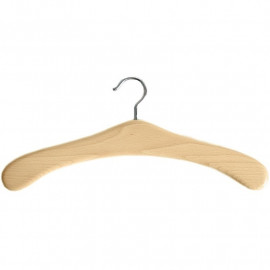
Both hangers hang vestments; they solve different problems. A vestment hanger is a straight, wide wooden hanger that supports the shoulder seam. A cope hanger is triangular or arch-shaped and supports the whole semicircular cut of a cope. Choosing the wrong one is the fastest way to put a permanent crease in an expensive garment.
What a Vestment Hanger Does
A vestment hanger is a straight hanger with arms of 52–56 cm, shaped to follow the shoulder line of a chasuble, dalmatic, surplice or alb. The garment hangs from its shoulders, the weight falls into the body, and the embroidery at the shoulder stays flat.
It works because most vestments are cut with a defined shoulder seam. Our wooden vestment hangers are solid beech, varnished, and come in 52 cm and 56 cm.
What a Cope Hanger Does
A cope is not cut like a chasuble. It is a semicircular cloak, open at the front, with a hood at the back. Hung on a straight hanger, only the centre of the shoulder is supported and the two front panels pull the garment out of shape.
A triangular or arch-shaped cope hanger follows the curve of the cope and carries the full width, so the weight is distributed along the whole garment instead of two points. That is the entire purpose of the shape.
The Differences That Matter
| Feature | Vestment hanger | Cope hanger |
|---|---|---|
| Shape | Straight, wide arms | Triangular or arch |
| Width | 52–56 cm | Often 58 cm or more |
| Best for | Chasuble, dalmatic, surplice, alb, cassock | Cope, especially heavy or embroidered |
| Load | Shoulder seam | Full semicircle |
| Storage | Open rail or cupboard | Wide cupboard or hanging bag |
When a Vestment Hanger Is Enough for a Cope
A light cope — wool or a light damask without heavy embroidery — can hang on the 56 cm surplice hanger without damage, provided the cupboard gives it room. The hanger supports the shoulder and the cope hangs freely.
Check two things: whether the cope pulls the hanger out of line, and whether the front panels fold over the ends of the arms. If either happens, the hanger is too narrow.
When You Need a Cope Hanger
Choose a triangular cope hanger when the cope is heavy, heavily embroidered, or made of a stiff fabric such as brocade. The signs that a straight hanger is failing are easy to read: a crease down the centre back, front panels that hang lower than the back, and a shoulder line that no longer sits flat when the cope is worn.
Heavy embroidered copes are the clearest case. The weight of the embroidery alone is enough to distort a straight hanger over a season.
Can One Hanger Do Both Jobs?
Not well. A straight hanger cannot support a semicircular cope, and a triangular cope hanger is the wrong shape for a chasuble: the point of the triangle pushes into the back of the garment and the shoulders are unsupported. A sacristy that keeps both vestment types needs both hanger types.
Storing Both Types Together
Keep the two shapes in separate sections of the cupboard. Hang chasubles and dalmatics on straight hangers in colour order, and copes on triangular hangers at the end of the rail, where there is room for the wider shape. Leave a hand's width between garments and keep the cupboard ventilated.
For the wider routine, see how to store liturgical vestments and how to hang a chasuble.
Frequently Asked Questions
Q: Can I hang a cope on a regular vestment hanger?
A: A light cope, yes, on a 56 cm hanger. A heavy or embroidered cope needs a triangular cope hanger to support the full semicircle.
Q: What size is a cope hanger?
A: Triangular cope hangers are typically 58 cm or wider across the base, because the cope is wider than a chasuble. Check the internal width of your cupboard before buying.
Q: Can I use a cope hanger for a chasuble?
A: No. The triangular shape pushes into the back of a chasuble and leaves the shoulders unsupported, which is worse than a narrow straight hanger.
Q: Do I need a cope hanger for a light wool cope?
A: Not necessarily. A 56 cm wooden vestment hanger is enough if the cope does not pull the hanger out of line and the front panels do not fold over the ends.
Q: How do I know a cope hanger is too small?
A: The front panels hang over the ends of the hanger, or the centre back develops a crease. Either sign means the hanger is not carrying the full width.
Looking for the straight version? Our wooden vestment hangers are in stock in 52 cm and 56 cm.