



An oil stock is the portable vessel that holds the holy oils; an ambry is the fixed cupboard or recess — usually in the church wall — where the oils are reserved between celebrations. The two work together: the ambry (or a secure sacristy cabinet) is the home of the oils, and the oil stocks are the vessels in which they are kept and carried to the font, the sickbed, and the altar.
What Is an Oil Stock?
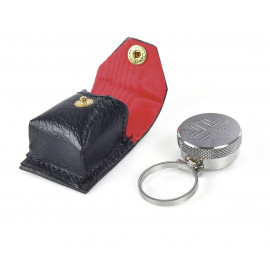
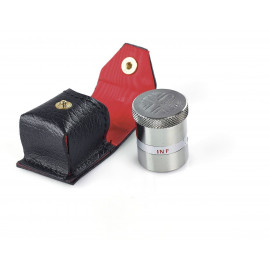
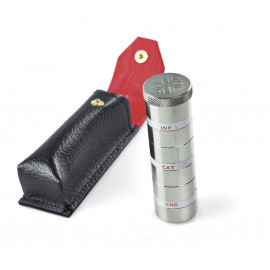
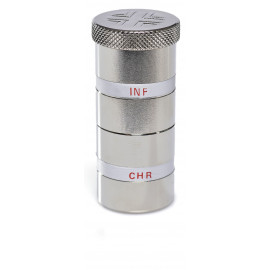
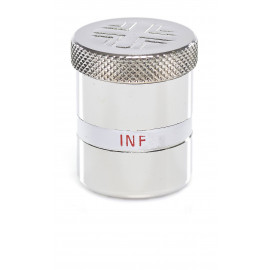
An oil stock is a small, dedicated container for one of the three holy oils — the Oil of Catechumens, the Oil of the Sick, or Sacred Chrism. Stocks are made of metal (nickel, brass, gold-plated) and usually labeled with the traditional abbreviations INF, CHR, and CAT, or OI, OC, and SC.
Three configurations cover almost every need:
- Single stocks — one oil each. Many have a finger ring, so a priest can carry the Oil of the Sick securely on hospital and home visits.
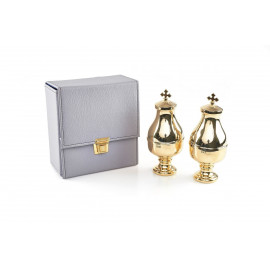
- Double stocks — two oils together, for example at the baptismal font, where chrism and the oil of catechumens are both used.
- Triple stocks — the complete set of all three oils in one unit or case, the standard arrangement for the parish sacristy.
Many modern stocks hold the oil in a removable glass cartridge or insert inside the metal housing. The cartridge lifts out for cleaning and refilling, which keeps the metal exterior — and its engraving — in good condition for decades.
What Is an Ambry?
An ambry (from the Latin armarium, a cupboard) is a recess or cabinet in the church — traditionally in the sanctuary wall or the sacristy, often near the baptismal font — where the holy oils are reserved. Ambries are usually closed and locked, both to protect the oils and to mark their sacred character. In some churches the ambry is a stone niche with a metal door, sometimes decorated with the IHS monogram or a cross; in others it is a wooden cabinet. Where a church does not have a built-in ambry, the oils are kept in a locked cabinet in the sacristy.
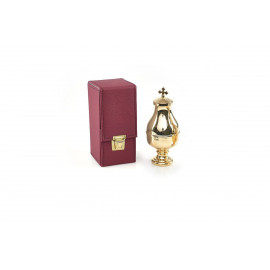
The oils themselves are delivered to the parish at the Chrism Mass and remain in the ambry or cabinet until they are poured into the oil stocks for use. Some larger parishes also keep a crystal ambry set — a larger, display-style vessel for the full year's supply — from which the smaller stocks are filled.
Can Holy Oils Be Kept at Home?
Normally, the holy oils are reserved in the church, and the faithful do not keep them at home. The one common exception is the Oil of the Sick: priests carry a small single stock — often with a ring — in a sick call bag or pocket case so they can anoint the sick at a moment's notice. If your parish organizes Communion to the sick or a hospital ministry, the oil stocks live with the parish's sick call set: pyx, burse, stole, and oil stock.
Practical Storage Rules
- Keep the oils cool and dark. Heat and direct sunlight degrade the oil over the year.
- Keep the vessels labeled and closed. Tight caps prevent spills and contamination; clear labels prevent mix-ups.
- Never return used oil to the stock. Oil that has touched a person in the sacraments is not poured back.
- Dispose of old oils properly. When the new oils arrive at the Chrism Mass, the previous year's oils are disposed of according to diocesan custom — usually by burning. Wash water that has touched the oils is poured into the sacrarium, not an ordinary drain.
- Clean the stocks gently. Warm water and mild soap, rinsed and dried completely before refilling.
Our holy oil stock collection includes single stocks with rings, double and triple sets, glass-cartridge models, and leather cases — 25 vessels from $32 to $592. To go deeper, read What Is a Chrismarium? and The Three Holy Oils Explained.
Frequently Asked Questions
Q: What is an ambry in a Catholic church?
A: An ambry is the recess or locked cupboard — traditionally in the sanctuary wall or sacristy — where the holy oils are reserved. The word comes from the Latin armarium, meaning cupboard.
Q: Is an ambry the same as a chrismarium?
A: Not exactly. A chrismarium (oil stock) is the portable vessel that holds the oil; an ambry is the fixed place in the church where the vessels are kept. Older texts sometimes used "chrismarium" for both.
Q: Where should oil stocks be kept?
A: In a clean, dry, secure place — the ambry, or a locked sacristy cabinet — away from direct sunlight and heat, with each vessel clearly labeled.
Q: How long can holy oils be kept?
A: The oils are renewed annually at the Chrism Mass, so each year's oils normally serve until the next Holy Week. Any remaining oil is disposed of reverently when the new oils arrive.
Q: Why do oil stocks have a ring?
A: The finger ring lets a priest carry a single oil stock securely — usually the Oil of the Sick — on hospital and home visits, keeping his hands free for the anointing.
