

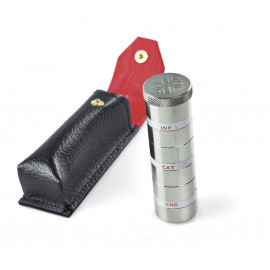
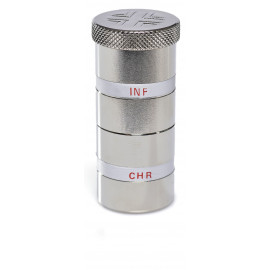
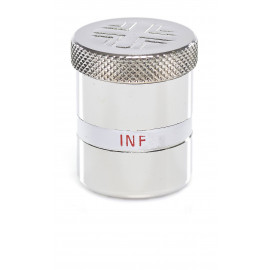


The Catholic Church uses three holy oils in its sacraments: the Oil of the Catechumens (OC), the Oil of the Sick (OI, also written OS), and Sacred Chrism (SC). Two are blessed and one is consecrated by the bishop at the Chrism Mass, usually during Holy Week, and then distributed to every parish for the year. Each oil is used for a different purpose, and each is kept in its own vessel — usually a set of oil stocks labeled INF, CHR, and CAT, or OI, OC, and SC.
The Oil of Catechumens (OC)
The Oil of Catechumens is used in the anointings that prepare a person for baptism. In the baptism of infants, the child is anointed with it on the breast before the water is poured; in the baptism of adults, it is used in the preparatory anointings on the hands and breast. The oil strengthens the candidate for the struggle against sin and marks the first stages of their entrance into the Church.
The Oil of Catechumens is also used at the ordination of priests, where the bishop anoints the palms of the new priest's hands. The bishop blesses this oil — he does not consecrate it, because it is not mixed with balsam.
The Oil of the Sick (OI or OS)
The Oil of the Sick is the oil of the sacrament of the Anointing of the Sick. Drawing on the words of Saint James — "Is anyone among you sick? Let him call for the elders of the Church, and let them pray over him, anointing him with oil in the name of the Lord" (James 5:14) — the priest anoints the forehead and hands of the sick person, praying for strength, peace, and the forgiveness of sins.
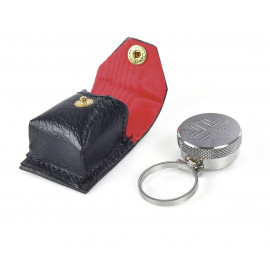
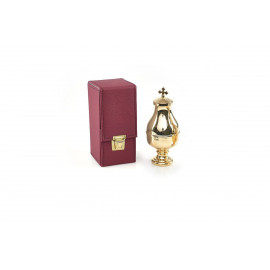
The bishop blesses this oil at the Chrism Mass, but in a case of true necessity any priest may bless it. Because it is used outside the church — in hospitals, homes, and hospices — the Oil of the Sick is the oil most often carried in a single oil stock with a finger ring, a small case, or a sick call set.
Sacred Chrism (SC)
Sacred Chrism is the most solemn of the three oils. It is olive oil mixed with balsam, a fragrant resin that symbolizes the "aroma of Christ" (2 Corinthians 2:15), and it is consecrated — not merely blessed — by the bishop. Chrism is used in:
- Baptism — the post-baptismal anointing of the crown of the head, marking the new dignity of the baptized.
- Confirmation — the anointing of the forehead with the words "Be sealed with the Gift of the Holy Spirit."
- Holy Orders — at the ordination of priests the bishop anoints the priest's hands with chrism after the oil of catechumens; at the consecration of a bishop he anoints the new bishop's head.
- Consecration of churches and altars — during a church dedication the bishop anoints the walls and the altar with chrism.
Because it is mixed with balsam and consecrated, chrism cannot be blessed by a priest in case of necessity — it comes to the parish only from the bishop at the Chrism Mass.
At a Glance
| Oil | Abbreviations | Used for | Blessed or consecrated |
|---|---|---|---|
| Oil of Catechumens | OC, CAT | Pre-baptismal anointings; ordination of priests | Blessed by the bishop |
| Oil of the Sick | OI, OS, INF | Anointing of the Sick | Blessed by the bishop (any priest in necessity) |
| Sacred Chrism | SC, CHR | Baptism, confirmation, holy orders, consecrations | Consecrated by the bishop with balsam |
How the Oils Are Stored and Labeled
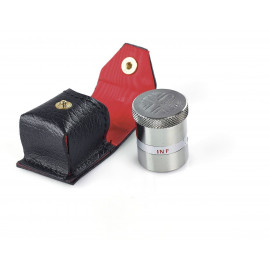
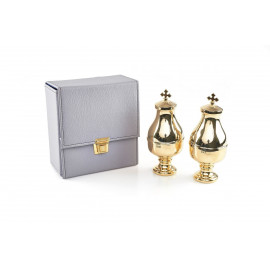
After the Chrism Mass, parishes fill their oil stocks from the vessels in which the oils were delivered. Because the three oils look nearly identical, clear labeling is essential: a mix-up in the sacristy can mean the wrong oil in a sacrament. Sets from church supply makers are engraved or printed with the traditional Latin abbreviations — INF, CHR, CAT — while some suppliers use the English-friendly OI, OC, and SC. Whichever convention your diocese uses, the oils should be kept in dedicated vessels, in a cool, dark place, and never in unlabeled or improvised containers.
Browse our holy oil stocks — single, double, and triple vessels with the traditional INF, CHR, CAT labeling, from $32. For the full story of the annual blessing, see Chrism Mass Explained, and to understand the vessels themselves, start with What Is a Chrismarium?
Frequently Asked Questions
Q: What oil do Catholics use for baptism?
A: In baptism, two oils are used: the Oil of Catechumens (OC) before the baptismal washing, and Sacred Chrism (SC) for the post-baptismal anointing of the crown of the head.
Q: What is chrism oil used for?
A: Sacred Chrism — olive oil mixed with balsam and consecrated by the bishop — is used in baptism, confirmation, the ordination of priests and bishops, and the consecration of churches and altars.
Q: What does OI or OS mean on an oil stock?
A: OI stands for oleum infirmorum, the Oil of the Sick (Latin infirmi means "the sick"); some suppliers mark it OS. Both refer to the oil used in the Anointing of the Sick.
Q: Do the holy oils expire or need to be replaced?
A: Yes. The oils are renewed every year at the Chrism Mass. Parishes should use the oils received that year and dispose of older oils according to diocesan custom, usually by burning.
Q: Can holy oil be made or blessed at home?
A: No. Sacred Chrism is consecrated by the bishop, and the other two oils are blessed by the bishop at the Chrism Mass; only the Oil of the Sick may be blessed by a priest in case of true necessity.
