

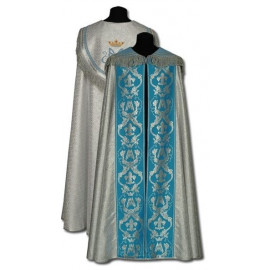
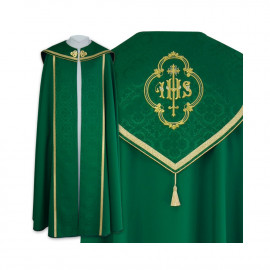
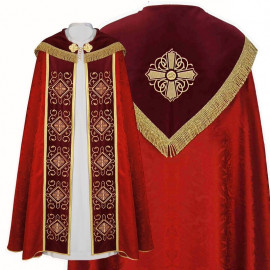

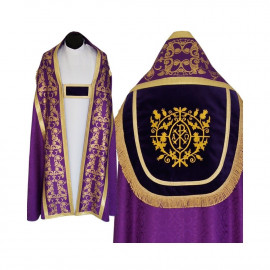
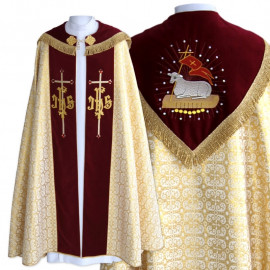
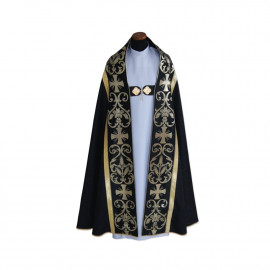
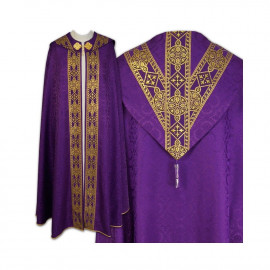
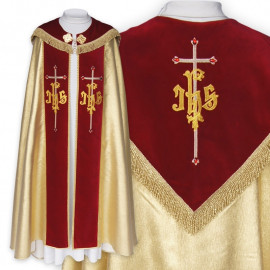
A bishop's cope and mitre should match in color, style, and embroidery. The cope is worn with the mitre and crozier at pontifical ceremonies, processions, and Benediction; the mitre has three traditional forms — pretiosa, auriphrygiata, and simplex. Choosing a set means matching the liturgical color, the cut of the cope, and the weight of the embroidery.
This guide explains what a bishop wears, how to match cope and mitre, and what to check before ordering.
What a Bishop Wears
- Cope — the outer vestment for processions, Benediction, and pontifical ceremonies outside Mass.
- Mitre — the liturgical headdress, worn with the cope at pontifical functions.
- Crozier — the pastoral staff, carried when the bishop walks or blesses.
- Stole and alb — worn under the cope.
Matching Cope and Mitre
Match the color first: white or gold for solemnities and Benediction, red for Pentecost and martyrs, green for Ordinary Time, violet for Advent and Lent, black for funerals where customary. Then match the style: a Gothic cope pairs naturally with a Gothic mitre, a Roman cope with a Roman mitre. Finally, match the embroidery — the orphrey of the cope and the front of the mitre should use the same motif and thread.
Our Catholic copes and embroidered mitres are made in matching colors and styles.
The Three Types of Mitre
| Type | Description | When worn |
|---|---|---|
| Mitra pretiosa | Ornate, with gold embroidery and precious stones | Solemn feasts and pontifical ceremonies |
| Mitra auriphrygiata | Gold fabric or white silk with gold embroidery | Sundays and lesser feasts |
| Mitra simplex | Plain white linen or silk | Funerals, Good Friday, and concelebrating bishops |
Colors and Seasons
The cope and mitre follow the liturgical color of the day. White and gold are the most versatile, especially for Benediction; red, green, violet, and black complete the set. For the full calendar, see our guide to cope colors.
Sizes and Fit
A bishop's cope is usually 145–160 cm long, with enough drape to accommodate the mitre and crozier. The mitre should sit comfortably without pressing on the forehead. Measure the head circumference and the height from the brow to the crown; custom sizes are available on request. See our guide to cope sizes and measurements.
Care and Storage
Store the cope on a wide padded hanger and the mitre in a rigid box. Keep both away from sunlight and damp, and repair loose threads before they unravel. Dry clean embroidered pieces only when necessary.
Frequently Asked Questions
Q: Does a bishop always wear a cope with a mitre?
A: At pontifical ceremonies, processions, and Benediction, yes — the cope is worn with the mitre and crozier. At Mass the bishop wears the chasuble.
Q: Should the cope and mitre match exactly?
A: They should match in color, style, and embroidery motif. Exact fabric matching is ideal but not always possible.
Q: Which mitre is worn for Benediction?
A: The mitra pretiosa or auriphrygiata, according to the solemnity; white or gold is the usual color.
Q: Can a priest wear a mitre?
A: No. The mitre is reserved to bishops, abbots, and certain prelates.
Q: How do I order a matching set?
A: Choose the cope and mitre in the same color and style, and contact us if you need a custom size or embroidery.
Conclusion
A matching cope and mitre set is the visible sign of the bishop's role in the liturgy. Browse our Catholic copes and mitres to build a set for your diocese.
