

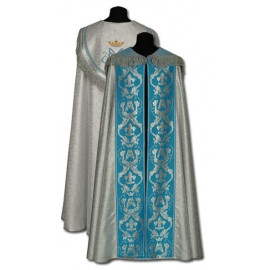
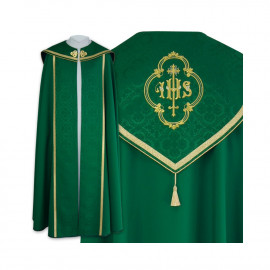
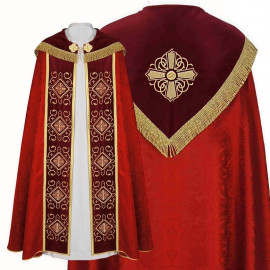

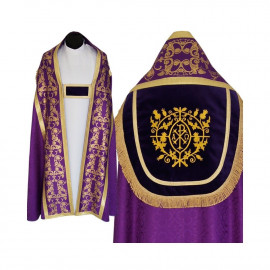
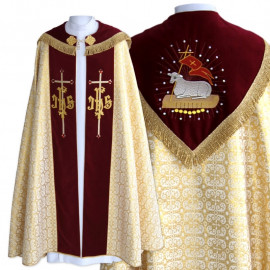
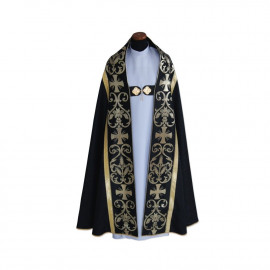
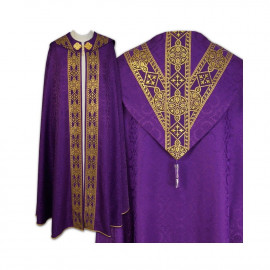
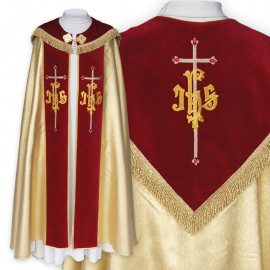
If you've ever attended a procession, Benediction, or an ordination, you've probably seen the cope — a long, flowing mantle worn over the shoulders. It is one of the most visually striking vestments in the Catholic Church. But what does it mean, when is it worn, and why does it look different from a chasuble?
A cope is a long, semicircular mantle — also called a liturgical cope, pluviale, or cappa — open at the front and fastened at the breast with a clasp called a morse. It is worn by bishops, priests, and deacons for celebrations outside Mass: processions, Benediction of the Blessed Sacrament, the Liturgy of the Hours, and sacraments celebrated outside the Eucharist. In this guide we trace its history, explain its symbolism, and show how it is worn today.
What Is a Cope?
A cope is a liturgical vestment shaped like a semicircular cloak. Unlike the chasuble, it is open at the front and has no sleeves, so the wearer's arms remain free. It is worn over an alb or surplice and is fastened at the chest with a morse — a clasp, brooch, or hook-and-chain closure.
The cope is the Church's vestment of movement. It is used when the clergy walk in procession, carry the Blessed Sacrament, sprinkle holy water, or preside at the Liturgy of the Hours. It is not worn by the priest celebrating Mass; the chasuble is the Mass vestment.
In everyday parish language, "cope", "liturgical cope", "processional cope", and "clergy cape" all mean the same garment. Our Catholic cope collection includes 126 designs in Roman, Gothic, semi-Gothic, Marian, and funeral styles.
Cope Terminology: Pluviale, Cappa, and the Morse
The English word "cope" comes from the Latin cappa, a hooded cloak. The Latin liturgical name is pluviale ("rain cloak"), a reminder that the vestment began as an outdoor garment. The word "cope" is related to "cape" and "chapel" — the chapel was originally the place where the cloak of St. Martin was kept.
- Morse — the clasp or brooch at the breast. Medieval morses were often gold, enamel, or set with precious stones.
- Orphrey — the embroidered band along the front edges and across the top.
- Hood or shield — the decorative panel at the back, often stiffened and embroidered.
- Lappets — the hanging ends of the hood or the front borders.
- Cappa magna — the long, trained cloak of cardinals and bishops; not a cope, but a relative.
- Mantum — a longer papal mantle fastened with a morse.
History of the Cope
The cope began as a hooded cloak. The earliest mention of a cappa is in the writings of St. Gregory of Tours (6th century) and in the Miracula of St. Fursey. A letter written in 787 by Theodemar, abbot of Monte Cassino, in answer to Charlemagne, shows that the garment called cuculla in Gaul was known as cappa to the monks of Cassino.
For centuries the cope remained a practical garment. An inventory of the abbey of Saint-Riquier in 801 lists 200 cappae; by 831 the number had grown to 377. Most were ordinary cloaks of simple material. By the 12th century, the cope made of rich material had become a standard ceremonial vestment, and its use spread across Western Europe.
Because the cope kept its shape and was not cut down like the chasuble, many medieval examples survive. Two of the most famous are the Syon Cope in the Victoria and Albert Museum, London, and the Ascoli Cope in the Pinacoteca Civica in Ascoli Piceno. Both are masterpieces of opus anglicanum, the English embroidery admired across Europe in the 13th and 14th centuries. The morse itself could be a work of goldsmith's art: Benvenuto Cellini's career was launched by a morse he made for Pope Clement VII.
In the 20th century, the cope was simplified along with other vestments, but it never lost its place as the vestment of processions and Benediction. For the parallel history of the Mass vestment, see our guide to the history of the chasuble.
Symbolism of the Cope
The cope symbolizes several things:
- Protection — as a cloak, it recalls God's protection over the wearer and the Church.
- Authority — it is worn by bishops, priests, and deacons when they act in a solemn liturgical role.
- Joy and solemnity — its rich fabric and embroidery mark feasts, processions, and Benediction.
- Reverence for the Blessed Sacrament — the cope is the vestment of Eucharistic processions and Benediction.
The hood or shield at the back recalls the garment's origin as a rain cloak. The orphrey and embroidery direct the eye to the cross or the IHS monogram, and the color follows the liturgical season. The cope is not a symbol of office in the same way as the mitre or the pallium; it is a symbol of the Church at prayer, moving through the world in procession.
Parts of a Cope
| Part | What it is | What to look for |
|---|---|---|
| Body | Semicircular mantle, often 145–160 cm long | Drape and weight |
| Orphrey | Embroidered band along the front edges and top | Density and color match |
| Hood / shield | Decorative panel at the back | Shape and embroidery |
| Morse | Clasp, brooch, or hook-and-chain closure | Security and finish |
| Lining | Inner layer, often satin or cotton | Comfort and breathability |
| Stole | Optional matching stole worn under the cope | Length and color match |
Who Wears a Cope?
- Bishops — with mitre and crozier at pontifical ceremonies, processions, and Benediction.
- Priests — at processions, Benediction, the Liturgy of the Hours, and sacraments outside Mass.
- Deacons — when presiding at Benediction or Vespers, or assisting at a solemn function; at Mass the deacon wears the dalmatic.
- Canons and chaplains — in choir and at chapter functions, according to local custom.
- Anglican and Lutheran clergy — the cope is also part of their tradition.
The cope is never worn by the priest and sacred ministers who are celebrating Mass.
When Is the Cope Worn?
| Occasion | Worn by | Color |
|---|---|---|
| Eucharistic processions (Corpus Christi) | Priest or bishop | White or gold; color of the day |
| Benediction of the Blessed Sacrament | Priest or deacon | White or gold |
| Liturgy of the Hours (Vespers, Lauds) | Priest, bishop, or deacon | Color of the day |
| Asperges and blessings | Priest or bishop | Color of the day |
| Palm Sunday and Easter Vigil | Priest or bishop | Red, white, or violet |
| Ordination | Bishop | White or gold |
| Sacraments outside Mass | Priest or bishop | Color of the day |
| Funerals | Priest or bishop | Black, violet, or white |
For the order of a Eucharistic procession, see our guide to Catholic processions; for the rite of Benediction, see our step-by-step guide.
What Color Cope Is Worn?
| Color | When it is worn |
|---|---|
| White / gold | Christmas, Easter, solemnities, feasts of the Lord and Our Lady, weddings, baptisms, Benediction |
| Red | Pentecost, Good Friday, feasts of the Passion and martyrs, confirmations |
| Green | Ordinary Time |
| Violet / purple | Advent, Lent, funerals (where customary), penance |
| Black | Funerals (where customary), All Souls |
| Rose | Gaudete and Laetare Sundays (where used) |
| Blue | Marian feasts (custom in some places) |
The cope normally follows the liturgical color of the day. White may always be worn for joyful celebrations or before the Blessed Sacrament; violet may always be worn for penitential celebrations. Cloth of gold may replace any color except violet and black. For the full calendar, see our complete guide to liturgical colors.
Cope vs Chasuble: What's the Difference?
| Vestment | Shape | When worn | Fastening |
|---|---|---|---|
| Cope | Semicircular mantle, open front | Processions, Benediction, Liturgy of the Hours, sacraments outside Mass | Morse, clasp, or hook and chain |
| Chasuble | Closed outer vestment, sleeveless | Mass (Eucharistic liturgy) | None; slips over the head |
The simplest rule: chasuble at Mass, cope outside Mass. The chasuble is closed and worn for the Eucharist; the cope is open, fastened with a morse, and worn for processions and Benediction. For choosing a Mass vestment, see our guide to how to choose a chasuble.
How Do You Wear a Cope?
- Put on the alb or surplice and cincture. The cope is worn over them, not over the chasuble.
- Put on the stole in the usual way — straight down for a priest, crossed for a deacon.
- Place the cope over the shoulders, with the hood or shield at the back.
- Fasten the morse, clasp, or hook-and-chain closure at the breast.
- Leave the arms free; the cope is meant to drape, not to be closed like a chasuble.
- A bishop adds the mitre and takes the crozier when appropriate.
How to Choose a Cope for Your Parish
Start with the occasions your parish actually celebrates. A parish that holds Benediction every week needs a white or gold cope; a parish with an annual Corpus Christi procession may also need green, red, and violet. Match the cut to your chasubles, check the length (a standard cope is about 145 cm / 57 in), and plan for storage. Our Catholic cope collection lists the fabric, embroidery, and whether a stole is included for every design.
How to Care for a Cope
Store the cope on a wide padded hanger or rolled flat in a garment bag. Avoid folding along the embroidery, which can crush the gold thread. Keep it away from direct sunlight and damp walls. Most embroidered copes should be dry cleaned; spot-clean only with a soft cloth and distilled water. Check the morse and the lining twice a year, and repair loose threads before they unravel. For detailed instructions, see our guide to caring for embroidered vestments.
Frequently Asked Questions
Q: What does a cope symbolize?
A: The cope symbolizes protection, authority, joy, and reverence for the Blessed Sacrament. As a cloak, it recalls God's protection; as a liturgical vestment, it marks the solemn role of the clergy in processions, Benediction, and the Liturgy of the Hours.
Q: What is the difference between a cope and a chasuble?
A: The chasuble is the closed outer vestment worn at Mass. The cope is an open, semicircular mantle worn outside Mass — for processions, Benediction, the Liturgy of the Hours, and sacraments celebrated outside the Eucharist. The cope fastens with a morse; the chasuble does not.
Q: Who can wear a cope?
A: Bishops, priests, and deacons may wear the cope. A bishop usually wears it with a mitre and crozier; a priest wears it with the stole. In the Catholic Church it is a clerical vestment.
Q: Can a deacon wear a cope?
A: Yes. A deacon may wear the cope when he presides at Benediction or Vespers, or when he assists at a solemn function. At Mass, the deacon's proper vestment is the dalmatic.
Q: When is a cope worn?
A: The cope is worn at processions, Benediction of the Blessed Sacrament, the Liturgy of the Hours, the Asperges, Palm Sunday, Corpus Christi, ordinations, sacraments outside Mass, funerals, and solemn blessings. It is not worn by the priest celebrating Mass.
Q: What color cope is worn for Benediction?
A: White or gold is the most common, especially for solemn Benediction. The cope may also follow the liturgical color of the day.
Q: What is a pluviale?
A: Pluviale is the Latin name for the cope, meaning "rain cloak." It refers to the garment's origin as a hooded outdoor cloak that was later adopted for liturgical use.
Q: What is a cappa magna?
A: The cappa magna is a long, trained cloak worn by cardinals, bishops, and certain prelates on solemn occasions. It developed from the same garment as the cope but is not a cope and is not worn for the same functions.
Q: How much does a cope cost?
A: Our copes range from $202 to $845. Simple satin or gabardine copes start at $202; embroidered IHS or Jerusalem Cross copes are $269–$496; premium damask and velvet copes are $513–$845.
Q: How do you measure for a cope?
A: Measure from the shoulder to the floor in shoes for the length, and across the shoulders and hem for the width. A standard adult cope is about 140–160 cm long; custom lengths are available on request.
Related Reading
- Cope vs Chasuble: What's the Difference and When to Wear Each
- How to Wear a Cope: Step-by-Step Vesting Guide
- Cope Colors and When to Wear Them
- Cope Sizes and How to Measure for a Cope
- Benediction Vestments: Cope, Humeral Veil, and More
- History of the Cope: From Rain Cloak to Cappa Magna
- Bishop Cope and Mitre: How to Choose a Matching Set
Conclusion
The cope is a beautiful vestment that adds solemnity to processions, Benediction, and other non-Eucharistic liturgies. Its history, symbolism, and visual impact make it a valuable addition to any parish's vestment collection.
Browse our collection of Catholic copes — available in every liturgical color and designed to match our chasuble lines.