





The bells are one of the simplest duties an altar server has — and one of the easiest to get wrong. Ring too early and you steal the moment; ring too late and you miss it. This guide explains exactly when to ring the bells at Mass, how many times, who rings them, and when the bells are supposed to stay silent.
What the Church Actually Says
The General Instruction of the Roman Missal (GIRM) mentions the bells in paragraph 150: "A little before the Consecration, if appropriate, a minister rings a small bell as a signal to the faithful." It continues: "According to local custom, the server also rings the bell as the priest shows the host and then the chalice."
Three things are worth noticing. First, the bell is a signal — its job is to alert the congregation that the most sacred moment of the Mass is at hand. Second, the words "if appropriate" mean the ringing is customary and almost universal, but not strictly obligatory. Third, everything after the first signal is "according to local custom," so the details vary from parish to parish — a good sacristan follows the custom of the house.
When Exactly to Ring the Bells
The ringing follows the shape of the Eucharistic Prayer:
- The signal before the consecration. The usual moment is the epiclesis — when the priest extends his hands over the bread and wine and asks the Father to send the Holy Spirit. The server rings the bell once (or three times, by local custom) as a sign that the consecration is approaching.
- The elevation of the host. After the words of consecration, the priest lifts the host. The server rings the bell — traditionally three times, slowly.
- The elevation of the chalice. The same pattern follows the consecration of the chalice: the priest lifts the chalice, and the bells ring again.
Some parishes also ring the bells at the doxology ("Through him, and with him, and in him...") or at the Lamb of God. These are local customs; if in doubt, ask the celebrant or the master of ceremonies before Mass.
How Many Times Do You Ring?
| Moment | Common pattern | Alternative (local custom) |
|---|---|---|
| Before the consecration (epiclesis) | 1 ring | 3 rings, or no signal at all |
| Elevation of the host | 3 rings | 1 ring, or continuous ringing |
| Elevation of the chalice | 3 rings | 1 ring, or continuous ringing |
The triple ring is the most widespread pattern, and it is the one most people recognize: three clear rings at each elevation. Before the 1970 Missal the rule was stricter — the bell was rung continuously during the Sanctus at Low Mass, and three times (or continuously) at each elevation. The current Missal leaves the number of rings to custom, which is why no two parishes sound exactly alike.
Who Rings the Bells — and How
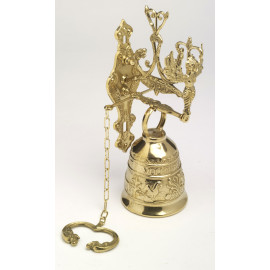
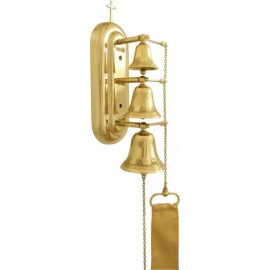
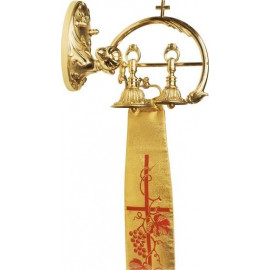
In most parishes the bells are rung by an altar server, standing at the credence table or on the altar step, with the bells within easy reach. In larger churches the bells may hang on the wall of the sanctuary and be rung by a cord or sash.
Practical points for servers:
- Hold, don't shake. A firm, controlled ring — three distinct strikes with a small pause — sounds far more reverent than a frantic jangle.
- Watch the priest, not the congregation. Ring when he elevates; do not anticipate.
- Practice the motion before Mass. Check that the handle is secure and that the bell can be heard clearly from the back of the church.
- Keep quiet between rings. The bell is a signal, not an accompaniment — the silence between the rings is part of the effect.
If you are training new servers, our guide to training altar servers covers the whole routine.
When the Bells Fall Silent
From the Gloria of the Mass of the Lord's Supper on Holy Thursday until the Gloria of the Easter Vigil, the bells are silent — the Church's way of marking the mourning of the Paschal Triduum. During those days a wooden clapper, the crotalus, may be used in place of the bells, most famously at the Good Friday liturgy. The bells return with the Gloria of the Easter Vigil, ringing out as a sign of the Resurrection.
In some places local custom also keeps the bells silent through Advent as a mark of restraint; where this is observed, the bells sound again at the Gloria of Midnight Mass on Christmas Eve. This is a custom, not a requirement.
Bells at Benediction and Eucharistic Adoration
Bells are also used outside Mass: a single bell is often struck as the priest lifts the monstrance to bless the congregation at Benediction, and some churches ring a bell to announce the beginning of adoration. The same rule applies as at Mass — the sound is there to draw attention to the Blessed Sacrament.
Bell or Gong?
In larger churches, a hand bell may not carry to the back of the nave. Many sacristans solve this with a church gong, struck with a wooden mallet — deeper, longer, and audible throughout a large building. Some parishes use both: bells for the consecration and a gong for processions and adoration. See our altar bells and church gongs for the full range.
Quick Checklist for Sacristans
- Bells clean, handle secure, reachable from the server's position
- Pattern confirmed with the celebrant (single, triple, or continuous)
- Server briefed on the epiclesis signal and both elevations
- Triduum: bells removed or silent; crotalus ready if used
- Bells stored safely — lacquered brass needs only a dry cloth, never water or chemicals
Frequently Asked Questions
Q: When exactly do you ring the bells at Mass?
A: A single signal shortly before the consecration — usually at the epiclesis, when the priest extends his hands over the gifts — and then three times at the elevation of the host and three times at the elevation of the chalice. The exact pattern follows local custom.
Q: How many times are the bells rung at Mass?
A: The most common pattern is three rings at each elevation, plus one signal before the consecration. Some parishes ring once per elevation, and before 1970 the bell was rung continuously during the Sanctus at Low Mass.
Q: Who rings the bells at Mass?
A: Usually an altar server, standing at the credence table or altar step. In churches with wall-mounted bells, the sacristan or a server rings them from the wall by a cord or sash.
Q: Why are the bells not rung during Holy Week?
A: The Church silences the bells from the Gloria of Holy Thursday until the Gloria of the Easter Vigil to mark the sorrow of the Triduum. A wooden crotalus may take their place.
Q: Do you need bells for a private Mass or a small chapel?
A: No — bells are customary "if appropriate," and a single small bell is enough for a chapel or private Mass. Browse our sanctuary bells for single bells, three-bell sets and sashes.
Conclusion
When to ring the bells comes down to three moments: the signal before the consecration, the elevation of the host, and the elevation of the chalice — three clear rings, unhurried, then silence. Learn the local custom, keep the bells within reach, and let the sound do its work: pointing everyone in the church to the altar at the very moment when heaven touches earth.
Shop our full collection of sanctuary bells and altar bells, and read more in our guides to the meaning of the altar bells and the types of altar bells.