A ciborium and a pyx are both vessels for the Blessed Sacrament, but they are not interchangeable. The ciborium is the large, lidded cup that holds the consecrated hosts at Mass and reserves them in the tabernacle; the pyx is a small, flat, closable case used to carry a few hosts to the sick and the homebound. If you are choosing between them — or need both — this guide explains what each vessel is for, how they differ, and how to choose well. You can browse our full liturgical ciboria and Catholic pyxes at any point.
What Is a Ciborium?
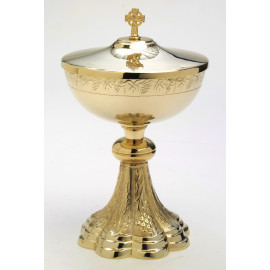
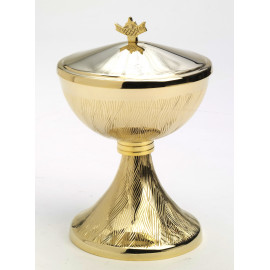
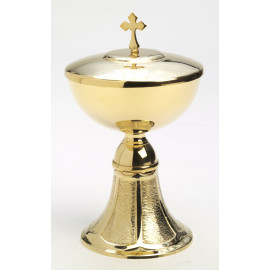
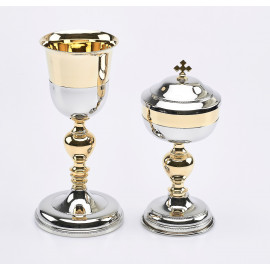
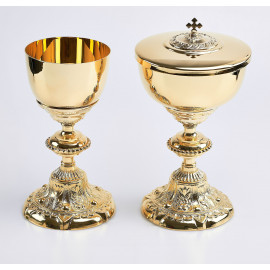
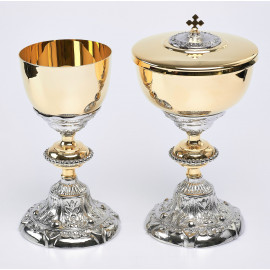
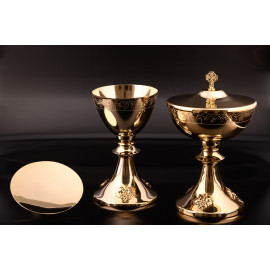
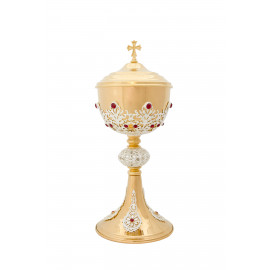
A ciborium is the wide, lidded vessel that holds the hosts which will be consecrated and distributed at Mass. Its defining feature is the fitted lid, usually topped with a cross, which protects the hosts and allows the vessel to be placed in the tabernacle afterwards with the remaining Blessed Sacrament. Because it touches the Eucharist, the inside of a ciborium is always gold- or silver-plated — the Church requires that the interior of a vessel holding the Blessed Sacrament be precious metal.
Ciboria range from mini models of about 11 cm, which hold a few dozen hosts for a weekday Mass, to large concelebration ciboria of 30 cm and more, which hold several hundred hosts for cathedral liturgies. Our ciborium collection spans that entire range, from $87 to $1,597.
What Is a Pyx?
A pyx is a small, round, flat container — typically 5 to 10 cm across, with a screw or snap lid — in which the Blessed Sacrament is carried outside the church, above all to the sick and the homebound. It is also used when a few hosts are brought to adoration outside Mass. A pyx usually holds from one host up to about ten; larger versions exist, but carrying many hosts is not their purpose. Because the pyx touches the Eucharist, its interior is also gold- or silver-plated, and it is often carried inside a small burse or case for protection and reverence.
The word comes from the Greek pyxis, a box — traditionally a box of boxwood, which is what the wood's name means. In older liturgical books a small ciborium used for the sick was sometimes called a pyx, which is why the two names still get confused. Browse our pyxes for Communion to the sick.
Key Differences at a Glance
| Ciborium | Pyx | |
|---|---|---|
| Purpose | Holds the hosts at Mass; reserves them in the tabernacle | Carries a few hosts to the sick or homebound |
| Capacity | 20 to 600+ hosts, by size | 1 to about 10 hosts |
| Shape | Wide cup with stem, base and cross-topped lid | Small flat round box, often with a ring |
| Where it is used | Altar and tabernacle | Outside the church — sick calls, processions |
| Who handles it | Priest, deacon, acolyte, commissioned minister | Priest, deacon, or extraordinary minister of Communion |
When the Church Uses Each Vessel
At Mass the hosts of the congregation are consecrated and distributed from the ciborium. What remains is placed in the tabernacle inside the ciborium or a larger custody vessel, and a lamp burns before it day and night. When Communion must be brought to someone who cannot come to church — the sick, the homebound, the dying — the priest or minister takes the Blessed Sacrament in a pyx. When the viaticum, the final Communion of a Christian's life, is administered, the pyx is the vessel that carries it.
Where the need is larger — a hospital round, a nursing home with several communicants, a priest carrying hosts to many rooms — a field ciborium may be used instead: a flat, secure vessel with a screw or magnetic closure that holds more than a pyx while remaining easy to carry. You will find these in our ciborium collection alongside the field models and custodies.
Can a Pyx Be Used at Mass?
No. At Mass the hosts are consecrated and distributed from a ciborium or from the paten; the pyx is not used for the distribution of Communion at Mass. It may, however, be placed on the altar before Mass so that the hosts it contains — or will contain — are consecrated together with the rest; after Communion they are placed in the pyx, which is opened only over a corporal so that no fragment of the Blessed Sacrament is lost. In practice, sacristans prepare the pyx for the hosts intended for the sick, and the priest or deacon fills it during Mass.
How to Choose a Ciborium and a Pyx
Choose the ciborium by the size of your congregation: a mini or small ciborium (20–50 hosts) for weekday Mass in a chapel, a standard model (50–150) for ordinary parish Masses, and a large or concelebration ciborium (150–600+) for Sunday crowds and cathedral liturgies. Check the lid fit and the stability of the base — a snug lid and a wide foot matter more than ornament.
Choose the pyx by how it will be carried and how many hosts it must hold: a slim pocket pyx for a single host, a larger round pyx for a small sick-call round. A screw lid is safer than a friction lid when the pyx travels. If your parish serves many homebound communicants, consider a pyx and a field ciborium together — and browse our ciboria and pyxes to compare sizes and prices.
Frequently Asked Questions
Q: What is the difference between a pyx and a ciborium?
A: A ciborium is a large, lidded cup that holds the hosts at Mass and reserves them in the tabernacle; a pyx is a small flat case that carries a few hosts to the sick. The ciborium stays in church; the pyx travels.
Q: Can you put a pyx inside a ciborium?
A: A pyx is not normally placed inside a ciborium. The hosts intended for the sick are usually consecrated at Mass and placed in the pyx afterwards, while the remaining hosts are reserved in the ciborium or custody in the tabernacle.
Q: How many hosts does a pyx hold?
A: A typical pyx holds from one host to about ten. Larger pyxes exist for hospital rounds, but when many hosts must be carried, a field ciborium with a secure closure is the better choice.
Q: Does a pyx need to be blessed?
A: Yes. Like the ciborium, the pyx is a sacred vessel destined to hold the Eucharist, and it should be blessed before use. Any priest can bless it; many parishes ask the bishop to bless larger sets of vessels.
Q: What is a field ciborium?
A: A field ciborium is a flat, secure lidded vessel for carrying the Blessed Sacrament outside church — to the sick, to hospitals, or in processions. It is larger than a pyx but more portable than a standard ciborium, and usually closes with a screw or magnetic catch.
Conclusion
Ciborium or pyx is not a choice between two versions of the same thing: one serves the altar and the tabernacle, the other serves the sick and the homebound. Most parishes need both, and most sacristies end up with several ciboria of different sizes. Our liturgical ciboria and pyxes cover every size in between; for deeper reading, see our guide to chalice vs. ciborium and the complete guide to Catholic altar vessels.