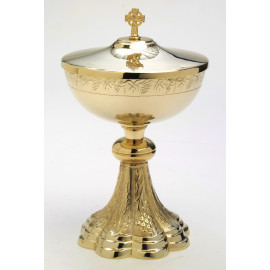
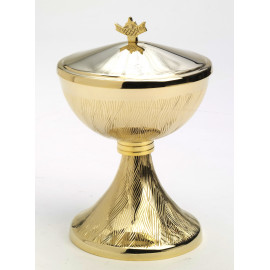
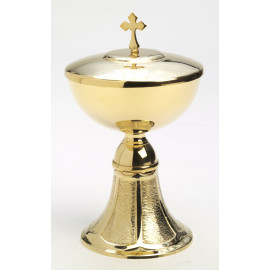
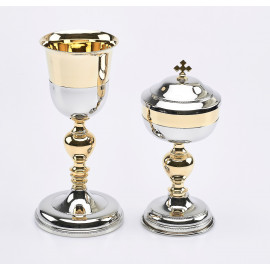
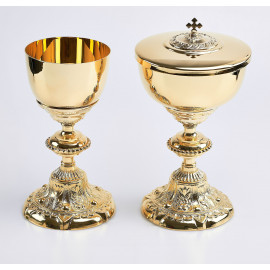
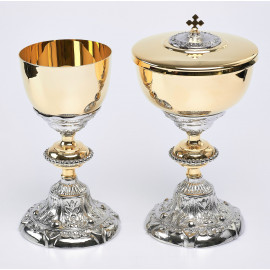
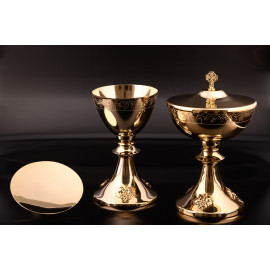
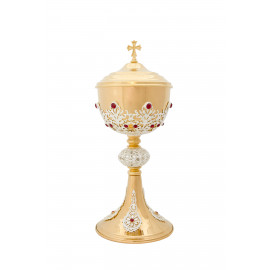
Every ciborium, from the plainest brass vessel to an engraved Maltese piece, has the same six parts: the bowl (or cup), the lid, the knob, the nodus, the stem, and the base. Each one has a job, and each one is worth checking before you buy — a snug lid and a stable base matter more to daily sacristy life than any ornament. This guide walks through the anatomy of a ciborium part by part, and ends with the checklist we use in our own workshop. Browse the ciborium collection to see each part in detail on real products.
The Bowl (Cup)
The bowl is the wide, shallow interior that holds the consecrated hosts. It is the only part of the ciborium that touches the Eucharist, which is why its inside is always gold- or silver-plated: the Church requires that the interior of a vessel holding the Blessed Sacrament be precious metal. The bowl's diameter sets the capacity — roughly 20–50 hosts at 11–14 cm, 50–150 at 14–18 cm, 150–600 at 19–26 cm — while its depth affects how the hosts lie. A deeper bowl protects the hosts from the lid and holds more without crowding; a shallow, very wide bowl is easier to distribute from when several ministers assist.
The Lid and Its Cross
The lid is the ciborium's defining feature — the part that distinguishes it from a chalice — and its job is protection: it keeps dust, insects, and anything else out of the vessel and lets the ciborium be placed in the tabernacle with the Blessed Sacrament inside. Most lids carry a cross on top, either as a simple raised cross or as an ornate finial. The critical quality is fit: the lid should sit snugly without wobbling, so that it can be lifted and replaced with one hand during distribution, and so that it does not rattle in procession. A loose lid is the most common defect in cheap ciboria, and the first thing to test on any model.
The Knob
The knob is the small grip at the centre of the lid. It exists for a practical reason: it lets the priest or deacon lift the lid without touching the rim, which is both more dignified and more hygienic during the distribution of Holy Communion. A good knob is large enough to grip with thumb and forefinger even when hands are occupied with a purificator, and smooth enough not to catch on vestments. On many ciboria the knob doubles as the base of the lid's cross.
The Nodus
The nodus is the decorative node on the stem — the bulge between bowl and base. Like the knob on the lid, it is a grip: it gives the celebrant a firm, secure hold on the ciborium while moving along the Communion line, and it is the point from which the vessel is naturally carried. Nodi are often the most ornamented part of a ciborium, with engraving, knurling, or cast motifs; the same feature appears on chalices for the same reason. When you hold a ciborium, the nodus should fall naturally into your grip — if you find yourself holding the bowl or the base instead, the proportions are off for your hand.
The Stem
The stem is the vertical shaft connecting the bowl to the base. Its height sets how the ciborium stands on the altar and how it feels in the hand: a taller stem suits a celebrant who distributes Communion standing, a shorter one keeps a large ciborium visually lower and more stable. The stem also carries the weight between the two working ends of the vessel, so its proportions decide whether a ciborium feels balanced when full or tips toward the bowl. In our ciborium collection, stems run from the short, sturdy shafts of the mini ciboria to the tall, slender stems of the cathedral models.
The Base
The base is the wide foot that keeps the ciborium stable on the altar, the credence table, and the tabernacle shelf. Stability is a liturgical virtue here: a ciborium that tips during the distribution of Communion risks spilling the Blessed Sacrament, so the base should be wide relative to the bowl and heavy enough that the vessel does not move when the lid is lifted one-handed. Bases range from simple flared feet to multi-lobed Gothic and Baroque forms; whatever the style, set the ciborium down on a hard surface before buying and press the rim lightly — it should not rock.
What to Check Before Buying
- Lid fit — no wobble, no rattle; it should seat with a soft, firm contact.
- Base stability — press the rim; the vessel must not tip or rock.
- Interior plating — gold or silver, uniform, with no thin patches at the rim.
- Grip points — knob and nodus must be comfortable for the hands that will use them daily.
- Weight — heavy enough to feel secure, light enough to carry through a full Communion line.
- Matching set — if the parish is buying chalices or patens at the same time, choose the same finish for a unified altar.
Frequently Asked Questions
Q: What are the parts of a ciborium called?
A: The six parts are the bowl (cup), the lid, the knob on the lid, the nodus (the node on the stem), the stem, and the base. The bowl, stem, nodus and base are usually one cast or spun piece; the lid is separate.
Q: Why does a ciborium have a knob on the lid?
A: The knob lets the lid be lifted and replaced without touching the rim of the vessel that holds the Blessed Sacrament. It also serves as the mount for the cross that crowns most ciborium lids.
Q: What is a nodus on a ciborium?
A: The nodus is the decorative node on the stem, midway between bowl and base. It is a grip: it gives the priest a firm, secure hold while carrying the ciborium and distributing Holy Communion. Chalices have the same feature.
Q: Does the lid of a ciborium have to fit tightly?
A: It should seat snugly without wobbling. A tight fit keeps dust out, protects the hosts, and allows the lid to be handled one-handed during Communion. A lid that rattles or sits loose is a sign of poor workmanship.
Q: Can a worn ciborium be repaired or replated?
A: Yes. Worn gold or silver plating can be restored by a specialist in sacred vessels, and a bent lid can be re-seated. If the plating of the interior — the part that touches the Eucharist — is worn through, have the piece replated before further use.
Conclusion
Bowl, lid, knob, nodus, stem, base: six parts, one purpose — to hold the Blessed Sacrament with reverence and to be handled with ease every day of the parish year. Judge a ciborium by how its lid seats and how its base stands before you judge its ornament. Every model in our liturgical ciborium collection is checked on exactly these points, and the complete guide to Catholic altar vessels shows how the ciborium's parts relate to the chalice and paten beside it.