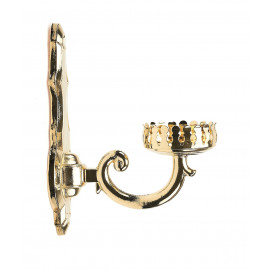
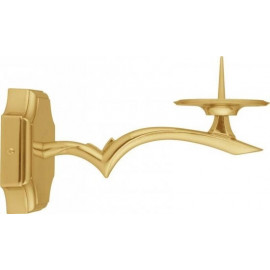
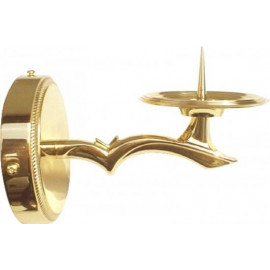
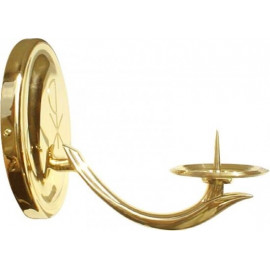
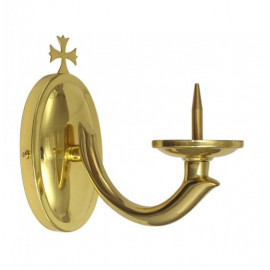
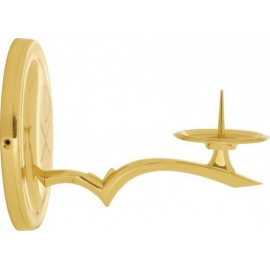
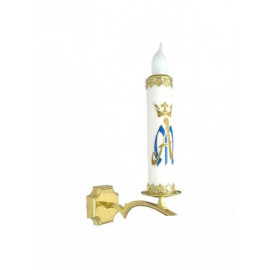
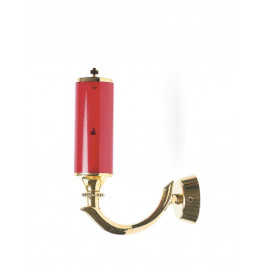
Brass church wall sconces are lacquered — polished at the workshop and sealed with a clear varnish cured at high temperature — which means the golden surface you see today is meant to stay that way for years with almost no care. The single most important rule follows from that: clean the sconce as lacquered brass, not as bare metal.
Why Lacquered Brass Needs Almost No Care
Bare brass tarnishes: it reacts with air, moisture and skin and slowly dulls from gold to brown. Polishing removes the tarnish — and a little of the metal with it. Lacquered brass, by contrast, is protected by a clear coat, so the shine survives without polishing. Our church wall lamps, like our altar candlesticks, are finished this way, and the same rules apply to all of it.
What You Need (Almost Nothing)
- A dry cotton cloth, microfiber cloth or other dry, dust-absorbing cloth.
- A soft brush with natural bristles for the corners of the casting.
- A plastic card or wooden toothpick for hardened wax.
That is the complete kit. No brass polish, no soap, no water, no ammonia, no vinegar, no ultrasonic cleaner.
Step by Step
1. Dust the sconce with the dry cloth — backplate first, then the arm and the candle cup. 2. Reach into the hollows of the casting with the soft brush; dust collects where the fingers cannot go. 3. Wipe once more with a clean part of the cloth until no film remains. 4. Check the candle socket and remove any wax crumbs so the next candle sits straight.
That is the whole routine, and for most churches doing it twice a year — before the great feasts — is plenty. Sconces in the sacristy or near the entrance, where hands touch them more, may want a monthly dusting.
Removing Candle Wax Safely
Wax drips are the one thing that really happens to a wall sconce. Let the wax harden completely — do not wipe it while warm, or you will smear it into the lacquer. Then lift the edge with a fingernail, a plastic card or a wooden toothpick and peel it away. If a thin film remains, warm it gently with a hairdryer on low and blot it with a paper towel — never scrape with metal, and never use a knife. For wax on fabrics and altar linens, see our cleaning guide for brass and church textiles.
What Not to Do
- No metal polish or tarnish remover. It strips the lacquer and exposes bare brass, after which the sconce will tarnish and need polishing forever.
- No water, no damp cloths. Water can seep under the lacquer at the edges and start corrosion.
- No chemical fluids, alcohol or ammonia-based cleaners. They attack the clear coat.
- No dishwasher, ever — even if the sconce comes off the wall easily.
- No abrasive pads or steel wool. They scratch the finish permanently.
When the Lacquer Ages
Lacquer is not eternal. After decades, or in a church with strong temperature swings, it may develop a cloudiness, small cracks or dark spots where moisture got underneath. At that point you have two good options: leave it — a church sconce with the patina of decades is not a fault — or send it to a workshop for re-polishing and re-lacquering, which restores the original finish. What you should not do is polish the worn spots locally; the result is a patchwork of shiny and dull.
Sconces in Damp Spaces
Baptisteries, crypts and entrances can be damp, and damp is the enemy of both lacquer edges and bare brass. Keep sconces in such spaces dusted and dry, avoid splashing them during cleaning of the building, and check them once a year for cloudy spots. If your church has serious humidity problems, choose the electric version of the sconce for those walls — no candle handling near water, and less reason for hands to touch the finish.
Frequently Asked Questions
Q: Can I use brass polish on lacquered sconces?
A: No. Brass polish is abrasive and will strip the clear lacquer, leaving bare metal that tarnishes. Lacquered brass is cleaned with a dry cloth only.
Q: How do I remove candle wax from a brass sconce?
A: Let the wax harden, then lift it off with a fingernail, plastic card or wooden toothpick. For a thin film, warm it gently with a hairdryer and blot with paper towel. Never scrape with metal.
Q: How often should church wall sconces be cleaned?
A: Twice a year — before the great feasts — is enough for most sconces. Dusting monthly helps in sacristies and entrances where hands touch the fixtures.
Q: The lacquer on my old sconce is cloudy. Can I fix it?
A: Cloudy or cracked lacquer cannot be spot-fixed; polishing one area creates a patchwork. Either keep the aged patina, which many churches prefer, or have the piece professionally re-polished and re-lacquered.
Q: Can I clean the sconce while it is still on the wall?
A: Yes — dry dusting needs no dismounting. Only remove the sconce if the mounting itself needs service, and have an electrician handle any electric model.
Related Reading
See our brass church wall lamps, the companion guide to cleaning brass altar candlesticks, and how to set up a Catholic church sanctuary.