




Setting up a Catholic church sanctuary is one of the most important projects a parish can undertake. The sanctuary is the focal point of the liturgy — where the altar, ambo, tabernacle, and presidential chair are located. Here's a complete guide to getting it right.
The Essential Elements
| Element | Requirement | Notes |
|---|---|---|
| Altar | Fixed, made of natural stone, consecrated | GIRM 298 |
| Ambo | Dignified, permanent, suitable for proclaiming the Word | GIRM 309 |
| Tabernacle | Noble, prominent, readily visible, suitable for prayer | GIRM 314 |
| Presidential chair | Signifies the priest's role as presider | GIRM 310 |
| Crucifix | On or near the altar | GIRM 308 |
| Candlesticks | At least 2 for Mass, more for solemn celebrations | GIRM 117 |
| Sanctuary lamp | Required near the tabernacle | Canon 940 |
Layout and Placement
The altar should be freestanding (not against the wall) so the priest can walk around it. The ambo should be prominent and visible to the congregation. The tabernacle should be in a prominent location but not on the altar used for Mass (GIRM 315).
The Tabernacle and the Sanctuary Lamp
The tabernacle is where the Blessed Sacrament is reserved between liturgies — the heart of the church even when Mass is not being celebrated. Canon 940 requires a special lamp to burn continuously before it: the sanctuary lamp. The lamp should be placed so it is clearly visible to anyone entering the church, traditionally in front of or beside the tabernacle, with a red glass globe. If you are choosing one, our guides cover what a sanctuary lamp is and why every church has one, how to hang a hanging sanctuary lamp, and when to choose an electric lamp.
Candles and Lighting
GIRM 117 requires at least two candles on or near the altar for Mass, and more for solemn celebrations — four or six, with six used when the bishop celebrates. Choose candlesticks that match the sanctuary's style so the altar reads as one composition. The Paschal candle, blessed at the Easter Vigil, stands in a prominent position in the sanctuary throughout Eastertide and is lit at baptisms and funerals; place its stand so it can be reached easily without crowding the altar. Browse altar candlesticks and candelabra.
Sacred Vessels and Linens
Every sanctuary needs a complete set of sacred vessels: a chalice and paten for the bread and wine, one or more ciboria for the hosts, and a monstrance if the parish celebrates Eucharistic adoration or Benediction. The altar itself is dressed with an altar cloth and, on the altar, a corporal, purificators, and a chalice veil in the color of the day. Keep vessels in a locked sacristy cupboard between liturgies.
Bells, Incense, and Sound
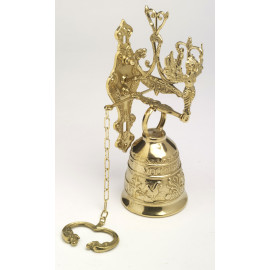
Sanctuary bells mark the consecration and add solemnity to processions — a set of sanctuary bells at the credence table is standard in most parishes. If the parish uses incense, plan for a thurible, boat, and spoon, plus storage for charcoal and incense that keeps the sacristy tidy. Both should be chosen with the sacristan's daily routine in mind.
A Practical Setup Checklist
- Confirm the diocesan requirements and any faculty needed before construction or reordering.
- Altar: fixed, consecrated, freestanding where possible (GIRM 298).
- Ambo: dignified and permanent, positioned for proclamation (GIRM 309).
- Tabernacle: noble, prominent, readily visible, not on the altar used for Mass (GIRM 314–315).
- Sanctuary lamp: burning continuously near the tabernacle (Canon 940).
- Candles: at least two, matched to the sanctuary's style (GIRM 117).
- Vessels and linens: chalice, paten, ciboria, monstrance (if used), corporals, purificators, veils.
- Bells and thurible: available and in good repair.
- Storage: locked sacristy cupboards for vessels, vestments, and supplies.
What I Recommend
Work with a liturgical consultant or architect who understands Catholic worship spaces. Not every architect does. Review the GIRM before making any decisions, and get diocesan approval before starting construction.
Frequently Asked Questions
Q: Can the tabernacle be on the altar?
A: The GIRM (315) recommends that the tabernacle not be on the altar used for Mass. It should be in a separate, prominent location — often a side chapel or a dedicated alcove.
Q: Where should the sanctuary lamp be placed?
A: Near the tabernacle, and clearly visible from the nave and the main entrance — traditionally directly in front of or beside it. Canon 940 requires that it burn continuously while the Blessed Sacrament is reserved; a red glass globe is the traditional choice. See our guide to what a sanctuary lamp is and browse the sanctuary lamp collection.
Q: How many candles should be on the altar?
A: At least two for Mass (GIRM 117), four or six for solemn celebrations, and six when the bishop celebrates. Use candlesticks that match the sanctuary's style and keep them clear of the altar's working surface.
Q: What vessels are needed for Mass?
A: At minimum a chalice and paten, ciboria for the hosts, cruets for water and wine, a lavabo set, and the linens — corporal, purificators, and finger towel. Parishes that celebrate adoration also need a monstrance, and a pyx for taking Communion to the sick.
Conclusion
A well-designed sanctuary serves the liturgy beautifully. Plan carefully, follow the Church's guidelines, and create a space that draws the faithful into the mystery of the Eucharist.
Browse our collection of sanctuary furnishings — altar vessels, sanctuary lamps, crucifixes, and candlesticks. For the details, see our guides to hanging sanctuary lamps, electric sanctuary lamps, and home sanctuary lamps.