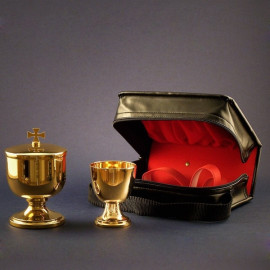


A travel Mass kit should open ready for Mass after any journey. The packing method is simple: heavy vessels first and centered, each wrapped so metal never touches metal; bottles upright and bagged; linens folded flat in the lid; and the stole on top, so the first thing a priest sees is the vestment he needs. Packed this way, a kit survives car trunks, overhead bins, and mission trails.
Before You Pack: Inventory and Inspection
Start with a dry run. Open the case, lay everything out, and check the inventory: chalice, paten, pyx, ciborium (if the set has one), cruets or bottles, corporal, purificator, pall, stole, oil stocks, sprinkler, and candles. Wipe each vessel with a soft cloth, check that the pyx closes firmly, and make sure nothing rattles loose in its slot. Five minutes before the trip prevents most travel damage.
Step 1: Pack the Heavy Vessels First
Load the chalice and ciborium into their fitted slots or the center of the case first - this keeps the weight low and central. If the case has removable trays, put the heaviest tray at the bottom. Never stack a chalice on top of a pyx, and never place vessels where the case lid will press on them when closed.
Step 2: Wrap the Chalice and Paten
Wrap the chalice cup in a soft cotton or flannel cloth, and lay the paten against a cloth surface rather than against another metal piece. The pall, if the set includes one, protects the chalice cup from the lid. For suede and leather cases, a cloth wrap is still worthwhile: leather can hold grit that scratches gold plating over years of travel.
Step 3: Bottles, Oils, and the Sprinkler
Fill wine and water bottles only about three-quarters full, close them tightly, and bag them - a zip pouch or a dedicated bottle pocket - so that any seepage stays away from linens and metal. Oil stocks travel closed and upright, ideally in their own compartment; the sprinkler goes in empty and dry. Pressure changes in flight can force liquid out of a full bottle, which is the most common packing accident in a Mass kit.
Step 4: Linens in the Lid
Fold the corporal flat - it should never be crumpled, because creases set in storage and it must lie flat on the altar or table. The purificator, finger towel, and any small tablecloth go on top of it. Linens must be completely dry before packing; damp linen in a closed case is how mildew starts. The lid tray or the top layer of the case is the right place for them.
Step 5: The Stole and Vestments on Top
Roll the stole rather than folding it sharply, and place it on top of the linens - it is the first thing the priest puts on and the last thing he needs from the case. In larger celebrant's suitcases, the alb or vestment set folds into the lid compartment, and the breviary goes in its slot if the case has one.
Traveling by Car, Train, and Plane
Sacred vessels are ordinary personal items as far as carriers are concerned: a travel Mass kit can go in carry-on or checked luggage. Empty the wine and water bottles before flying, and use a lockable case if it travels in checked baggage. In a car, keep the case out of direct sun and out of a hot trunk - wax candles soften and linens yellow in heat. For everyday hospital rounds, a compact sick call bag with just the pyx, stole, and oils is easier to carry than a full case.
After the Journey: Unpack and Reset
Unpack the same day. Air the case open for a few hours, check the linens for dampness, and wipe the vessels. Top up the oil stocks, replace used candles, and return the kit to its storage spot - a dry cabinet or sacristy shelf, not a damp basement. Once a quarter, do a full inventory so nothing is missing when the phone rings at night.
Frequently Asked Questions
Q: How do you keep a chalice from tarnishing in a case?
A: Keep the chalice dry, wrap it in soft cloth (never plastic, which traps moisture), and avoid leaving the case in damp rooms or hot cars. A silica gel packet in the case helps in humid climates.
Q: Can you fly with a travel Mass kit?
A: Yes. Sacred vessels and linens travel normally in carry-on or checked baggage. Empty the wine and water bottles before the flight, and use a lockable case if the kit goes in checked luggage.
Q: What if the wine or water bottle leaks?
A: Carry bottles upright, filled only about three-quarters full, in a sealed pouch or their own pocket. If a bottle leaks, wash and dry the case lining before storing the vessels again.
Q: How often should you repack a Mass kit?
A: Check it before every trip and do a full inventory once a quarter: linens clean and folded, oils topped up, hosts fresh, vessels free of tarnish.
Q: Can hosts be kept in the pyx between visits?
A: Consecrated hosts are normally carried from the church directly to the sick, and any that remain are returned to the tabernacle. Do not store hosts in a pyx overnight unless your diocese directs otherwise.
Ready-Made Kits and Cases
If you would rather start from a fitted set, browse our travel Mass kits - 34 cases from $137, from compact sick call kits to complete celebrant's suitcases with dedicated slots for every vessel and linen. Free shipping over $100.