

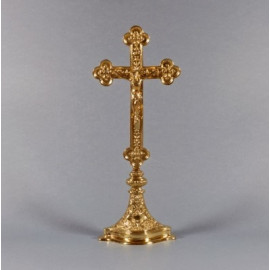
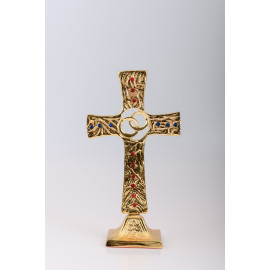
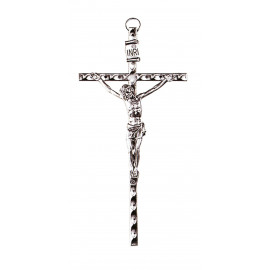
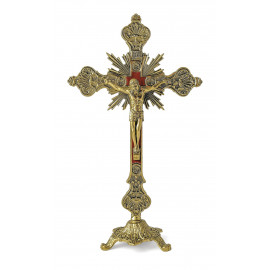

An altar cross is the one furnishing every visitor sees during Mass — and the one most often chosen by eye alone. But there are three things to get right before style: the rubric (it should carry the corpus), the size (it must read from the back of the church), and the finish (it must survive decades of incense, candle smoke, and cleaning). This guide walks through all three.
What the Church Requires
The General Instruction of the Roman Missal (no. 117) is short and specific: "there is also to be a cross, with the figure of Christ crucified upon it, either on the altar or near it, and it is to be clearly visible to the assembled congregation." Three practical consequences:
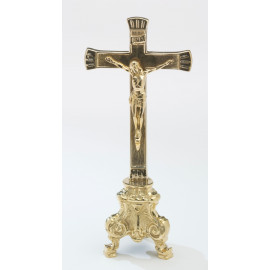
- It should be a crucifix — a cross with the corpus, not a bare cross.
- On the altar or near it — on the altar itself, behind it, or beside it; all three arrangements are found.
- Clearly visible — visibility is a rubric, not a preference. A small cross lost behind a floral arrangement fails the instruction's intent.
Sizing: How Big Should an Altar Crucifix Be?
Visibility drives the size. A useful rule of thumb for parish churches:
- Small chapels and oratories: 20–30 cm crucifixes read clearly; a 26 cm crucifix with matching candlesticks makes a complete arrangement.
- Parish churches: 39 cm to 60 cm is the common working range; the cross should be proportionate to the altar mensa and visible from the last pew.
- Large churches and cathedrals: 60 cm and up, often suspended or placed high behind the altar.
As a check, stand at the back of the nave and look at where the cross will stand. If you cannot identify the corpus, it is too small for the space.
Cross or Crucifix on the Altar?
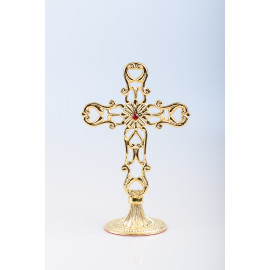
A crucifix — the corpus matters here. A bare cross may be beautiful, and plain altar crosses are still sold and used, but the Missal's wording asks for "the figure of Christ crucified." When both are present in a sanctuary, the crucifix belongs on or near the altar; a bare cross works well on a wall, above a doorway, or in a procession. The full distinction is explained in Cross vs Crucifix.
Matching the Altar: Style and Finish
- Gilded and polished brass — the classic pairing with marble and stone altars; warm under candlelight, easy to keep clean.
- Oxidized gold and silver — a deliberate aged finish; it reads as antique and hides fingerprints well. A good choice for wooden altars and traditional interiors.
- Wood with metal inlay — warmer and quieter; suits simple chapels and home oratories.
- Proportion: a heavy stone altar carries a substantial brass set; a light wooden altar is overwhelmed by it. Match visual weight, not just height.
Altar Sets and Candlesticks
Many parishes pair the crucifix with candlesticks flanking it. If you are buying both, a matched set saves you from hunting for a compatible style and finish later: our altar crucifix with two candlesticks (26 cm gilded brass) is exactly that, and our altar candlesticks collection covers the standalone options. A missal stand completes the sanctuary arrangement.
For Chapels, Offices, and Home Oratories
Smaller spaces follow the same logic at a smaller scale: a 26–32 cm crucifix on the altar or credence table, or a standing crucifix with a base where the altar is used for private prayer. For a home oratory, a standing crucifix (19–32 cm) on the prayer table, with a small candle, is the classic arrangement — see How to Set Up a Home Altar.
Frequently Asked Questions
Q: What is an altar crucifix?
A: A crucifix placed upon or near the altar, where it is often the principal ornament. Per GIRM 117 it bears the figure of Christ crucified and must be clearly visible to the congregation.
Q: What is the cross on the altar called?
A: It is called an altar cross, or an altar crucifix when it carries the corpus. It stands at the center of the altar or near it, often flanked by candlesticks.
Q: How big should an altar crucifix be?
A: Large enough that the corpus is clearly visible from the back of the church. In practice: 20–30 cm in chapels, 39–60 cm in parish churches, 60 cm and up in large churches.
Q: Does the altar cross have to be a crucifix?
A: The Missal asks for a cross "with the figure of Christ crucified upon it" (GIRM 117), so a crucifix is the form that fulfills the instruction in substance.
Q: Can an altar cross be placed behind the altar?
A: Yes — GIRM 117 allows the cross "either on the altar or near it." Behind, beside, or on the altar are all legitimate arrangements as long as it is clearly visible.
Q: How much does an altar crucifix cost?
A: In our collection, altar-grade crucifixes run from $290 for a gilded 26 cm crucifix with two candlesticks to $484 for a 39 cm solid brass altar cross. Browse the collection.