
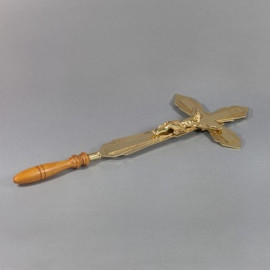

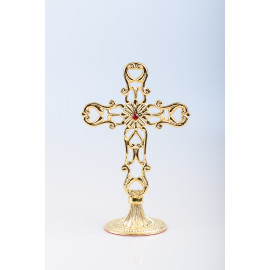
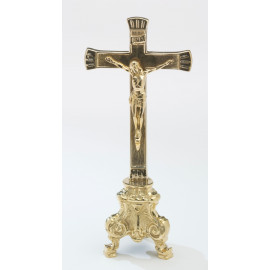

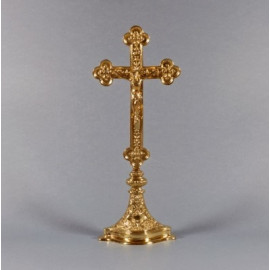
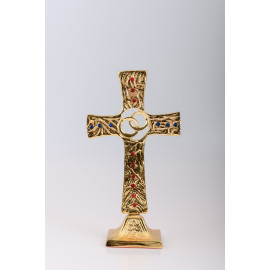
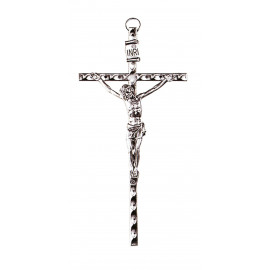
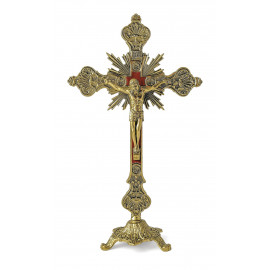

A crucifix is a cross with the figure of Christ on it; a cross is the shape alone, without the corpus. That is the difference in one sentence. Both are central Catholic symbols, both are used in worship and devotion, and the Church actually asks for both in different places — but the distinction matters for how each is used, displayed, and understood.
What Exactly Is a Crucifix?
The word comes from the Latin cruci fixus — "(one) fixed to a cross." A crucifix, then, is a cross that carries the corpus: the sculpted or painted figure of Jesus crucified. Almost always the corpus is topped with the INRI plaque — the Latin Iesus Nazarenus Rex Iudaeorum, "Jesus the Nazarene, King of the Jews" — the title Pilate had fastened to the cross (John 19:19).
The crucifix is a portrait of the Passion. It does not merely say that Christ died; it shows who died and how. That is why it holds such a central place in Catholic devotion: it is the sacrifice of Calvary made visible in the middle of daily life.
What Is a Plain Cross?
A plain cross — sometimes called a bare cross — is the instrument itself, without the figure. It is the older and simpler symbol, the sign Christians have used since the earliest centuries. When you see a bare cross, the emphasis usually falls on the Resurrection and the victory over death: the tomb is empty, the cross stands as a sign of triumph rather than suffering.
Many designs qualify: the Latin cross (the standard Western shape with a longer lower arm), the Greek cross (four equal arms), the Celtic cross with its ring, the Maltese cross, the Tau cross of the Franciscan tradition. You can see many of these shapes side by side in our guide to the types of Catholic crosses.
Why Catholics Use Both
Catholic worship uses crosses and crucifixes together, in different roles:
- On and near the altar, the Church asks specifically for a crucifix. The General Instruction of the Roman Missal (no. 117) directs that "there is also to be a cross, with the figure of Christ crucified upon it, either on the altar or near it" — clearly visible to the congregation. The crucifix keeps the sacrifice of the Mass visually connected to the sacrifice of Calvary.
- In processions, on vestments, and in blessing, the bare cross frequently appears: processional crosses, the cross embroidered on a chasuble, the small crosses of blessing gestures. Here the cross functions as a sign of Christian identity and triumph.
- In the home, both are traditional: a crucifix above the bed or doorway, a simple cross as wall art or gift.
So the choice is rarely "either-or." The question is usually which one is right for a specific place — and on the altar, the answer is a crucifix.
Cross vs Crucifix at Home: Which Should You Hang?
The strongest Catholic tradition is a crucifix — in the bedroom, above a doorway, or in the prayer corner. The crucifix accompanies prayer in a direct way: it is difficult to look at the corpus and remain abstract. A bare cross is equally appropriate as decor or as a gift, especially in designs like the San Damiano or a Celtic cross. Many families have both: a crucifix where the family prays, a cross where the home is decorated. Our guide Where to Hang a Crucifix in Your Home covers the traditions room by room.
Do Catholics Wear a Cross or a Crucifix?
Both are worn. A crucifix necklace is a public witness of faith and a private reminder of the Passion; a plain cross necklace often signals Christian identity in a quieter way. Neither is required, and neither is superstitious — a necklace does not act as a charm, it acts as a reminder. Franciscans have worn the Tau cross on a thong for centuries as their particular sign; small wooden crucifixes with a thong continue that custom.
Cross vs Crucifix: Quick Comparison
| Cross | Crucifix | |
|---|---|---|
| Contains | Two beams, no figure | Cross + corpus (figure of Christ), usually with INRI |
| Emphasizes | Resurrection, victory | Passion, sacrifice, love |
| On the altar | — | Required in substance by GIRM 117 |
| Typical use | Processions, vestments, jewelry, decor | Altar, home prayer, bedroom, doorway |
Ready to choose? Browse our Catholic crosses and crucifixes — altar, standing and hanging crucifixes with the corpus, plus plain crosses — from $4.
Frequently Asked Questions
Q: What is the difference between a Catholic cross and a crucifix?
A: A crucifix includes the corpus, the figure of Christ crucified; a plain cross does not. Both are Catholic symbols — the crucifix emphasizes the Passion, the bare cross the Resurrection.
Q: What is the Catholic crucifix called?
A: It is simply called a crucifix, from the Latin cruci fixus, "(one) fixed to a cross." An altar crucifix is one used on or near the altar.
Q: Why do Catholics use a crucifix instead of a plain cross?
A: Because the crucifix keeps the sacrifice of Christ visible and connects the Mass to Calvary. On and near the altar the Church asks for a cross with the figure of Christ crucified (GIRM 117).
Q: Is it okay for a Catholic to wear a crucifix?
A: Yes. Wearing a crucifix is a long-standing devotion — a witness of faith and a reminder of the Passion — not a requirement and not superstition.
Q: Why do Protestants not use crucifixes?
A: Many Protestant traditions prefer the empty cross to emphasize the Resurrection and to avoid what they see as dwelling on the suffering of Christ. Catholics use both forms, but the crucifix is the standard in Catholic worship spaces.
Q: Is a cross without Jesus still a Christian symbol?
A: Yes. The bare cross has been a Christian sign since the earliest centuries and remains fully Christian; it simply emphasizes the victory of the Resurrection rather than the sacrifice of the Passion.
Browse the collection: Catholic crosses and crucifixes.
