

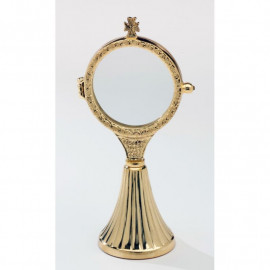
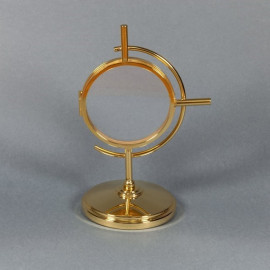
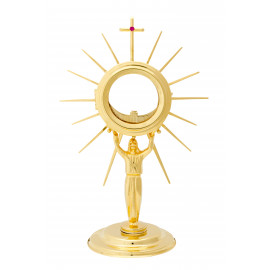
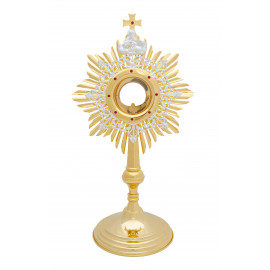
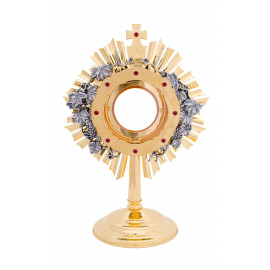
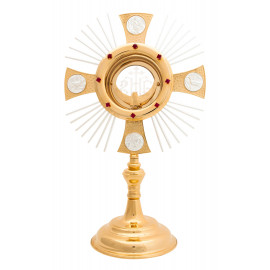
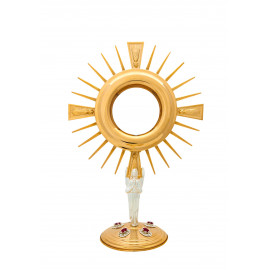
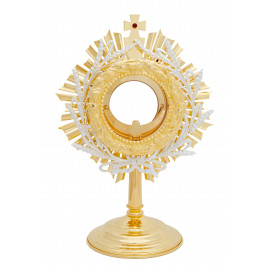
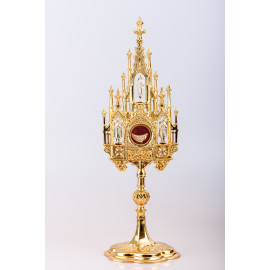
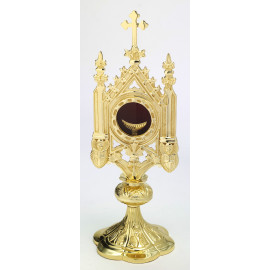
For a Corpus Christi procession, choose a custodia or monstrance that is stable, has a secure lunette, and is tall enough to be seen without being too heavy to carry. The Blessed Sacrament is exposed in the lunette, and the vessel may be carried under a canopy, placed on a tabor at stations, and used for Benediction at the end. The practical details matter as much as the ornament.
Corpus Christi is the feast of the Body and Blood of Christ. In many places the procession takes place on the Thursday after Trinity Sunday, or on the following Sunday. The host is exposed in a monstrance or custodia, and the faithful walk with the Blessed Sacrament through the streets or around the church grounds. The vessel is the visual center of the procession, so it should be dignified, secure and easy to see.
Why the vessel matters
A procession is not the same as static adoration. The vessel is lifted, carried, turned and set down. The lunette must hold the host firmly; the base must be stable; the height must suit the carrier and the canopy. A vessel that is perfect on an altar may be awkward in a procession, and a processional vessel may be too large for a side chapel.
If your parish already has a large monstrance, use it for the main procession and keep a smaller custodia for the side chapel or home oratory. If you are choosing a new vessel, start with the host and the route, then choose the size.
Stability and carrying
Check the base. A broad base — such as the hexagonal base on the 40 cm custody — is more stable than a narrow round base. Check the weight with the lunette and host in place, not empty. A vessel that feels light in the sacristy may feel different after a long walk.
Practice the lift and the turn before the procession. Decide who will carry the vessel, whether gloves will be used, and where the carrier will pause. If the vessel is heavy, use two carriers or a carrying arrangement. Do not improvise a grip on the glass capsule or the lunette.
Lunette and host
The lunette must grip the host securely. An adjustable guide or a track keeps the host centered. Check that the lunette slides smoothly into the vessel and that the glass is secure. If the host can tilt, the vessel is not ready for a procession.
For a large host, use a large-host custodia or a monstrance with a matching lunette. The 36 cm large-host custody in our collection is designed for a larger host; the 21 cm custodia accepts up to 7 cm. Do not force a host into a lunette that is too small.
Height, canopy and tabor
The vessel should be tall enough to be seen from the crowd, but not so tall that it is unstable or difficult to carry. A 36–40 cm custodia is a practical height for many parishes. Check the canopy clearance and the height of the carrier. If the vessel will be placed on a tabor at stations, measure the tabor top and the total height.
A monstrance throne (tabor) gives the vessel a stable platform between stations. Check that the top is level and that the vessel cannot slide. A monstrance veil can cover the vessel when the Blessed Sacrament is not exposed; it is not a substitute for the lunette or the glass capsule.
Veil, weather and practical checks
For outdoor processions, avoid leaving the vessel in direct sun or damp air for long periods. Gold-plated brass is durable, but the glass and the lunette should be checked before and after the procession. Carry a soft cloth for fingerprints and a spare lunette if one is available.
A monstrance veil is used to cover the vessel when the Blessed Sacrament is not exposed. It should be long enough to cover the vessel without dragging, and it should be handled with clean hands. If the procession includes Benediction, check that the veil can be removed easily and that the lunette is secure.
Procession checklist
- Measure the host and confirm the lunette fit.
- Check the glass capsule for chips or cracks.
- Test the weight with the lunette and host in place.
- Practice the lift, turn and set-down.
- Check the tabor top and the canopy clearance.
- Prepare the veil and a soft cloth.
- Assign carriers and a place to pause.
- Check the weather and have a plan for rain or wind.
Frequently Asked Questions
Q: Can a custodia be used for a Corpus Christi procession?
A: Yes, if it is stable and the lunette is secure. A larger custodia or monstrance is usually chosen for a public procession; a mini custodia is better suited to a chapel or home oratory.
Q: How do I keep the host secure during the procession?
A: Use a lunette that grips the host firmly, check that it slides smoothly into the vessel, and avoid tilting the vessel. Practice the lift and the turn before the liturgy.
Q: Do I need a tabor for the procession?
A: Not always, but a tabor provides a stable platform at stations and between parts of the route. Check that the top is level and that the vessel cannot slide.
Q: Should the custodia be covered during the procession?
A: A monstrance veil can cover the vessel when the Blessed Sacrament is not exposed. During exposition, the host should be visible. Follow local custom and the direction of the priest.
Q: What if it rains during the procession?
A: Have a plan to move the procession indoors or to cover the vessel. Avoid leaving the custodia in damp air for long periods, and dry the glass and metal with a soft cloth afterward.
Related reading
Read what a monstrance is, custodia vs monstrance vs ostensorium, and monstrance vs tabernacle vs ciborium. Browse custodias and tabors.


