


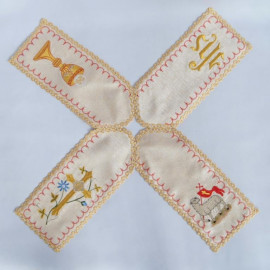
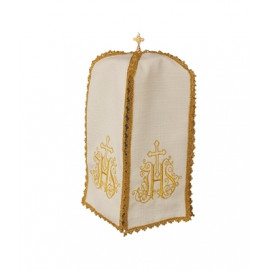
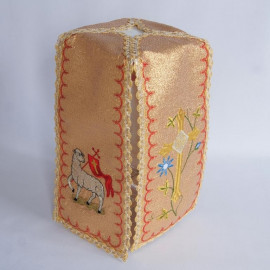
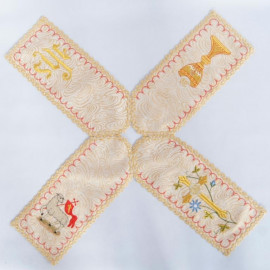
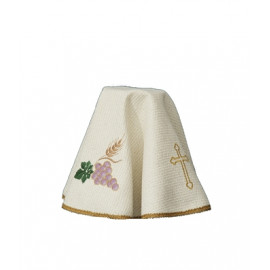
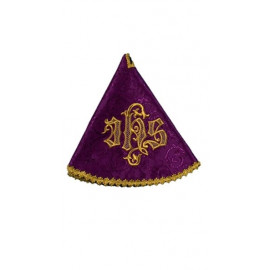
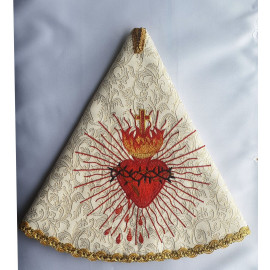
The tabernacle veil and the ciborium veil are often mentioned together, but they cover different things. The tabernacle veil — also called the conopaeum — covers the tabernacle itself, the fixed place where the Blessed Sacrament is reserved. The ciborium veil covers the smaller vessel inside. This guide explains the tabernacle veil, its Latin name, when it is used, and how it differs from the ciborium veil.
What Is a Tabernacle Veil?
A tabernacle veil is a cloth that covers the tabernacle or the place of reservation. Its purpose is the same as the ciborium veil: to veil the reserved Sacrament from direct view and to express reverence for the Real Presence. It is usually larger than a ciborium veil because it covers the whole tabernacle, not just the vessel.
The veil may be white or gold, and in some places it follows the liturgical colour. It is a traditional custom rather than a universal requirement; many parishes use it, especially where the tabernacle is prominent in the sanctuary, while others reserve the Blessed Sacrament in a niche or a separate chapel.
What Is a Conopaeum?
Conopaeum is the Latin term for the tabernacle veil. The word is sometimes used loosely for the ciborium veil as well, but strictly it refers to the cover of the tabernacle or the place of reservation. In parish inventories you may see “conopaeum” listed alongside the tabernacle, the sanctuary lamp, and the ciborium.
Tabernacle Veil vs Ciborium Veil
| Tabernacle veil | Ciborium veil | |
|---|---|---|
| What it covers | The tabernacle or place of reservation | The ciborium inside the tabernacle |
| Typical size | Larger; made for the tabernacle | 24–53 cm in our collection |
| Typical colour | White, gold, or the liturgical colour | White; gold on solemnities |
| Latin name | Conopaeum | — (no fixed Latin term) |
The two veils can be used together: the ciborium is covered, placed in the tabernacle, and the tabernacle is covered by its own veil. For the smaller cover, see our embroidered ciborium veils; for the vessel itself, see our liturgical ciboria.
When Is the Tabernacle Veil Used?
The tabernacle veil is used wherever the Blessed Sacrament is reserved and the parish chooses to veil the tabernacle. It is especially visible in churches where the tabernacle is placed in the centre of the sanctuary or in a side chapel. It may be removed when the tabernacle is opened for Communion or adoration, and replaced afterwards.
The ciborium veil, by contrast, is used on the vessel itself: the ciborium is covered after Communion and whenever it is returned to the tabernacle. The two customs are related but independent; a parish may use one, both, or neither.
Choosing a Tabernacle Veil
- Measure the tabernacle. The veil should cover the front and sides and fall to the desired length; measure the width, height, and depth before ordering.
- Choose the colour. White or gold is the common choice; some parishes use the liturgical colour.
- Match the embroidery. A tabernacle veil can share the motif of the ciborium veil and the vestments, especially for solemn feasts.
- Check the fixing. Some veils hang from a rod or rail; others are fitted to the tabernacle door. Confirm the attachment before ordering.
Frequently Asked Questions
Q: What is a tabernacle veil?
A: A tabernacle veil is a cloth that covers the tabernacle or the place where the Blessed Sacrament is reserved. It is a sign of reverence and a traditional custom.
Q: What is a conopaeum?
A: Conopaeum is the Latin term for the tabernacle veil. It is sometimes used loosely for the ciborium veil, but strictly it refers to the cover of the tabernacle.
Q: Is a tabernacle veil required?
A: It is a traditional custom rather than a universal requirement. Many parishes use it, especially where the tabernacle is prominent; others reserve the Blessed Sacrament in a niche or a separate chapel.
Q: What is the difference between a tabernacle veil and a ciborium veil?
A: The tabernacle veil covers the tabernacle; the ciborium veil covers the ciborium inside. The tabernacle veil is larger, and the two can be used together.
Q: What colour should a tabernacle veil be?
A: White or gold is the common choice; some parishes use the liturgical colour. The ciborium veil is traditionally white, with gold for solemn occasions.
Conclusion
The tabernacle veil and the ciborium veil belong to the same family of reverent covers, but they are not the same thing. If you are equipping a sacristy, start with the ciborium veil for the vessel, then measure the tabernacle for its own veil. Our guide to ciborium veils explains the smaller cover in detail.


