


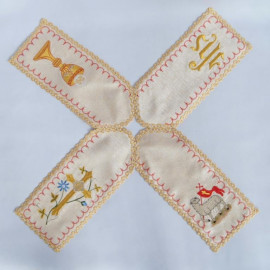
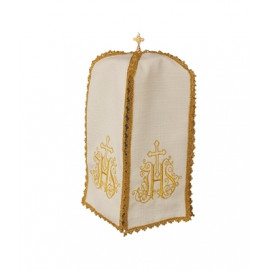
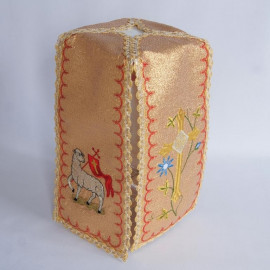
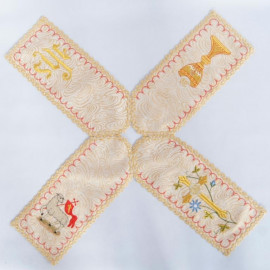
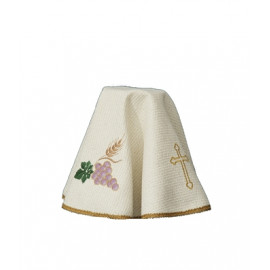
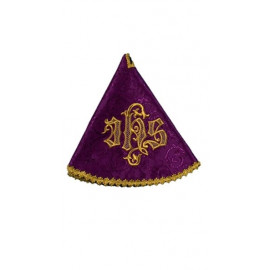
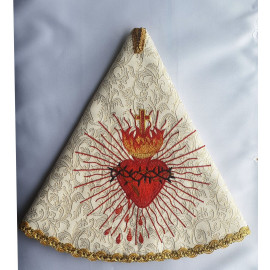
A ciborium veil is the small cloth — traditionally white — placed over the ciborium while the Blessed Sacrament is reserved in the tabernacle. It is a sign of reverence rather than a piece of furniture: it keeps the eyes of the faithful from fixing directly on the vessel, honors the Real Presence within, and continues a custom that reaches back to the veils of the Temple. This guide explains what a ciborium veil is, why churches use it, how it differs from the chalice veil and the monstrance veil, and how to choose one. Our workshop makes embroidered ciborium veils in 27 designs from $40.
What Is a Ciborium Veil?
The ciborium veil is a small square or circular cover, usually 29–53 cm across, laid over the ciborium inside the tabernacle. It is made of fine fabric — traditionally linen or silk, often embroidered and finished with lace or gold trim — and it rests directly on the lid and bowl, draping down the sides. Its purpose is twofold: it protects the vessel from dust when the tabernacle is opened, and it veils the ciborium from direct view, a gesture of the same reverence that gives us the tabernacle veil or curtain in front of the tabernacle door.
The custom is ancient. In the Old Testament the vessels of the sanctuary were covered when not in use, and the Church took up the practice early: by the Middle Ages the reserved ciborium was kept under a veil in many places, and the custom survived the reforms of the liturgy as a matter of local piety.
Why Churches Veil the Ciborium
The veil is, first, a sign of reverence: what is most sacred is covered, as the chalice is veiled before Mass and the tabernacle itself is veiled or curtained. Second, it is a practical protection: a tabernacle is opened many times a day, and the veil keeps dust away from the vessel that holds the Blessed Sacrament. Third, it teaches: a veiled ciborium inside the tabernacle quietly signals to anyone who opens it — sacristan, priest, or visitor — that what is inside is the Body of Christ, not a stored object. In parishes that reserve the Blessed Sacrament in a side chapel or adoration room, the veiled ciborium often becomes part of the visual language of the space.
Holy Thursday and the Altar of Repose
The most visible moment for the ciborium veil is Holy Thursday. After the Mass of the Lord's Supper, the Blessed Sacrament is carried in procession to the altar of repose, where it is kept until the liturgy of Good Friday. The ciborium is veiled for that journey — traditionally in white, and often in gold for the solemnity of the night — and remains veiled at the altar of repose. Parishes that own only one veil often choose a white-and-gold design that serves both the ordinary reserve and the Holy Thursday procession.
What Color Should a Ciborium Veil Be?
Unlike the chalice veil, whose color follows the liturgical season, the ciborium veil in the Latin rite is traditionally white, with gold reserved for the most solemn occasions such as Holy Thursday. The reason is that the veil covers the reserved Sacrament itself rather than a liturgical action: white, the color of the Eucharist and of feasts, is the default. Embroidered motifs follow the same logic — IHS monograms, wheat and grapes, the Lamb, and Marian emblems are all common — while seasonal colors appear more often on chalice veils, where they match the vestments of the day.
Ciborium Veil vs. Chalice Veil vs. Monstrance Veil
| Ciborium veil | Chalice veil | Monstrance veil | |
|---|---|---|---|
| What it covers | The reserved ciborium in the tabernacle | The prepared chalice before Mass | The monstrance during procession or blessing |
| When used | Whenever the ciborium is reserved | Before Mass, and in procession | Processions, Benediction, outdoor adoration |
| Typical color | White (gold on solemnities) | Follows the liturgical color of the day | White or gold |
All three are available in our vestment workshop: ciborium veils, chalice veils, and monstrance veils, each in a range of embroidered motifs.
How to Choose the Right Size
Measure the ciborium you intend to veil: the veil must cover the lid and drape down the sides of the bowl, so it should be wider than the ciborium by roughly 8–15 cm on each side. For a standard parish ciborium of 14–18 cm, a veil of about 35–45 cm is right; mini ciboria take the smallest sizes, cathedral ciboria the largest. If the veil will also be used on a chalice or in procession, choose the middle of the range. Our ciborium veils run from 29 cm to 53 cm and are embroidered in our own workshop in Poland — which also means custom sizes and motifs are possible on request.
Caring for an Embroidered Veil
Embroidered veils should be hand-washed in cool water with a mild soap, rinsed without wringing, and dried flat away from direct sunlight. Press on the reverse side with a cool iron, using a cloth between the iron and the embroidery; never iron directly over gold thread or lace. Store the veil flat or rolled — not folded along the embroidery — and keep it in a dry place; a linen bag or a drawer in the sacristy is ideal. Treated this way, a good veil will serve the tabernacle for decades.
Frequently Asked Questions
Q: Is a ciborium veil required by the Church?
A: It is a venerable custom rather than a universal requirement. Many parishes veil the reserved ciborium as a sign of reverence, especially where the tabernacle is not curtained; others use the veil only on Holy Thursday.
Q: What color is a ciborium veil?
A: Traditionally white, with gold used on the most solemn occasions such as Holy Thursday. Unlike the chalice veil, it does not usually change with the liturgical season, because it covers the reserved Sacrament rather than a liturgical action.
Q: What is the difference between a chalice veil and a ciborium veil?
A: The chalice veil covers the chalice prepared for Mass and follows the color of the day's vestments; the ciborium veil covers the reserved ciborium in the tabernacle and is traditionally white or gold.
Q: Can a ciborium veil be used on a pyx or a monstrance?
A: A small ciborium veil can cover a large pyx or a standing ciborium, but monstrances have their own veils, cut longer for the rays and the luna. Choose the veil made for the vessel you will cover.
Q: How do I measure for a ciborium veil?
A: Measure the width of the ciborium at its widest point and add 8–15 cm on each side, so the veil drapes over the lid and down the bowl. For a 14–18 cm ciborium, a veil of 35–45 cm is the usual fit.
Conclusion
The ciborium veil is a small thing that carries a large idea: the vessel that holds the Blessed Sacrament is covered because what it contains is holy. Whether your parish veils the ciborium every day or only on Holy Thursday, our embroidered ciborium veils — 27 designs from $40, made in our workshop — are cut to fit the ciboria we sell, and the guides to chalice veils and monstrance veils complete the set.
