
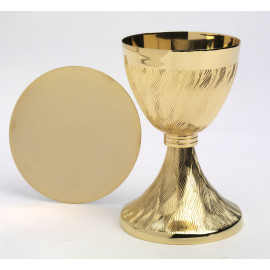
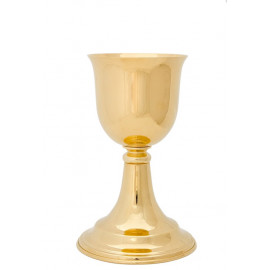
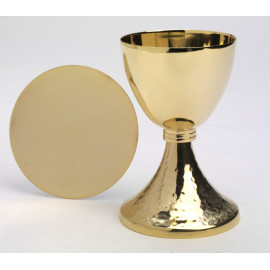
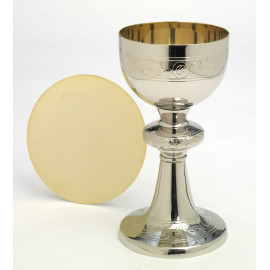
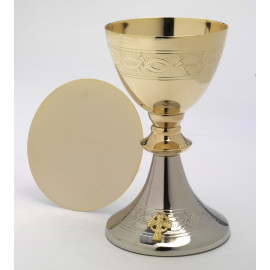
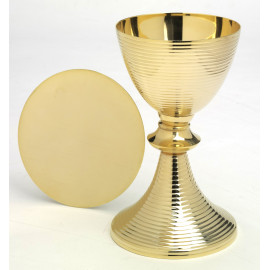
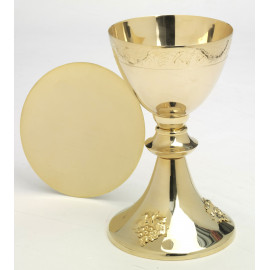
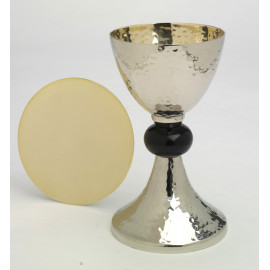
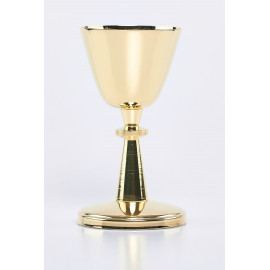
Most chalices fall into four style families: Gothic, Romanesque, Baroque, and modern. The style shapes the silhouette of the cup, the profile of the node and foot, and the density of ornament — but it does not affect the validity of the chalice. Any of the four can fully meet the Church's requirements, so the choice is about beauty, fit with your church, and the kind of celebration the chalice will serve.
What "Style" Means in a Chalice
When we talk about the style of a chalice, we mean three things: the silhouette (the proportions of cup, stem, node, and foot), the ornament (engraving, relief, applied stones, enamel), and the finish (gold, silver, or two-tone plating). The classic parts are the same in every style — cup, stem, knop, and base — and our guide to the parts of a chalice walks through each one. What changes from style to style is how those parts are shaped and decorated.
The Gothic Chalice
The Gothic style grew out of the great cathedrals of the 12th–16th centuries, and it carries their signature: verticality. A Gothic chalice is typically tall and slender, with a narrower cup, an elongated stem, and ornament drawn from pointed arches and tracery. The overall impression is upward and austere rather than lush.
Our Gothic-style chalice (22 cm) follows that tradition with hand-worked ornament and a two-tone finish — it is one of the two most ornate chalices we carry. Gothic works best in churches with pointed arches, stone tracery, or a generally vertical interior.
The Romanesque Chalice
The Romanesque style predates Gothic, and it looks like it: sturdy, rounded, and sober. Cups tend to be wider and shallower, feet broad and stable, and ornament restrained — often limited to simple engraved bands, a cross, or the IHS monogram. Where Gothic reaches upward, Romanesque sits solidly on the altar.
Romanesque is a natural choice for older parish churches with rounded arches and heavy masonry, and for pastors who want a chalice that reads as ancient without being ornate. Many modern reproductions of Romanesque chalices keep the broad proportions but use a cleaner, contemporary ornament vocabulary.
The Baroque Chalice
The Baroque style emerged in the 17th century with a taste for drama: rich ornament, scrolling foliage, cartouches, rays, and often applied stones or enamel. A Baroque chalice is meant to catch candlelight and draw the eye at the elevation. It pairs naturally with churches built or furnished in the Baroque and later periods, and with solemn celebrations.
Our Baroque chalice (24.5 cm) is the most richly ornamented piece in the collection, and the matching Baroque chalice and ciborium set brings the same language to the ciborium so the vessels agree on the altar.
Modern and Two-Tone Chalices
Modern chalices, developed through the 20th century, strip the ornament back to geometry: clean lines, balanced proportions, and a calm surface. Some carry a single strong motif — a Maltese cross, a simple IHS, a band of wheat and grapes — rather than full coverage. Two-tone designs, where gold and silver finishes play against each other, sit at the contemporary end of this family; our gilded brass chalice with silver elements (22 cm) is a good example.
How to Choose a Style for Your Church
Three questions usually settle the choice. First: what does the church itself look like? A Gothic chalice in a Romanesque building will always look slightly borrowed. Second: what vessels will stand beside it? The chalice, paten, ciborium, and pall should feel like one family. Third: which Masses will it serve? Many parishes keep a restrained chalice for daily Mass and bring out the ornate one for Sundays and solemnities.
You can browse the full range — Gothic, Baroque, Maltese, and modern — in our liturgical chalice collection, and compare materials and price tiers in our guide to chalice prices.
Frequently Asked Questions
Q: What is the most traditional chalice style?
A: Gothic and Romanesque are the oldest surviving style families — Gothic from the 12th–16th centuries and Romanesque from the centuries before it. Baroque followed in the 17th–18th centuries. All three are still made today, and all three appear in ordinary parish use.
Q: What is the difference between Gothic and Romanesque chalices?
A: Gothic chalices are tall, slender, and pointed, with vertical ornament drawn from cathedral architecture. Romanesque chalices are sturdier and rounder, with broader cups, wide feet, and restrained decoration. Gothic reaches upward; Romanesque sits solidly.
Q: Can I mix chalice styles on the same altar?
A: Nothing forbids it, but most sacristies keep the vessels consistent — a Baroque chalice beside a Romanesque ciborium can look accidental. If you are buying a chalice for an existing set, match the dominant style of the vessels you already use.
Q: Does a chalice's style affect its validity for Mass?
A: No. Style is purely aesthetic. What matters for validity is what the Church requires of the material — precious metal, or a gilded cup interior — which our guide to chalice requirements explains in detail. A simple modern chalice and an ornate Baroque one can both be fully liturgical.
Conclusion
Gothic, Romanesque, Baroque, or modern — the style of a chalice is a question of beauty and fit, not of law. Choose the family that speaks the same architectural language as your church, keep the vessels consistent, and let the chalice's ornament serve the celebration rather than compete with it. Browse the full collection of liturgical chalices to see all four styles side by side.
