
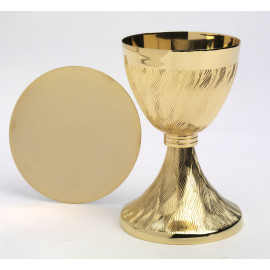
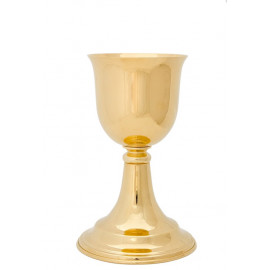
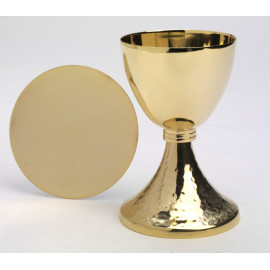
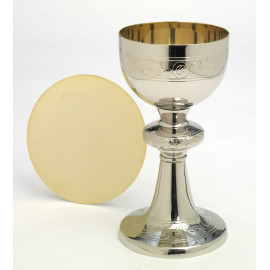
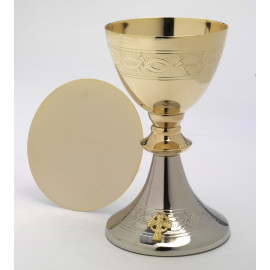
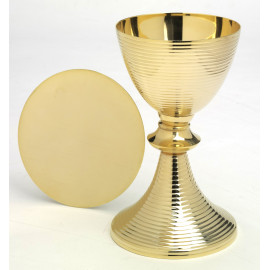
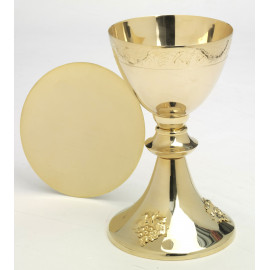
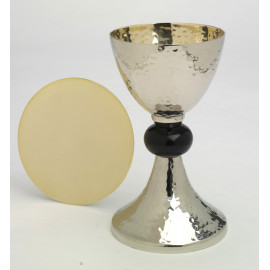
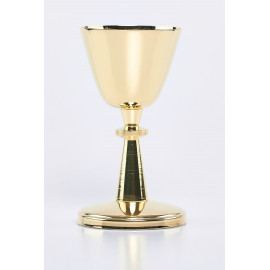
The Church's requirements for a chalice are few but specific. Canon 924 of the Code of Canon Law requires that the chalice and paten be made of precious metal; if they are made of metal that corrodes, or of metal less precious than gold, they must be gilded on the inside. The General Instruction of the Roman Missal (no. 328) repeats the same rule. Everything else — style, size, ornament — is left to sound judgment and local custom.
The Core Requirement: Precious Metal or a Gilded Interior
The rule exists for a simple reason: the chalice holds the Precious Blood, and the Church wants the vessel that touches it to be worthy and durable. In practice, the requirement means one of three things for the cup of the chalice:
- Solid precious metal — gold or silver. Rare today outside of heirlooms and gifts, because of cost.
- Base metal with a gilded interior — the standard solution: a brass or silver-plated chalice whose cup interior is gold-plated. This is what the great majority of parish chalices, including entry-level models, use.
- Other solid materials — permitted in some regions only by decision of the competent authority, provided the material is noble, solid, and suited to sacred use. Glass, ceramic, and common wood are not used for the cup.
What the rule is not is a requirement that a chalice be expensive. A well-made brass chalice with a properly gilded cup meets the law exactly as a solid gold one does — and every chalice in our collection meets it, from the $129 mini chalice upward.
Gold, Silver, and Gold-Plated: What's Actually Used
Historically, parish chalices were silver; the richest churches used gold. Today the economics are different — gold and silver prices make solid precious-metal chalices rare outside of special commissions — and the gold-plated interior has become the standard solution. It satisfies the canonical requirement, it is easy to maintain, and it keeps a quality chalice within reach of any parish. Our guides to brass vs silver chalices and gold-plated vs silver-plated chalices compare the practical differences.
Who May Touch and Purify the Chalice
The GIRM (no. 279) is specific about the purification of the sacred vessels: after Communion, the chalice and other vessels are purified by the priest, the deacon, or an instituted acolyte — ordinarily at the credence table. Other ministers and servers handle the vessels only as the rubrics allow, and always with the care owed to objects consecrated to worship. The same reverence governs everything around the chalice: the paten that holds the host, the pall and veil that cover it, and the purificator that dries it. Our guide to cleaning and polishing a chalice covers the day-to-day care that keeps a vessel worthy of its use.
Blessing Before First Use
A new or used chalice is set apart for sacred use by blessing. The blessing is normally given by a bishop or priest using the approved rite, and it should be obtained before the chalice is first used at Mass — not after. If a chalice has been restored or has passed through unknown hands, have it examined and blessed before it returns to the altar.
A Practical Checklist When Buying a Chalice
When you shop for a chalice, verify four things: that the inside of the cup is precious metal (gilded counts), that the vessel is solid and free of cracks or wobble, that the size suits your celebration (13 cm mini and travel models through 22–26 cm solemn chalices), and that blessing will be arranged before first use. Our guide to chalice prices explains what each price tier offers, and our full collection lists the cup material for every model.
Frequently Asked Questions
Q: Do Catholic chalices have to be gold?
A: No. The requirement is precious metal — or, for a base metal, gilding on the inside of the cup. A brass chalice with a gold-plated interior fully satisfies Canon 924 and GIRM 328. Solid gold chalices exist but are not necessary for a reverent celebration of Mass.
Q: Can a chalice be made of glass or wood?
A: Glass, ceramic, and common wood are not used for the cup of a chalice. The Church requires precious metal or a gilded interior; in some regions, other solid and noble materials may be permitted by the competent authority, but the ordinary materials of everyday tableware are excluded.
Q: Who can purify the chalice after Communion?
A: According to the GIRM (no. 279), the sacred vessels are purified by the priest, the deacon, or an instituted acolyte after Communion, ordinarily at the credence table. Other ministers handle the vessels only as the rubrics provide.
Q: Does a chalice need to be blessed before use?
A: Yes — a chalice is set apart for sacred use by blessing, normally given by a bishop or priest with the approved rite. This applies to new chalices and to used chalices that return to liturgical service.
Conclusion
The Church's chalice requirements come down to one sentence: precious metal, or a gilded interior. Around that core sit the practical rules — who may purify the vessels, how they are blessed, how they are cared for — that protect the reverence due to the Eucharist. Choose a chalice that meets the requirement, treat it with the care it deserves, and let its beauty serve the liturgy. Browse our liturgical chalices, or start with the price guide if you are planning a purchase.
