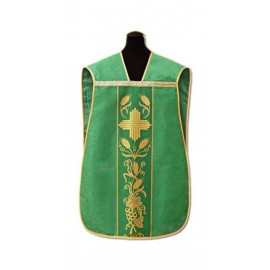

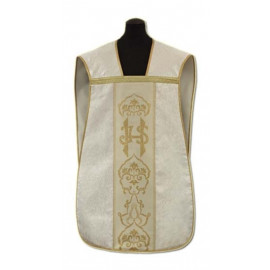
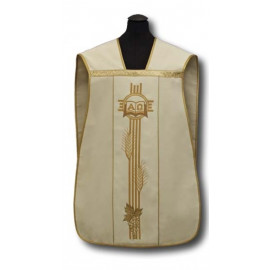
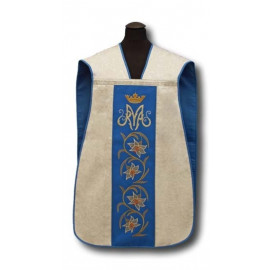
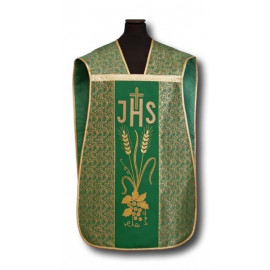
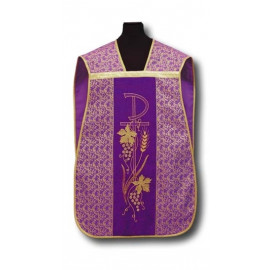
A fiddleback chasuble is the most closely fitted style of Roman chasuble — the outermost vestment worn by a Catholic priest at Mass. If you have seen a Traditional Latin Mass, you have almost certainly seen one: a narrow vestment with a shaped, decorated back that leaves the arms completely free.
What Is a Fiddleback Chasuble?
The fiddleback is a Roman-cut chasuble in its most tailored form. Instead of the wide, flowing drape of the Gothic chasuble, it has a shorter, narrower front panel and a back that is cut and stiffened into a distinctive shape, usually adorned with a cross, an embroidered image, or an orphrey band.
The cut is not merely decorative. A priest celebrating the Traditional Latin Mass makes many precise gestures — the elevations, the signs of the cross, the handling of the chalice — and the fitted cut keeps the vestment out of the way while still looking solemn and complete.
Why Is It Called a "Fiddleback"?
The name comes from the shape of the vestment's back, which resembles the back of a violin (a fiddle): narrower at the top, flaring slightly outward toward the hem, with a defined curve. The comparison is visual, not musical — the chasuble was never shaped like an instrument, but the silhouette is unmistakable once you know what to look for.
The term itself is informal and largely English-speaking; in older liturgical books the same vestment is simply called a Roman chasuble, and in some languages it is described by its cut rather than by a nickname.
Fiddleback vs Roman vs Gothic: What's the Difference?
- Gothic chasuble: wide and flowing, with a full-length front panel and a broad yoke over the shoulders. Common at Novus Ordo Masses and concelebrations.
- Roman chasuble: tailored and close-fitting, with a shorter front and a cross-shaped back. Traditional for the Latin Mass.
- Fiddleback: the most fitted Roman variant, with the characteristic violin-shaped back, often worn over a matching stole, maniple, burse, and chalice veil.
- Semi-Gothic: a middle form — a full front panel but a narrower, more tailored drape than the Gothic.
In everyday use, "Roman" and "fiddleback" are often used interchangeably; strictly speaking, the fiddleback is the most extreme point of the Roman cut. Compare all cuts in our guide to Roman vs Gothic chasubles.
A Short History: From the 18th Century to the Latin Mass Today
For most of the Middle Ages the chasuble was a large, conical cloak that had to be gathered over the arms. From the 17th century onward, vestment makers began to cut it back — first for practicality, then for display: the reduced surface allowed dense embroidery and whole scenes to be worked into the back of the vestment.
By the 18th and 19th centuries the fully fitted fiddleback had become standard in Rome and across much of Europe. After the liturgical reforms of the 20th century, the Gothic cut returned to favor in many parishes, while the fiddleback survived as the classic vestment of the Traditional Latin Mass — where it remains the most recognizable silhouette today.
How to Recognize a Fiddleback
- The front panel is short and narrow — often ending above the knees.
- The back is shaped like a violin back, with orphreys running down the center.
- The shoulders are cut close, so the arms are fully free.
- It is frequently sold as a set with stole, maniple, burse, and chalice veil.
Who Wears a Fiddleback Chasuble?
Any priest may wear a Roman-cut chasuble at any Mass; in practice it is most associated with the Traditional Latin Mass, solemn celebrations, and priests who prefer the traditional silhouette. Because the vestment is fitted, the standard length works for most celebrants — see our sizing notes in the Roman chasuble collection.
Choosing a Fiddleback Chasuble
Look for three things: an honest fabric description (velvet, damask, jacquard, or wool blends each behave differently), a genuine embroidery description, and clear information about what is included — a matching stole at minimum, ideally a full set. Our Roman chasubles include 99 models from $165 to $1,412, most with a matching stole and 22 as complete sets.
Q: Why is it called a fiddleback chasuble?
A: Because the shape of its back resembles the back of a violin — narrower at the top and flaring toward the hem.
Q: Is a Roman chasuble the same as a fiddleback?
A: In practice the terms are often used interchangeably, but strictly speaking the fiddleback is the most fitted version of the Roman cut.
Q: Is a fiddleback chasuble still allowed today?
A: Yes. The chasuble is the proper vestment of the priest at Mass, and the Roman cut is fully permitted; it is especially common at Traditional Latin Mass celebrations.
Q: What is the difference between a fiddleback and a Gothic chasuble?
A: The Gothic is wide and flowing with a full-length front; the fiddleback is closely fitted with a shorter front and a shaped back.
Q: How much does a fiddleback chasuble cost?
A: Simple damask Roman chasubles start around $165; heavily embroidered velvet fiddlebacks with a full set can reach $1,400 or more.
Q: Can a fiddleback chasuble be worn at a Novus Ordo Mass?
A: Yes — the Roman cut is a legitimate chasuble for any Mass; many priests simply prefer the Gothic for concelebrations.