


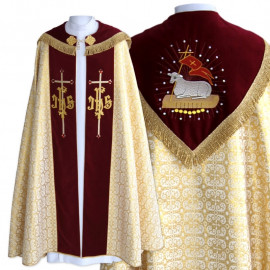
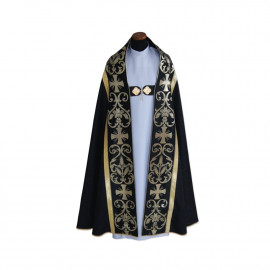
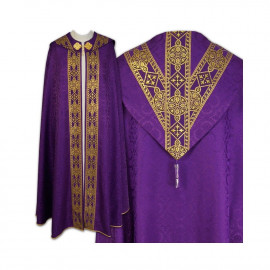
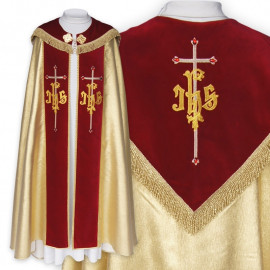
The cope began as a hooded rain cloak. The Latin name pluviale means "rain cloak," and the earliest mentions of a cappa describe a hooded garment worn for warmth and protection. Over the Middle Ages it became the Church's vestment of processions, Benediction, and the Liturgy of the Hours — and one of the most richly embroidered garments in Western art.
This is the story of how a practical cloak became a liturgical vestment, and why so many medieval copes survive when other vestments were cut down and remade.
Origins: Cappa and Pluviale
The earliest mention of a cappa is in the writings of St. Gregory of Tours (6th century) and in the Miracula of St. Fursey, where it means a cloak with a hood. A letter written in 787 by Theodemar, abbot of Monte Cassino, in answer to Charlemagne, shows that the garment called cuculla in Gaul was known as cappa to the monks of Cassino.
For centuries the cope remained a practical garment. An inventory of the abbey of Saint-Riquier in 801 lists 200 cappae; by 831 the number had grown to 377. Most were ordinary cloaks of simple material, used in choir for warmth as much as for ceremony.
The Medieval Cope
By the 12th century, the cope made of rich material had become a standard ceremonial vestment, and its use spread across Western Europe. Because it kept its semicircular shape and was not cut down like the chasuble, it became a canvas for embroidery: orphreys of gold thread, hoods worked with figures of saints, and morses of enamel and precious metal.
Syon, Ascoli, and Opus Anglicanum
Two of the most famous surviving copes are the Syon Cope in the Victoria and Albert Museum, London, and the Ascoli Cope in the Pinacoteca Civica in Ascoli Piceno. Both are masterpieces of opus anglicanum, the English embroidery admired across Europe in the 13th and 14th centuries. The morse itself could be a work of goldsmith's art: Benvenuto Cellini's career was launched by a morse he made for Pope Clement VII.
Reformation and Anglican Use
The cope survived the Reformation in the Church of England and in the Lutheran churches of northern Europe, where it remained the vestment of processions and choir offices. In the Catholic Church it continued in use for pontifical ceremonies, Benediction, and the Liturgy of the Hours.
The Cappa Magna
The cappa magna is a long, trained cloak worn by cardinals, bishops, and certain prelates on solemn occasions. It developed from the same garment as the cope but is not a cope: it has a train, it is not fastened with a morse in the same way, and it is reserved to higher prelates. The mantum, a longer papal mantle, is another relative.
The Modern Cope
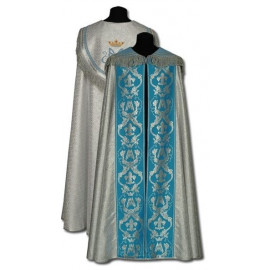
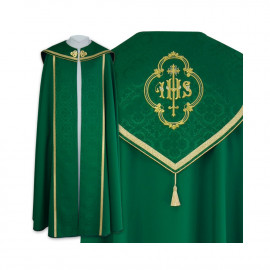
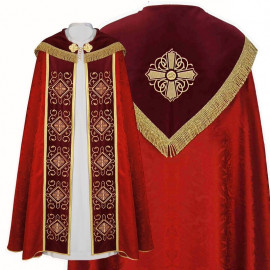
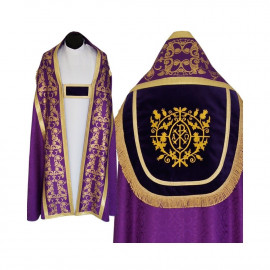
In the 20th century, the cope was simplified along with other vestments, but it never lost its place as the vestment of processions and Benediction. Today it is worn by bishops, priests, and deacons in the Roman rite, and by Anglican and Lutheran clergy. Modern copes are usually made of satin, damask, brocade, or cotton blends, with embroidered orphreys and a decorative hood.
Frequently Asked Questions
Q: Where does the word "cope" come from?
A: From the Latin cappa, a hooded cloak. The Latin liturgical name is pluviale, "rain cloak."
Q: How old is the cope?
A: The earliest mentions of a cappa date to the 6th century; by the 12th century it was a standard ceremonial vestment.
Q: What is opus anglicanum?
A: English medieval embroidery, famous across Europe in the 13th and 14th centuries. The Syon and Ascoli copes are among its masterpieces.
Q: Is the cappa magna a cope?
A: No. It developed from the same garment, but it is a distinct vestment reserved to higher prelates and worn with a train.
Q: Why do so many medieval copes survive?
A: Because the cope kept its shape and was not cut down like the chasuble, so old copes were preserved rather than remade.
Conclusion
The cope is a garment with a long memory: a rain cloak that became a symbol of the Church in procession. To see the modern form, browse our Catholic cope collection, and for the symbolism read our guide to what a cope symbolizes.


