
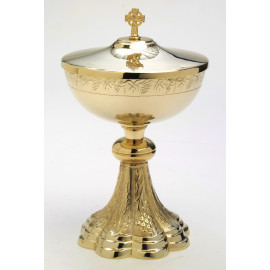
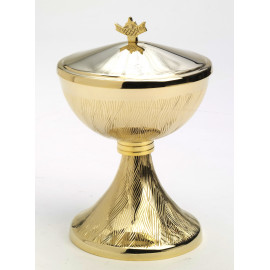
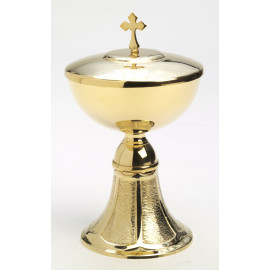
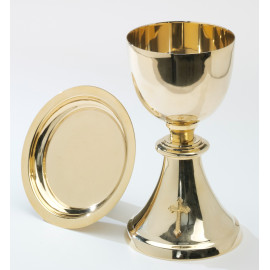
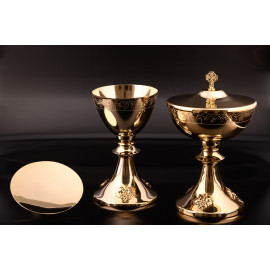
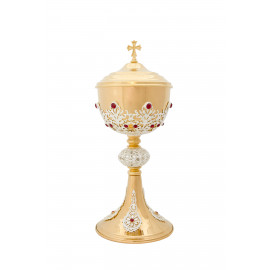
Ciborium is pronounced sih-BOR-ee-um — four syllables, stress on the second: /sɪˈbɔːriəm/. The plural, ciboria, is sih-BOR-ee-uh. The word comes from the Greek kiborion, the cup-shaped seed pod of the Egyptian water lily, which was copied as a drinking cup in the ancient world and later gave its name first to the canopy over the altar and then to the vessel that holds the consecrated hosts. This short guide covers the pronunciation, the etymology, the plural, and the second, architectural meaning of the word — the things people most often ask about a word they meet in the liturgy and rarely hear spoken. For the vessel itself, see our liturgical ciborium collection.
How to Say Ciborium
In both British and American English the word is pronounced sih-BOR-ee-um, with the stress on the second syllable. In the International Phonetic Alphabet it is written /sɪˈbɔːriəm/ (British) or /sɪˈbɔːriəm/ (American, with the same stressed vowel in most accents). Spelled out for reading aloud: si as in "sit", BOR as in "bore", ee as in "see", um as in "hum".
The two most common mistakes are stressing the first syllable ("SIH-borium") and turning the c into a hard sound ("kih-BOR-ium"). The c before i in words of Latin origin is soft — the same rule that gives us "ciboria", "circa", and "Caesar" — and the stress in -orium words (sanctuary, offertory, ciborium) regularly falls on the syllable before the ending. Say "sih-BOR-ee-um" and you will be understood in any sacristy.
Why People Struggle With the Word
Most Catholics meet "ciborium" in print — in a missal, a sacristy inventory, or a church supply catalogue — long before they hear it spoken, and the spelling is not transparent. The "-orium" ending suggests a place (as in "crematorium"), which makes the vessel sense feel counterintuitive, and the word's two meanings do not help. Add the fact that the older name for a small ciborium, pyx, is sometimes used loosely for the same object, and the confusion is understandable. The pronunciation, however, is perfectly regular once you know the pattern.
The Etymology: From the Lotus Cup to the Altar
The Greek kiborion (κιβώριον) originally named the seed pod of the Egyptian water lily, whose cup-like shape was imitated in metal and used as a drinking cup around the Mediterranean. Latin adopted the word as ciborium, still meaning a drinking vessel. Early Christian writers then applied it to the canopy supported on columns over the altar — the architectural feature that survives today — and only later, by the Middle Ages, did the word transfer to the vessel that holds the consecrated hosts. So the modern ciborium is the third meaning of an old word: a cup, then a canopy, then the vessel of the Eucharist.
The Plural: Ciboria
The plural of ciborium is ciboria, following the Latin pattern of words ending in -ium: medium becomes media, millennium becomes millennia, ciborium becomes ciboria. The pronunciation follows the singular: sih-BOR-ee-uh. In a sentence: "The sacristy keeps three ciboria — one for weekday Mass, one for Sunday, and one for the tabernacle." The alternative English plural "ciboriums" appears occasionally, but ciboria is the form used in liturgical books and church inventories, and it is the one to use.
Two Meanings: the Vessel and the Canopy
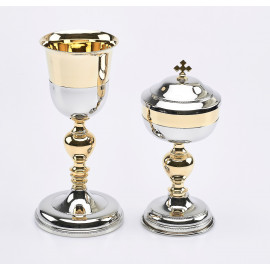
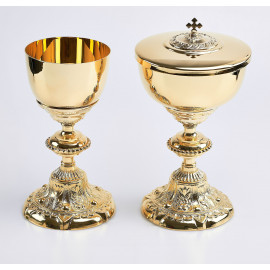
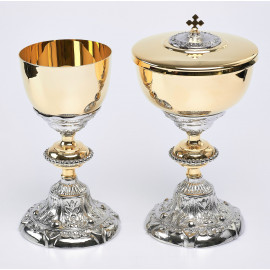
When you meet the word "ciborium" in a church, look up. If the object is a covered cup on the altar or in the tabernacle, it is the vessel — browse our liturgical ciboria to see one. If it is a freestanding canopy on four columns over the altar — also called a baldachin — it is the architectural ciborium, the older sense of the word. Dictionaries list both meanings for a reason: the transfer from canopy to vessel happened because the vessel, like the canopy, "houses" what is holy. If someone tells you their church "has a ciborium", they may mean either; the context — sacristy or sanctuary — tells you which.
Ciborium in Other Languages
Catholicism is universal, and so is the word: Spanish copón, Italian ciborio, French ciboire, German Ziborium, Polish cyborium, Portuguese cibório, Latin ciborium. The Spanish copón is the outlier — it comes from a different root, copa, "cup" — which is why Spanish-speaking parishes sometimes puzzle over the English word, and vice versa. In every other major European language the Greek-Latin stem survives intact.
Frequently Asked Questions
Q: How do you pronounce "ciborium"?
A: Sih-BOR-ee-um, with the stress on the second syllable — /sɪˈbɔːriəm/ in the IPA. The c is soft, like an s; the plural, ciboria, is sih-BOR-ee-uh.
Q: What does "ciborium" mean in English?
A: In liturgical English it means the covered vessel that holds the consecrated hosts at Mass and reserves them in the tabernacle. In church architecture the same word means the canopy over the altar, also called a baldachin.
Q: Is it "ciborium" or "ciboria"?
A: Ciborium is the singular — one vessel. Ciboria is the plural — two or more. A sacristy with three vessels has three ciboria; the one on the altar is a ciborium.
Q: Why is the vessel called a ciborium?
A: The name comes from the Greek kiborion, a drinking cup shaped like the seed pod of the Egyptian water lily. Early Christians first used the word for the canopy over the altar; by the Middle Ages it had transferred to the vessel of the Eucharist.
Q: What is the Spanish word for ciborium?
A: Copón. Spanish uses a different root — from copa, "cup" — while most other languages kept the Greek-Latin stem: ciborio in Italian, ciboire in French, Ziborium in German, cyborium in Polish.
Conclusion
Sih-BOR-ee-um: four syllables, one old word with three lives — a lotus-pod cup, a canopy over the altar, and today the covered vessel of the Eucharist. Now that you can say it, see what it names: our liturgical ciboria come in every size from mini to cathedral, and our guides to chalice vs. ciborium and the complete guide to Catholic altar vessels show how it works alongside the other sacred vessels.


