

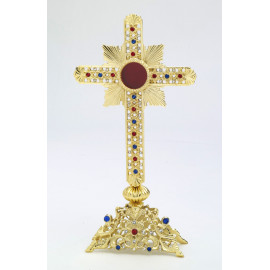
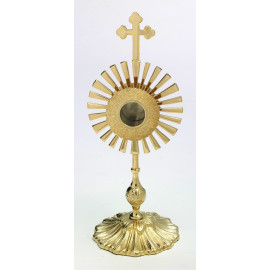
Reliquaries are not one object but a family of objects. The same word covers a tiny brass capsule kept in a sacristy, a house-shaped chasse on a medieval altar, and a life-sized silver arm made to hold the bone of a martyr. The differences are not only artistic: the form tells you what the vessel was made to do, how the relic was meant to be seen, and where it belonged in the church.
This guide explains the main types of Catholic reliquaries, the words used in older inventories, and the forms that are practical for a parish, a chapel or a home today.
What Is a Reliquary?
A reliquary is a container made to hold, protect and display a relic. The relic may be a fragment of a saint’s body (first class), an item the saint owned or used (second class), or an object touched to a first-class relic (third class). The reliquary is not worshipped; it is the vessel that makes veneration possible while keeping the relic safe.
The Church’s law assumes that relics will be authenticated and treated with reverence. Canon 1237 requires that the altar of a church contain a relic, usually in a sealed cavity in the altar stone, and Canon 1190 forbids the sale of sacred relics. A reliquary, as a vessel, can be bought and sold; the relic inside it cannot.
The Three Classes of Relics
The class of relic affects the size and form of the reliquary. A first-class relic is usually a small fragment of bone, hair or blood, and it is normally sealed inside a theca or capsule before it is placed in a larger vessel. A second-class relic may be a piece of clothing, a book or a rosary, and it needs a larger cavity. A third-class relic is an object touched to a first-class relic; it may be a rosary, a medal or a piece of cloth, and it is often kept in a simple reliquary or a display case.
In practice, most parish reliquaries are made for a sealed theca rather than for a bare relic. That is why the internal capsule diameter matters more than the outside height when you are choosing a vessel.
Box Reliquaries and Chasses
A chasse (French châsse) is a box-shaped reliquary in the form of a house, with a sloping roof and often a glass front. The form was developed in the Middle Ages for the public display of a saint’s relics, and it remains one of the most recognizable reliquary shapes. A chasse usually sits on an altar, a plinth or a shrine, and its wide front makes the relic visible to a congregation.
The word feretory is related but not identical. A feretory is a portable shrine — large enough to be carried in procession — or the chapel in which such a shrine is kept. The word comes from the Latin feretrum, a bier. A feretory is therefore a reliquary designed for movement and public honor, while a chasse is primarily a display vessel.
Theca, Pendant and Cross Reliquaries
A theca is a small, brooch-like reliquary worn on the breast or sewn into a vestment to hold a tiny fragment of a first-class relic. The word is also used for a small hinged case that holds a relic. A theca is normally sealed and should not be opened; the seal is part of its authentication.
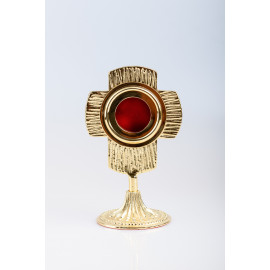
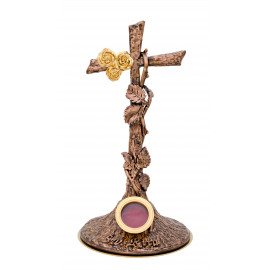
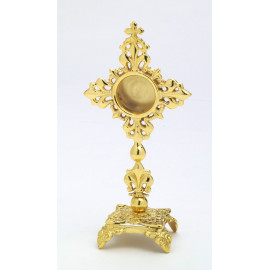
A pendant reliquary is a small cross or locket worn on a chain. A cross reliquary is a cross-shaped vessel with a cavity and usually a glass window, made either as a pendant or as a standing cross for an altar. Cross reliquaries are common for personal devotion and as gifts, and larger standing crosses are used in chapels and home oratories.
Arm, Head and Body Reliquaries
In medieval Europe, reliquaries were often shaped like the part of the body they contained. An arm reliquary held a forearm bone; a head reliquary or bust held a skull; a foot reliquary held a foot. These forms are historical and museum pieces today. They are not the kind of reliquary normally bought for a parish altar, but they explain why older inventories describe a reliquary by its shape rather than by its size.
The most famous examples — the Shrine of the Three Kings in Cologne, the Reliquary of St Foy at Conques, the arm reliquaries of the medieval treasuries — are works of goldsmithing as much as vessels for relics. Their forms were intended to make the saint present to the viewer, not merely to store a fragment.
Capsules, Relic Boxes and Ostensorium-Style Reliquaries
A capsule or relic box is the smallest practical reliquary: a brass cylinder or box with a screw or hinged closure, often with a glass window. It is used to store a single relic, to transfer a relic safely, or to keep a first-class relic in the sacristy. Capsules are usually measured by their internal diameter, not by their height.
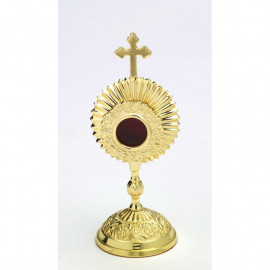
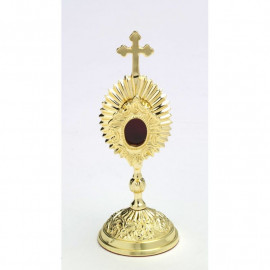
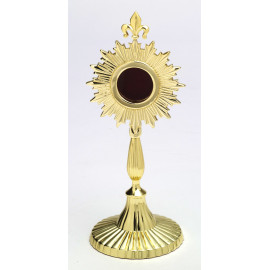
An ostensorium-style reliquary borrows the sunburst or tower form of a monstrance but is made for a relic rather than for the Blessed Sacrament. It is a display vessel: the glass window, the decorated frame and the weighted base are designed to make the relic visible from a distance. It should not be confused with a monstrance, which is consecrated for the Eucharist.
Which Type Should You Choose?
Start with the relic, not with the catalogue. If the relic is already sealed in a theca, measure the theca and choose a reliquary whose cavity is slightly larger. If the relic will be venerated by a congregation, choose a display reliquary, a chasse or a standing cross with a glass front. If it will be kept in a sacristy or carried, choose a capsule or a small theca.
For a parish altar, the usual choice is a brass or gilded reliquary between 20 and 30 cm high, with a glass window and a stable base. For a side chapel or a shrine, a larger display reliquary between 30 and 40 cm gives the relic more presence. For a home, a small cross or a compact reliquary between 10 and 20 cm is usually enough.
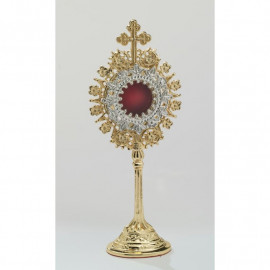
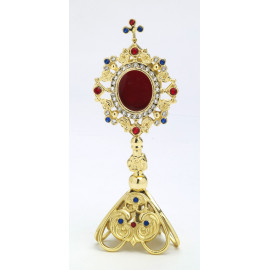
Our Catholic reliquaries include capsules, cross reliquaries, gothic tower reliquaries, sunburst and filigree designs, and large display pieces, so the same page covers the whole range. If you are still deciding between a vessel for a relic and a vessel for the Blessed Sacrament, read our guide to chapel monstrances and ciboria.
Frequently Asked Questions
Q: What are the main types of reliquaries?
A: The main types are box reliquaries and chasses, theca and pendant reliquaries, cross reliquaries, arm and head reliquaries, capsules and relic boxes, and ostensorium-style display reliquaries. The form usually follows the size of the relic and the way it will be venerated.
Q: What is the difference between a chasse and a feretory?
A: A chasse is a box-shaped or house-shaped reliquary made for display, often with a glass front. A feretory is a portable shrine large enough to be carried in procession, or the chapel where such a shrine is kept. A feretory is designed for movement; a chasse is primarily a display vessel.
Q: What is an arm reliquary?
A: An arm reliquary is a reliquary shaped like a forearm, made in the Middle Ages to hold an arm bone or another relic of a saint. Similar forms include head, bust and foot reliquaries. They are historical and museum objects today, not the usual choice for a parish altar.
Q: What is a theca?
A: A theca is a small, brooch-like reliquary worn on the breast or sewn into a vestment, or a small hinged case for a relic. It is normally sealed and should not be opened. The word is often used for the small container that holds a first-class fragment inside a larger reliquary.
Q: Which reliquary is best for a parish altar?
A: For a parish altar, choose a brass or gilded reliquary between 20 and 30 cm high, with a glass window and a stable base. If the relic is already sealed in a theca, check the internal capsule diameter before you buy. For a larger shrine, a display reliquary between 30 and 40 cm is usually more suitable.
Related Reading
Continue with What Are Catholic Relics? Classes, Veneration, and Reliquaries Explained and browse our Catholic reliquaries.


