
Every liturgical vestment carries meaning, but the chasuble carries the most: it is the last garment the priest puts on before Mass, and the prayers that accompany it explain why.
The Yoke of Christ
The traditional vesting prayer for the chasuble asks: "Lord, who have said, 'My yoke is sweet and my burden light,' grant that I may so carry it as to merit your grace." The vestment is understood as the yoke of Christ — not a burden of servitude but the sweet yoke of the Gospel (Matthew 11:30), worn by the priest as he takes on the work of the altar.
The Seamless Robe
The chasuble is also read as a symbol of the seamless robe of Christ (John 19:23) — the garment the soldiers did not divide — and, in the writings of the Fathers, as an image of the charity that should "cover all things" and unite the Church. Because it covers the whole body and is the outermost garment, it is traditionally described as charity itself: the virtue that must clothe everything the priest does.
The Vesting Prayers
Each vestment has its own prayer as it is put on: the amice (helmet of salvation), alb (purity), cincture (chastity), maniple (patience and tears), stole (the yoke of immortality), and finally the chasuble (the yoke of Christ). Prayed in order, they trace the priest's interior preparation for the Eucharist.
What Each Color Symbolizes
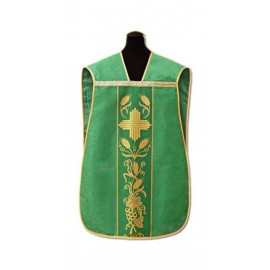
- White and gold: joy, light, and glory — Christmas, Easter, feasts of the Lord and saints.
- Red: the fire of the Holy Spirit and the blood of martyrs — Pentecost, Good Friday, martyrs' feasts.
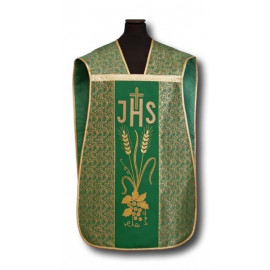
- Green: hope and life — Ordinary Time.
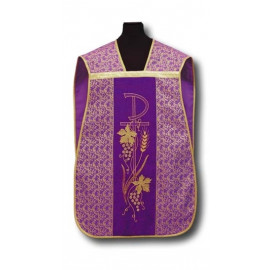
- Violet: penance and preparation — Advent and Lent.
- Rose: joyful relief in the middle of penance — Gaudete and Laetare Sunday.
- Black: mourning — funeral Masses where customary.
See the full season-by-season selection in our Roman chasuble collection and the history in the history of the chasuble.
Symbolism of the Cut Itself
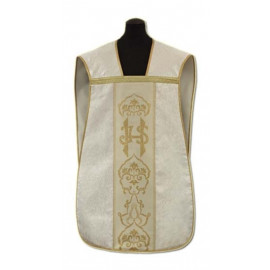
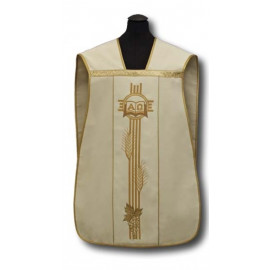
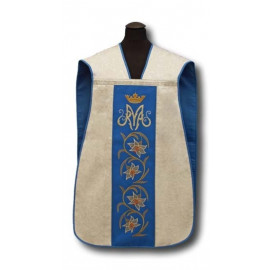
The cross formed by the orphreys on the back of the Roman chasuble is not decoration: it places the cross of Christ on the shoulders of the priest as he stands at the altar. The embroidered images — IHS, the Sacred Heart, Marian motifs — extend the same logic, turning the vestment into a confession of faith before a single word is spoken.
Q: What does the chasuble symbolize?
A: The yoke of Christ, charity, and the seamless robe of Christ — the vesting prayer explicitly calls it the sweet yoke of the Lord.
Q: What does the "yoke of Christ" mean?
A: It refers to Matthew 11:30 — the burden of the Gospel that is light and sweet to the one who bears it in love.
Q: Why is the chasuble called a casula?
A: From the Latin for "little house" — the original garment was a full cloak that covered the body like a small tent.
Q: What do the colors of the chasuble mean?
A: White and gold for joy and glory, red for the Spirit and martyrs, green for hope, violet for penance, rose for joyful relief, black for mourning.
Q: What does the priest pray when putting on the chasuble?
A: "Lord, who have said, 'My yoke is sweet and my burden light,' grant that I may so carry it as to merit your grace."