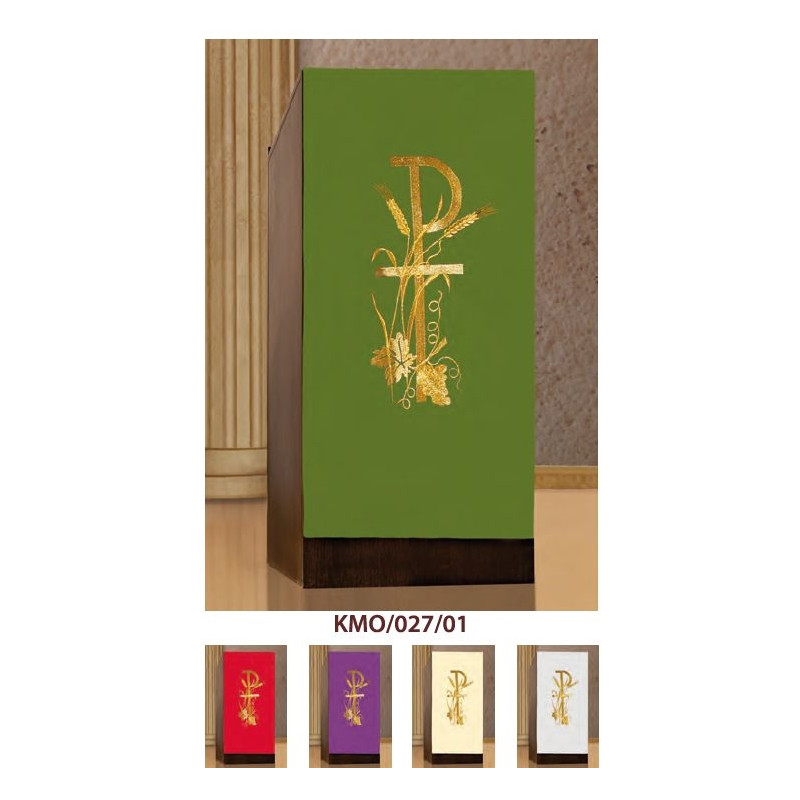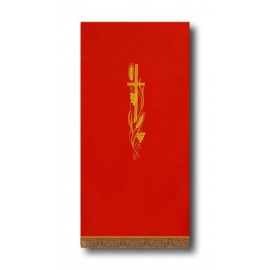


A pulpit fall is the decorative cloth that hangs down in front of a pulpit, ambo, or lectern. It is usually embroidered, made in the liturgical color of the season, and changed with the Church year. In Catholic parishes the same piece is often called an ambo fall or lectern cover; in Protestant churches the narrower version is often called a pulpit scarf.
What Is a Pulpit Fall?
A pulpit fall is a fabric panel, usually rectangular, that covers the front of the preaching or reading stand. It may be attached with hooks, a rail, Velcro, or ties, and it usually hangs free at the bottom so the embroidery is visible to the congregation. The word fall refers to the way the cloth falls or hangs down the front of the furniture.
The fall is a liturgical parament, not a structural part of the building. That matters for parishes: a fall can be changed for Advent, Lent, Easter, or a patronal feast, washed, stored, and replaced far more easily than the ambo itself. It protects the wood or stone from dust, scratches, and candle wax, and it gives the reading desk a finished, dignified appearance.
The Many Names: Ambo Fall, Pulpit Scarf, Lectern Cloth
The vocabulary is unusually rich, and the words are not always interchangeable. The table below explains the terms you will see in parish inventories, catalogs, and older liturgical books.
| Term | What it means | Where you see it |
|---|---|---|
| Pulpit fall | The hanging cloth on the front of a pulpit, often embroidered and seasonal. | Older Catholic inventories, Anglican and Lutheran churches. |
| Ambo fall | The same kind of panel made for the ambo, the Catholic reading desk. | Catholic parishes, especially since the Second Vatican Council. |
| Pulpit scarf | A narrower, often reversible hanging used mainly in Protestant churches. | Protestant churches; in Catholic use the word is often a loose synonym. |
| Lectern cloth / lectern cover | A cover for a standing reading desk. | Parishes, chapels, schools, retreat centers. |
| Pulpit hanging | An older, broader term for a hanging on a pulpit. | Historic inventories and architectural descriptions. |
If you are shopping online, the search terms are often mixed. Pulpit fall, ambo fall, lectern cover, pulpit scarf, and pulpit hanging can all lead to the same kind of church textile. The important thing is to match the piece to the furniture you actually have, not to the label in the catalog.
What a Pulpit Fall Is Not
A pulpit fall is not an altar frontal or antependium. The frontal hangs on the front of the altar; the fall hangs on the ambo, lectern, or pulpit. They may coordinate in color and embroidery, but they are different pieces for different places in the church.
It is also not a chalice veil, a burse, or a ciborium veil. Those cover the sacred vessels, not the reading desk. If you are building a coordinated set, our altar tablecloths, chalice veils, and ciborium veils are made to match the same embroidery.
A Short History
The ambo takes its name from the Greek ambon, a step or elevated place. In the early basilicas, the ambo was a raised platform from which the Gospel and Epistle were proclaimed; over the centuries it fell out of use in many places, and preaching moved to the pulpit. The Second Vatican Council restored the ambo as the standard place of the Liturgy of the Word in Catholic churches, and the General Instruction of the Roman Missal treats it as a place of dignity: from it the readings, the responsorial psalm, and the Easter Proclamation are proclaimed, and it may also be used for the homily and the prayer of the faithful (GIRM 309).
The pulpit comes from the Latin pulpitum, a raised platform or stage. In medieval and early modern churches it was often a tall, enclosed wooden structure with a sounding board, placed for preaching to a large nave. The lectern is a simpler standing desk; the word is related to the Latin lectrum, a reading place. All three pieces can carry a fall or cover, but their proportions differ.
Colors and Liturgical Seasons
A pulpit fall follows the same color rules as the vestments and altar frontals. The general norms are in GIRM 346 and the following paragraphs; local custom and the diocesan calendar always take precedence.
- White and gold: Christmas, Easter, solemnities of the Lord and Our Lady, weddings, baptisms, and funerals where customary.
- Green: Ordinary Time — the long season of growth and discipleship.
- Red: Pentecost, Palm Sunday, Good Friday, and feasts of martyrs, apostles, and evangelists.
- Violet or purple: Advent, Lent, and requiem Masses where customary.
- Rose: Gaudete Sunday (Third Sunday of Advent) and Laetare Sunday (Fourth Sunday of Lent).
- Black: Requiem Masses where local custom permits.
Most parishes build a small set: green for Ordinary Time, violet for Advent and Lent, white for Christmas and Easter, and red for Pentecost and martyrs. Rose and Marian designs are added for particular feasts. Our embroidered lectern and pulpit covers are available in all of these colors, with IHS, Alpha and Omega, PAX, Marian, Christmas, Lenten, Easter, and Holy Spirit motifs.
How to Measure and Choose
Measure the width of the desk top and the drop you want at the front. A fall should hang straight, without pulling at the corners, and it should clear the floor, microphone, and book stand. Our standard sizes are 50 × 160 cm, 58 × 180 cm, and 55 × 250 cm; custom sizes are available for non-standard furniture.
For weekly use, an 80% polyester / 20% wool blend is durable, drapes well, and resists creasing. A stain-resistant tablecloth fabric is easier to iron and is a practical choice for a busy sacristy. Choose the embroidery after the color: IHS, Alpha and Omega, and PAX are classic for the ambo, while Marian or Christmas motifs suit particular feasts. For a step-by-step method, see our guide to measuring a lectern or ambo for a cover.
Care and Storage
Wash the fall separately in cold water with a mild detergent, iron it while still slightly damp on the reverse side, and store it flat or rolled so the embroidery does not crease. Remove candle wax by pressing the area between clean paper towels with a warm iron; do not scrape the embroidery with a sharp tool. For a complete method that also covers corporals, purificators, and altar cloths, read our guide to washing liturgical linens.
Frequently Asked Questions
Q: What is a pulpit fall?
A: A pulpit fall is the decorative cloth that hangs down in front of a pulpit. It is usually embroidered and made in the liturgical color of the season, and it may also be called an ambo fall or lectern cover depending on the furniture it covers.
Q: Is a pulpit fall the same as an ambo fall?
A: In practice, yes — both are fabric panels for the front of the reading or preaching stand. The word ambo is more common in Catholic use, while pulpit fall is common in older inventories and in Anglican and Lutheran churches.
Q: What is a pulpit scarf?
A: A pulpit scarf is a narrower, often reversible hanging used mainly in Protestant churches. In Catholic use the words are sometimes used loosely for a pulpit fall, but the proportions are different: a Catholic ambo fall is usually wider and longer.
Q: What color should I choose?
A: Match the vestments and altar frontals. Green is the most useful first choice because it is used throughout Ordinary Time; then add violet for Advent and Lent, white for Christmas and Easter, and red for Pentecost and martyrs.
Q: How do I measure for a pulpit fall?
A: Measure the width of the desk top and the drop from the front edge to where you want the cover to end. Check the attachment — hooks, rail, Velcro, or ties — and whether the cover must clear a microphone or book stand.
Q: Can I use a pulpit fall on a lectern?
A: Yes, if the proportions fit. The piece is the same kind of textile; what matters is the width, the drop, and the way it attaches to the furniture. Measure the lectern as you would a pulpit and choose the closest standard size or a custom cover.
Related Reading
Continue with Ambo vs. Pulpit vs. Lectern, How to Measure a Lectern or Ambo for a Cover, Pulpit Scarf Colors and Their Meaning, and How to Choose a Lectern or Pulpit Cover. Browse our embroidered lectern, pulpit, and ambo covers.