

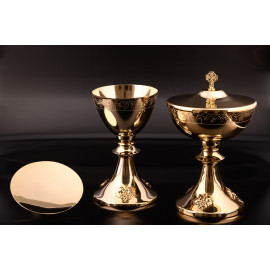
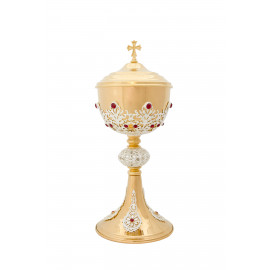
A custodia exposes the consecrated host; a ciborium reserves it. That is the short answer. The custodia holds one host in a lunette behind glass so the faithful can see it during adoration, Benediction or a procession. The ciborium is a lidded vessel that holds many hosts in the tabernacle and is used to distribute Communion. The two vessels serve different moments in the life of a parish.
Because both are made of gold-plated brass and both hold the Eucharist, they are often confused in catalogues and conversations. The confusion can lead to the wrong purchase: a ciborium is not designed for exposition, and a custodia is not the standard vessel for reservation. This guide explains the difference and helps you choose.
What a ciborium does
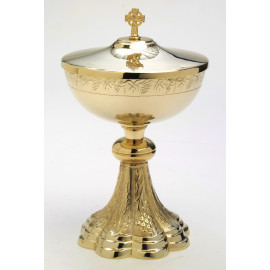
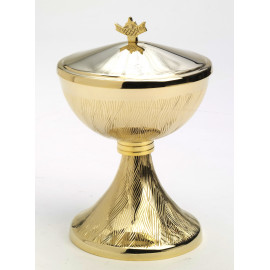
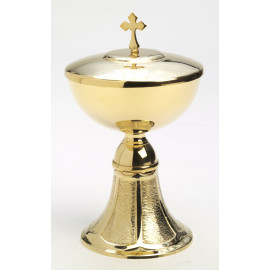
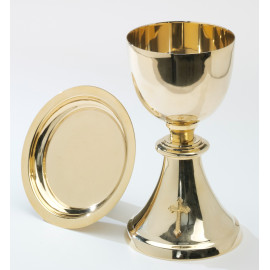
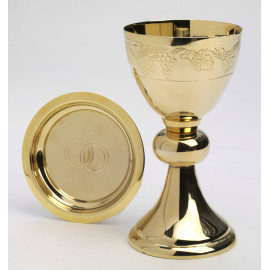
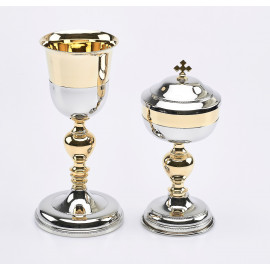
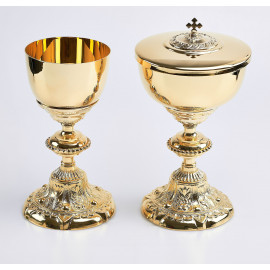
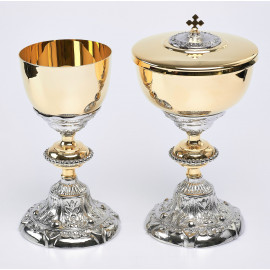
A ciborium is a lidded vessel used to reserve the Blessed Sacrament in the tabernacle and to distribute Communion at Mass. It is usually bowl-shaped with a fitted lid and a knob or cross on top. The lid protects the hosts and keeps the vessel suitable for reservation. Ciboria come in different capacities, from small chapel vessels to large concelebration ciboria.
If your question is “how many hosts does it hold?”, you are probably looking for a ciborium. Our guide to ciborium capacity explains the sizes. If you need a vessel for the tabernacle, start with our ciboria.
What a custodia does
A custodia — also called a custodia, ostensorium or monstrance — holds one host in a lunette so it can be seen. It is an exposition vessel. The host is placed in the lunette, the lunette is slid into the glass capsule, and the vessel is placed on an altar, throne or tabor. The custodia is used for Eucharistic adoration, Benediction and processions such as Corpus Christi.
Our custodias range from 11 cm mini custodias for a side chapel to 40 cm display custodias for a parish church. The glass capsule diameters are 8 cm, 9 cm and 16 cm; the large-host models accept a correspondingly larger host.
Key differences
| Feature | Custodia | Ciborium |
|---|---|---|
| Main job | Expose one host | Reserve and distribute many hosts |
| Lid | Usually open or with a glass capsule | Fitted lid |
| Host visibility | Visible through glass | Hidden under the lid |
| Typical use | Adoration, Benediction, procession | Mass, tabernacle, Communion |
| Capacity | One host in the lunette | Many hosts, depending on size |
| Place | Altar, throne, tabor | Altar, tabernacle |
Can you use a ciborium for adoration?
A ciborium is not the normal vessel for exposition because the host is hidden under the lid. For adoration and Benediction, the Church uses a monstrance or custodia so the Blessed Sacrament can be seen. If a ciborium is used to bring the Blessed Sacrament to the altar, the host is normally transferred to a lunette and placed in the exposition vessel.
There may be local customs or specific circumstances, but the ordinary practice is clear: use an exposition vessel for exposition. If you are planning adoration, choose a custodia or monstrance.
Can you use a custodia for reservation?
A closed custodia can hold a host, but it is not the standard vessel for reservation in the tabernacle. The ciborium is designed for that purpose: it has a fitted lid, a capacity for many hosts, and a shape that fits the tabernacle. A custodia is an exposition vessel; it is not a substitute for a ciborium in ordinary parish use.
If you need a vessel to carry Communion to the sick, a pyx is the usual choice. A closed custodia is larger and more ceremonial; a pyx is smaller and designed for transport.
Which should you buy first?
If your parish reserves the Blessed Sacrament in the tabernacle but does not have a proper ciborium, buy the ciborium first. If your parish has a ciborium but needs a vessel for adoration or Benediction, buy the custodia. If you are starting from scratch, the ciborium is the more basic vessel; the custodia is the next step when the parish begins regular exposition.
For a small chapel or home oratory, a mini custodia may be enough for private exposition. For a parish church, a larger custodia or monstrance is more suitable. The monstrances page covers the larger processional pieces; the ciboria page covers reservation.
Frequently Asked Questions
Q: What is the difference between a custodia and a ciborium?
A: A custodia exposes one host in a lunette behind glass; a ciborium is a lidded vessel that reserves many hosts in the tabernacle and is used for Communion. They serve different purposes.
Q: Can a ciborium be used as a monstrance?
A: Not normally. The host is hidden under the lid, so a ciborium is not designed for exposition. Use a custodia or monstrance for adoration and Benediction.
Q: Can a custodia be used to reserve the Blessed Sacrament?
A: A closed custodia can hold a host, but it is not the standard vessel for reservation. The ciborium is designed for the tabernacle; a pyx is used for carrying Communion to the sick.
Q: Which vessel holds more hosts?
A: A ciborium. It is made to hold many hosts for reservation and distribution. A custodia holds one host in the lunette for exposition.
Q: Do I need both a custodia and a ciborium?
A: Most parishes need a ciborium for reservation and a custodia or monstrance for exposition. If the parish has regular adoration or Benediction, both are useful.
Related reading
Read monstrance vs tabernacle vs ciborium, ciborium vs pyx, and how many hosts a ciborium holds. Browse custodias and ciboria.


