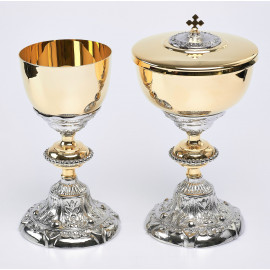
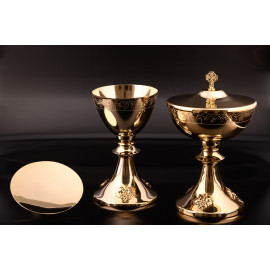
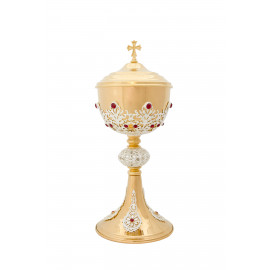
A standard parish ciborium holds roughly 50 to 150 hosts; a large or concelebration model holds 150 to 600, and cathedral-sized ciboria can hold more than a thousand. The exact capacity depends on the diameter and depth of the bowl and on the size of the hosts — but for practical planning, the diameter is all you need. This guide gives you the working numbers, explains how stacking ciboria change the math, and helps you match a ciborium to your congregation. Browse the sizes in our liturgical ciborium collection as you read.
How Ciborium Capacity Is Measured
Manufacturers describe a ciborium by its bowl diameter — the figure you see in our product names, such as "14 cm" or "12 cm". Capacity is then a function of two things: how wide and how deep the bowl is drawn, and how large the hosts are. A shallow bowl of 12 cm and a deep bowl of 12 cm can differ by 50 percent in the number of hosts they hold. This is why published capacities are always given as ranges, and why a "150 host ciborium" may comfortably hold 180 of a small host — or only 120 of a large one.
For planning purposes, most parishes count communicants and add a margin. Hosts are not stacked in a tall pile: they lie flat, one on another in shallow layers, and a ciborium is never filled to the brim. A useful rule is to size for the usual Sunday attendance plus about 10–20 percent.
Capacity by Bowl Diameter
| Bowl diameter | Typical capacity | Best for |
|---|---|---|
| 11–14 cm (mini) | 20–50 hosts | Weekday Mass, small chapels, travel kits |
| 14–18 cm | 50–150 hosts | Regular parish Masses |
| 19–26 cm | 150–600 hosts | Sunday Mass, larger congregations |
| 28–34 cm | 600–1,000+ hosts | Cathedrals and concelebration |
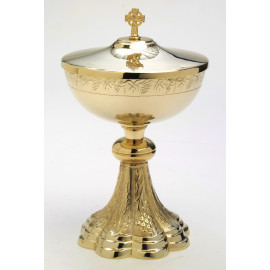
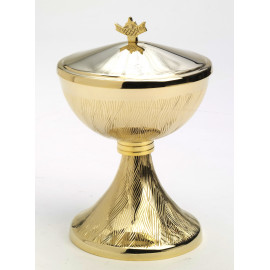
For reference, our 25 cm gilded ciborium — a popular choice for large Sunday Masses — is rated for around 600 hosts. A 12 cm brass ciborium, the workhorse of weekday Mass, holds a couple of hundred of the smaller hosts used in many parishes.
Matching Capacity to Your Congregation
Count your communicants, not your attendance: in many parishes about 70–80 percent of those present come forward for Communion, and the number varies with the season. A weekday Mass with 20 communicants needs a mini ciborium of 11–14 cm. A Sunday Mass with 150 communicants is comfortable with a 16–18 cm ciborium. A cathedral with 800 communicants at the principal Mass needs the largest models, and often more than one ciborium, or a ciborium plus a stacking set.
Remember that the ciborium also reserves hosts in the tabernacle after Mass. Parishes that keep a substantial reserve for adoration and for the sick often keep one large ciborium — or a stacking set — for reservation, and a smaller one for distribution. Our guide to ciborium vs. pyx explains how the reserved hosts are later carried to the homebound.
Stacking Ciboria: Reserving Hundreds of Hosts
A stacking ciborium is a deep-bowled ciborium with a close-fitting lid, designed so that two or three can be nested and stacked inside the tabernacle. Stacking is the standard solution when a parish reserves several hundred hosts: the bowls take the footprint of one ciborium but hold the contents of three, and the tabernacle shelf height is the only limit. We stock double and triple stacking models in our ciborium collection; they are also the usual choice for churches that expose the Blessed Sacrament regularly.
Does Host Size Change Capacity?
Yes — significantly. The small hosts used for the congregation are typically about 3 to 3.5 cm across; the large host the priest receives can be 5.5 cm or more. A ciborium that holds 200 small hosts may hold fewer than half that number of large ones. If your parish uses larger hosts, or hosts of an unusual thickness, size up: the cost of a slightly larger ciborium is small next to the awkwardness of running short at Communion, and larger ciboria are also deeper, which keeps the hosts from pressing against the lid.
When You Need a Custody Instead
For very large reservations some churches use a custody — a flat, wide vessel with a lid, designed for the tabernacle rather than the altar. A custody holds more hosts in less height than a ciborium, and it is the traditional vessel for reserving the Blessed Sacrament for a large number of communicants. Many sacristies combine both: ciboria for Mass, a custody for the tabernacle reserve, and a pyx for the sick.
Frequently Asked Questions
Q: How many hosts do I need for 100 communicants?
A: Plan for about 110–120 hosts to allow for visitors and a small reserve. A 14–16 cm ciborium, typically rated at 50–150 hosts, covers a congregation of 100 communicants comfortably.
Q: What size ciborium is best for a small chapel?
A: A mini ciborium of 11–14 cm, holding 20–50 hosts, is the standard choice for weekday Mass and small chapels. If the chapel reserves the Blessed Sacrament in the same ciborium, choose the upper end of that range.
Q: Can you stack hosts in a ciborium to fit more?
A: Hosts naturally lie in shallow layers, and a ciborium should not be filled to the brim — the lid must close without pressing the hosts. To hold more, choose a deeper bowl or a stacking ciborium rather than piling hosts higher.
Q: How full should a ciborium be filled?
A: Fill it so the lid rests freely, with the hosts lying flat below the rim. A ciborium packed to the brim risks crushing hosts and spilling fragments; it is better to consecrate a second ciborium than to overfill one.
Q: What is the largest ciborium you sell?
A: Our cathedral and concelebration ciboria reach 34 cm in diameter, with typical capacities of 600–1,000+ hosts. They are made for the largest Sunday Masses and for parishes that reserve a large number of hosts for adoration.
Conclusion
Choose by communicants first, then by hosts: a mini ciborium for weekday Mass, a standard ciborium of 14–18 cm for Sunday parish Masses, a large or concelebration model for cathedrals — and a stacking set when the tabernacle must hold several hundred hosts. Every size in this guide is available in our liturgical ciborium collection; for the vessels that work alongside it, see the complete guide to Catholic altar vessels.