

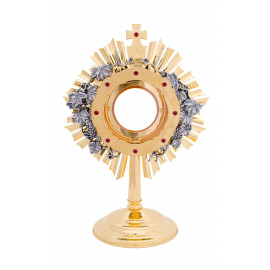
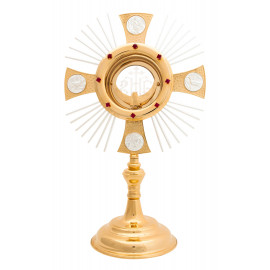
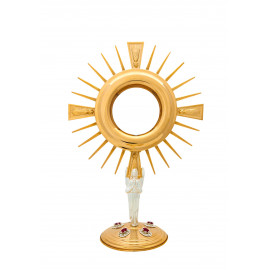
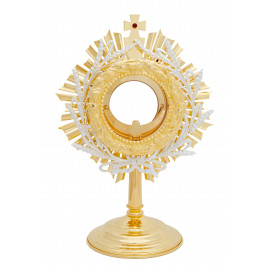
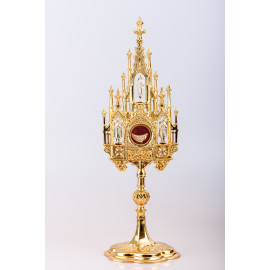
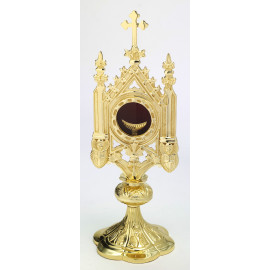
Custodia, monstrance and ostensorium are three names for the same basic task: holding the consecrated host so the faithful can see it. The differences are mostly about size, setting and the way the vessel is used. A small custodia may sit on a side altar; a large monstrance may be carried through the streets on Corpus Christi. Both are exposition vessels, and both are distinct from the ciborium used to reserve hosts in the tabernacle.
The confusion is old. In English, “custody” is used for the vessel that keeps and shows the Blessed Sacrament; “custodia” is the Latin form; “ostensorium” comes from the Latin ostendere, “to show.” Many catalogues use the words interchangeably. Others distinguish the custodia as the receptacle that holds the host within the monstrance. The safest approach is to look at the object itself: if it has a lunette and a glass capsule for exposing one host, it is doing the work of a custodia or monstrance.
What does “custodia” mean?
Custodia is Latin for a keeping or guarding. In liturgical use it names the vessel that holds and protects the consecrated host, often while showing it. A custodia can be a complete exposition vessel with a stand, a glass capsule and a lunette; it can also refer to the receptacle inside a larger monstrance. The word is common in Spanish and Italian, and it appears in English liturgical writing as a synonym for the smaller exposition vessel.
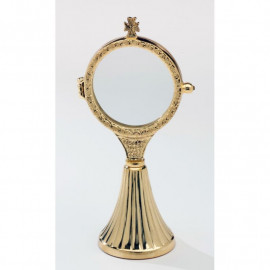
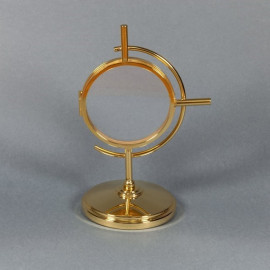
Our custodias are complete vessels. They range from 11 cm mini custodias for a side chapel to 40 cm display custodias for a parish church. The host sits in a lunette behind glass, and the vessel is placed on an altar, a throne or a tabor.
What is a monstrance?
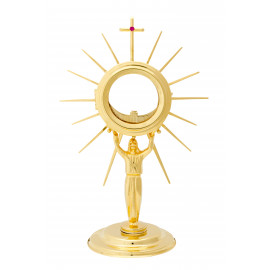
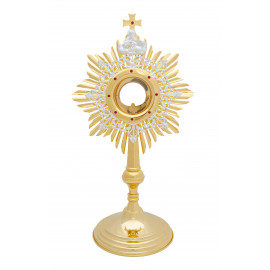
A monstrance — from monstrare, “to show” — is the large exposition vessel normally used for public adoration, Benediction and processions. It usually has a prominent sunburst or architectural frame around the glass capsule, and it is often tall enough to be seen from the back of a church. A monstrance may be carried under a canopy in a Corpus Christi procession, or placed on a throne for adoration.
The boundary between a large custodia and a monstrance is not fixed. A 40 cm gold-plated custodia and a large processional monstrance both expose the host; the monstrance is usually more elaborate, larger and designed for public ceremony. If you need a processional piece for the main sanctuary, start with our monstrances and ostensoria and check the height, weight and tabor fit.
What is an ostensorium?
Ostensorium comes from ostendere, “to show.” It is a general term for a vessel that displays a sacred object, and in Eucharistic use it is essentially another name for a monstrance or custodia. Some writers prefer “ostensorium” for the vessel that shows the host, and “custodia” for the receptacle that guards it. In practice, the two words overlap, and catalogues often list the same object under both names.
If a product description says “ostensorium,” look for the same practical details: host diameter, lunette type, glass capsule size, height and stability. The name does not tell you whether the vessel is suitable for a large host or a procession; the measurements do.
The practical differences
| Feature | Custodia | Monstrance | Ostensorium |
|---|---|---|---|
| Main job | Hold and show the host | Show the host, often for public ceremony | Show the host |
| Typical size | 11–40 cm in our collection | Often 40–100 cm or more | Varies with the object |
| Setting | Side chapel, altar, throne | Main sanctuary, procession | Church or chapel |
| Portability | Usually easy to move | May need two carriers or a tabor | Depends on size |
| Ornament | Simple to ornate | Often elaborate | Varies |
The terms are not ranked. A small custodia is not a “lesser” monstrance; it is the right tool for a side chapel or a home oratory. A large monstrance is not automatically better for every parish; it may be too heavy for a narrow sanctuary or a small tabor. Choose by the host, the space and the way the vessel will be used.
Which one should you choose?
Start with the host. If you expose a large host, check the lunette and the glass capsule before anything else. A 16 cm capsule and an adjustable guide are more important than the style of the base. If you expose a small host in a side chapel, an 8–9 cm capsule mini custodia is easier to handle and store.
Then consider the setting. A vessel that stays on an altar can be smaller and lighter. A vessel that will be carried in a procession needs a secure lunette, a stable base and a height that suits the carrier and the canopy. If the vessel will sit on a tabor between stations, measure the tabor top and check the fit. Our guide to what a tabor is explains the stand.
Finally, consider the rest of the sanctuary. Gold-plated brass is the standard material in our collection; it is durable and repairable. A baroque or rococo custodia can match existing candlesticks and a ciborium, while a simple round base may suit a modern church. The ornament should serve the liturgy, not compete with the Blessed Sacrament.
Frequently Asked Questions
Q: Is a custodia the same as a monstrance?
A: The words overlap. Many sources treat custodia as a synonym for monstrance; others use custodia for the receptacle that holds the host inside the monstrance. In practice, a custodia is often the smaller exposition vessel, while a monstrance is the large, often processional piece.
Q: Is an ostensorium a monstrance?
A: In Eucharistic use, yes — ostensorium is a general term for a vessel that shows the host, and it is often used as another name for a monstrance or custodia. The practical details (host size, lunette, capsule, height) matter more than the label.
Q: What is the difference between a custodia and a ciborium?
A: A ciborium is a lidded vessel used to reserve hosts in the tabernacle and distribute Communion. A custodia is an exposition vessel: the host is visible in a lunette behind glass. If you need to store hosts, choose a ciborium; if you need to show the host, choose a custodia.
Q: Can a custodia be used for Benediction?
A: Yes. Benediction uses the Blessed Sacrament exposed in the lunette. A custodia with a secure lunette, a stable base and a suitable height can be used, provided the vessel is dignified and the host is clearly visible.
Q: How do I choose between a custodia and a monstrance?
A: Choose by host size, setting and portability. A smaller custodia suits a side chapel or home oratory; a larger monstrance suits the main sanctuary and public processions. Check the lunette, capsule, height, weight and tabor fit before you decide.
Related reading
Continue with what a monstrance is, monstrance vs tabernacle vs ciborium, and how to choose a monstrance. For the vessels themselves, see our custodias and monstrances.


