
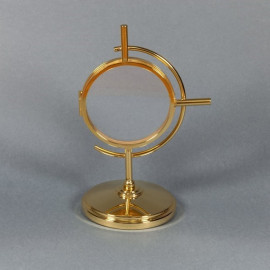
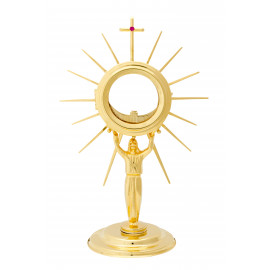
Choosing a monstrance comes down to three matches: the size must fit the space, the luna must fit the host, and the style must fit the church. Here is how to get all three right.
Start with the Host and the Luna
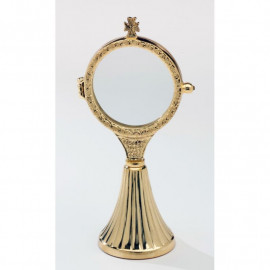
The luna (lunette) is the glass holder inside the monstrance, and it must match the host you will expose. Most of our monstrances are made for a traditional host; the Neo-Gothic model takes hosts up to Ø 3 cm, while the large-host monstrances are built for hosts of 12.5 cm and 14.5 cm. If your parish exposes a large host, measure it before ordering — a standard luna will not hold it.
Match the Size to the Space
| Setting | Height | Why |
|---|---|---|
| Home oratory, small chapel | 17–20 cm | Readable up close; easy to store ($242–$1,045) |
| Parish chapel, side altar | 30–40 cm | Visible from a few rows back ($479–$1,827) |
| Large church, processions | 45–52 cm | Visible from the back of the nave; more stable when carried ($1,666–$2,698) |
When in doubt, size up: a monstrance that is slightly too large still reads beautifully, while one that is too small disappears during adoration.
Choose the Style
- Sunburst — the timeless classic; round window with radiating rays. Fits any church.
- Neo-Gothic — pointed arches and tracery; ideal for traditional sanctuaries and stone churches.
- Baroque / traditional — scrollwork, figures and rich ornament; matches older continental interiors.
- Apostle designs — figures of the twelve apostles around the luna; the most ceremonial option.
Check the Details
- Base stability — critical if the monstrance will be carried in processions or Benediction.
- Glass — clear, undamaged, and easy to clean; the host must be visible from every angle.
- Finish — galvanic gold plating or 24-carat gilding; both wear well with simple care.
- Luna mechanism — the clip should hold the host firmly but release it without strain.
New or Used?
Used and antique monstrances can be beautiful and affordable, but check the luna, glass, gilding and stability before buying — and remember that a second-hand vessel should be blessed before liturgical use. Our full checklist: Antique and Used Monstrances.
What Comes Next
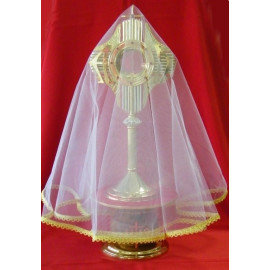
Once the monstrance is chosen, plan the supporting pieces: a humeral veil for Benediction, a tabor or throne for longer exposition, and a safe place to store the vessel. For price expectations, see How Much Does a Monstrance Cost?
Frequently Asked Questions
Q: What size monstrance do I need for a chapel?
A parish chapel or side altar is best served by a 30–40 cm monstrance. For a home oratory, 17–20 cm is sufficient; for a large church, choose 45–52 cm.
Q: What host size fits a standard monstrance?
Most monstrances take a traditional host, and models like our Neo-Gothic monstrance are rated for hosts up to Ø 3 cm. Large-host monstrances are built for 12.5 cm and 14.5 cm hosts.
Q: How much should a parish spend on a monstrance?
Parishes typically spend $479–$1,827 for a chapel or church monstrance; our full range runs from $242 (chapel) to $2,698 (45 cm, large host). A monstrance is a lifetime purchase, so buy the best fit rather than the lowest price.
Q: Can I use a monstrance at home?
Yes — a chapel-size monstrance may be kept in a home oratory as a devotional object. Public exposition of the Blessed Sacrament, however, is reserved to a priest or deacon and takes place in a church or chapel.
Conclusion
Host first, size second, style third — and check stability before anything else if the monstrance will be carried. Browse our monstrances with these three matches in mind, and the right vessel will pick itself.
