

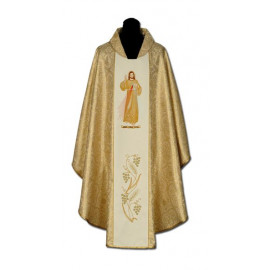
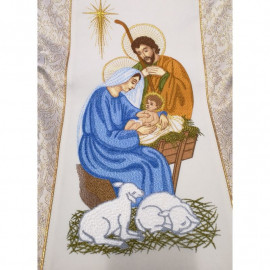
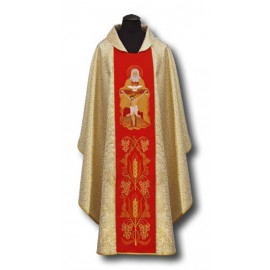
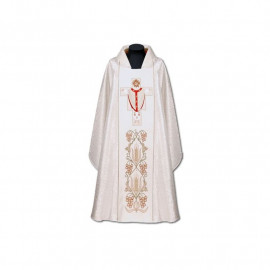
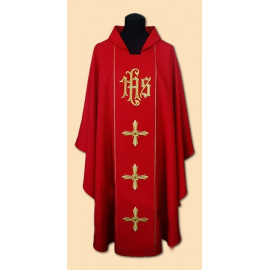
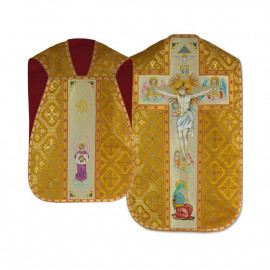
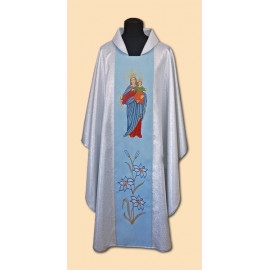
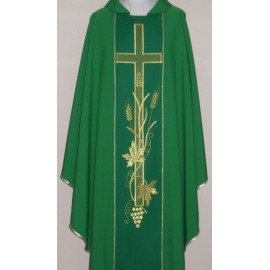
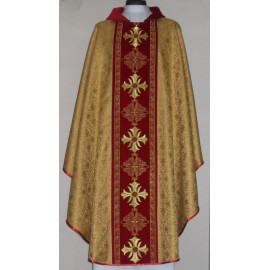
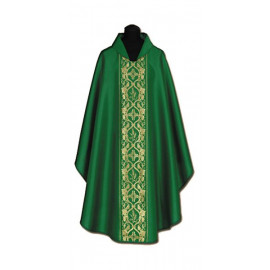
Most chasubles in our collection are 127 × 158 cm or 130 × 160 cm, but the right fit depends on the cut and on the priest's measurements. A Roman chasuble sits closer to the body, a Gothic chasuble drapes more fully, and a semi-Gothic chasuble falls between the two. Measure the shoulders and the desired length before comparing sizes.
What the Measurements Mean
Chasuble measurements are usually given as width × length. The width is measured across the shoulders or across the widest part of the garment; the length is measured from the shoulder line to the hem. A 127 × 158 cm chasuble is a common parish size. A 130 × 160 cm chasuble gives a little more room through the shoulders and a slightly longer drop.
These are finished garment measurements, not body measurements. The chasuble should hang freely over the alb and stole without pulling across the chest or riding up at the back. If the priest is tall, check the length; if he is broad-shouldered, check the width. The cut also changes how the numbers feel: a Gothic chasuble uses more fabric and drapes wider than a Roman chasuble of the same nominal size.
Roman vs Gothic Fit
The Roman (conical) chasuble is the more fitted cut. It is narrower across the shoulders and often shorter at the sides, so it follows the body more closely. The Gothic chasuble is wider and fuller; it falls in a broad, even drape and gives more coverage. The semi-Gothic chasuble is a middle shape, with more room than the Roman but less volume than the Gothic.
For a celebrant who prefers a traditional, close fit, the Roman collection is the natural starting point. For a fuller, more dramatic drape, see the Gothic collection. For a compromise, see the semi-Gothic collection.
How to Measure a Priest
You need two measurements: shoulder width and the desired length. Ask the priest to stand naturally, wearing a normal shirt, with the arms relaxed at the sides. Measure across the back from the point of one shoulder to the point of the other. Then measure from the shoulder line down to where the hem should fall — usually below the knee, but the exact length is a matter of cut and preference.
If the priest wears a bulky alb or a heavy stole, allow a little extra room. If the chasuble is intended for a tall celebrant, check the back length rather than relying on the nominal size. When in doubt, compare the measurements with a chasuble the parish already uses and fits well. The goal is a clean drape, not a tight fit.
Common Sizes in Our Collection
In our current collection, 103 listings give 127 × 158 cm and 99 listings give 130 × 160 cm. Some shorter models are described with a 125 cm length. The exact size is printed on each product page, together with the fabric and what is included. If a parish needs a specific size, start with the product pages and compare the measurements before ordering.
Most listings also mention a matching stole. If the parish is ordering for several priests, keep a simple record of each celebrant's preferred size and cut. That avoids repeat measuring and makes it easier to order a replacement in the same style. Our full chasuble collection lets you filter by style and color.
What If the Chasuble Is Too Long?
A chasuble that is slightly too long can still hang correctly if the cut is right, but a garment that drags or catches under the arms will be uncomfortable and will wear at the hem. Do not alter the embroidery or the front panel without a professional vestment maker. If the length is wrong, exchange the garment for a shorter size or a different cut rather than cutting it at home.
For storage, use a wide vestment hanger so the shoulders keep their shape. Avoid sharp folds and hanging the chasuble by the neck opening. A garment bag protects the embroidery between Masses.
Care and Storage
Most embroidered chasubles are dry clean only. Check the care label on the individual product page. Store the chasuble on a wide hanger, away from direct sunlight, and repair loose threads before they pull the embroidery. Velvet and brocade should not be pressed flat; steam carefully if needed. For more detail, see our guide to caring for embroidered vestments.
Frequently Asked Questions
Q: What is the standard size of a Catholic chasuble?
A: A common size is 127 × 158 cm, with 130 × 160 cm also widely used. The right size depends on the priest's shoulders, height and preferred cut.
Q: How do I measure for a chasuble?
A: Measure across the back from shoulder point to shoulder point, then measure from the shoulder line to the desired hem. Allow extra room for a bulky alb or stole.
Q: Should a chasuble be below the knee?
A: The hem usually falls below the knee, but the exact length depends on the cut and the celebrant's preference. The key is a clean drape without dragging or pulling.
Q: Is a Gothic chasuble bigger than a Roman chasuble?
A: Yes. A Gothic chasuble is wider and fuller than a Roman chasuble of the same nominal size. A semi-Gothic chasuble sits between the two.
Q: Can a chasuble be altered?
A: Minor hem adjustments may be possible, but embroidery and front panels should be handled by a professional vestment maker. If the size is wrong, exchanging the garment is usually safer.
Continue Reading
- How to Choose a Chasuble: Complete Guide for Priests and Sacristans
- Roman Chasuble vs Gothic Chasuble: Key Differences Explained
- How Much Does a Chasuble Cost? Price Ranges Explained
- How to Store Liturgical Vestments Properly
Related: See standard sizes in our wedding chasubles.


