

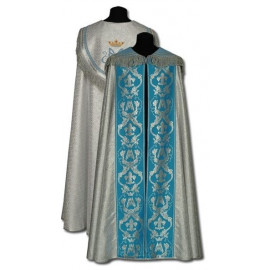
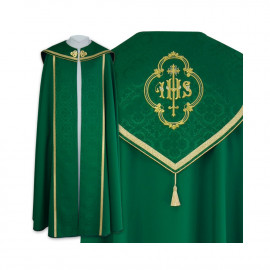
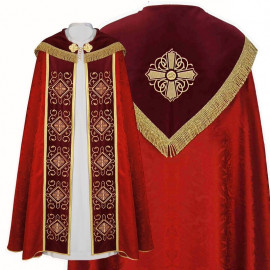

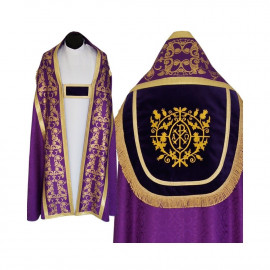
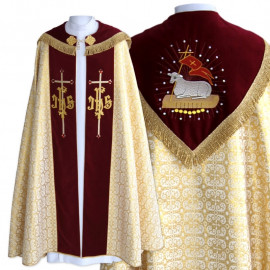
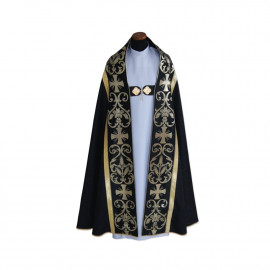
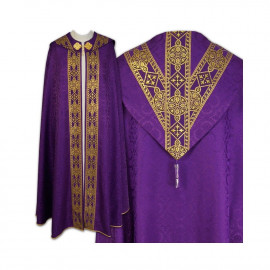
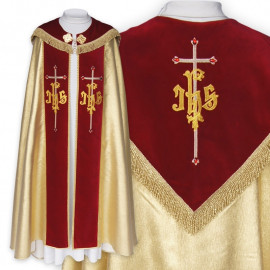
The difference between a cope and a chasuble is simple: the chasuble is the closed outer vestment worn by the priest at Mass, while the cope is an open, semicircular mantle worn outside Mass — for processions, Benediction of the Blessed Sacrament, the Liturgy of the Hours, and sacraments celebrated outside the Eucharist. The cope fastens at the breast with a clasp called a morse; the chasuble does not fasten at all.
Both are outer vestments, both are worn over the alb and stole, and both are made in the liturgical colors. But they serve different liturgies, and confusing them is one of the most common questions from sacristans and parish volunteers. This guide explains the differences, the history, and how to choose each.
What Is a Chasuble?
The chasuble is the sleeveless outer vestment worn by the priest celebrating Mass. It is closed at the front and slips over the head, covering the alb and stole. Its shape and color follow the liturgical season; the chasuble is the vestment of the Eucharist.
The word comes from the Latin casula, "little house," because the garment originally covered the whole body. Over the centuries it was cut down so the priest's arms could move freely. For the full history, see our guide to the history of the chasuble.
What Is a Cope?
The cope is a long, semicircular mantle open at the front and fastened at the breast with a morse. It is worn over the alb or surplice for celebrations outside Mass: processions, Benediction, the Liturgy of the Hours, the Asperges, and sacraments such as baptism, confirmation, matrimony, and funerals outside Mass.
The cope leaves the arms free, which is why it is used for movement — walking in procession, carrying the Blessed Sacrament, or blessing with holy water. A bishop normally wears it with a mitre and crozier. See our Catholic cope collection for 126 designs in every liturgical color.
Cope vs Chasuble: Key Differences
| Feature | Cope | Chasuble |
|---|---|---|
| Shape | Semicircular mantle, open at the front | Closed, sleeveless outer vestment |
| When worn | Outside Mass: processions, Benediction, Liturgy of the Hours, sacraments outside Mass | Mass (Eucharistic liturgy) |
| Fastening | Morse, clasp, or hook and chain at the breast | None; slips over the head |
| Arms | Free; the cope drapes | Covered by the garment |
| Hood | Decorative hood or shield at the back | None |
| Typical use | Movement, processions, blessings | Celebration of the Eucharist |
When to Wear Each
- Mass: chasuble.
- Processions, Benediction, the Liturgy of the Hours, sacraments outside Mass: cope.
- Asperges before Mass: cope or chasuble according to local custom.
- Funerals: chasuble for the Mass; cope for the absolution and the procession to the grave.
If you are choosing a Mass vestment, see our guide to how to choose a chasuble. If you are equipping a parish for processions and Benediction, start with a white or gold cope and add colors as needed.
Can a Cope Be Worn at Mass?
Not by the priest celebrating Mass — he wears the chasuble. The cope is used for the Asperges and processions before Mass, and for celebrations outside Mass. In some ceremonies a bishop may wear a cope for the entrance procession, but the Eucharistic liturgy itself is celebrated in the chasuble.
How to Choose
Choose the chasuble for the Mass and the cope for everything around it. Match the cut — Roman, Gothic, or semi-Gothic — and the color. A parish that holds Benediction regularly needs at least a white or gold cope; a parish with processions may also need green, red, and violet. Our Catholic copes are made in Poland and many include a matching inner stole.
Frequently Asked Questions
Q: What is the difference between a cope and a chasuble?
A: The chasuble is the closed outer vestment worn at Mass. The cope is an open, semicircular mantle worn outside Mass — for processions, Benediction, the Liturgy of the Hours, and sacraments outside the Eucharist. The cope fastens with a morse; the chasuble does not.
Q: Can a priest wear a chasuble outside Mass?
A: The chasuble may be worn for ceremonies directly before or after Mass, such as the Asperges or the absolution of the dead, to avoid changing vestments. For other non-Eucharistic celebrations, the cope is the proper vestment.
Q: Do a cope and chasuble have to match?
A: They should match in color and ideally in style. Many parishes buy a cope that matches their existing chasuble set so the two can be used together during the same celebration.
Q: Which is worn for Benediction?
A: The cope — usually white or gold — with the humeral veil for the blessing. The chasuble is not worn at Benediction.
Q: Is a cope worn over a chasuble?
A: No. The cope is worn over the alb or surplice, not over the chasuble.
Q: How much does each cost?
A: Our copes range from $202 to $845; chasubles vary by style and fabric. See the collections for current prices.
Conclusion
The cope and the chasuble are complementary, not interchangeable. The chasuble is the vestment of the Mass; the cope is the vestment of the procession, Benediction, and the Church at prayer outside the Eucharist. Browse our Catholic cope collection to find the right color and style for your parish.
