
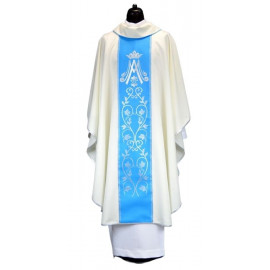
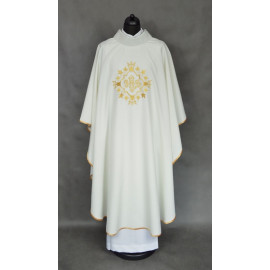
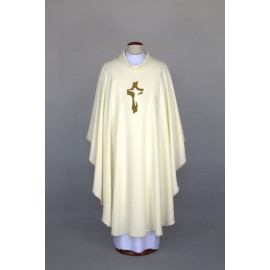
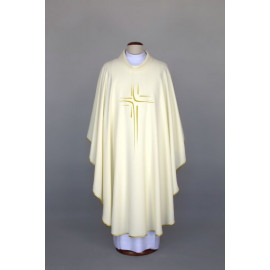
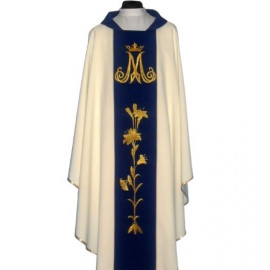


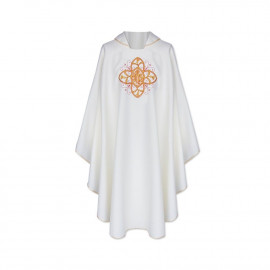
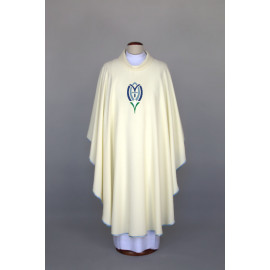
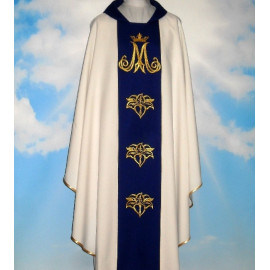




What Are Ecru Chasubles?
An ecru chasuble is a Mass vestment in the natural ivory tone between white and cream. Ecru is not a separate liturgical colour: it is a shade of white, and it is worn on the days when white vestments are prescribed. This collection gathers 31 ecru chasubles, priced from $141 to $968, made in Poland; 21 of the listings include a matching stole.
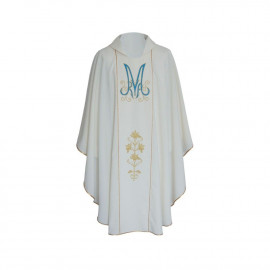
Ecru is the warmest of the white family. It reads as softer than bright white under candlelight, photographs well, and is a favourite for weddings, Marian feasts and solemnities where a pure white would feel cold. 13 of the 31 models in this collection are Marian chasubles.
When Is an Ecru Chasuble Worn?
Because ecru is a shade of white, it follows the rules for white vestments:
- Christmas and Easter — the great solemnities of the Lord's birth and resurrection.
- Feasts of the Lord that are not of the Passion — for example the Presentation, the Transfiguration or Corpus Christi.
- Feasts of Our Lady, of the angels and of saints who were not martyrs.
- Weddings, baptisms, ordinations and religious profession — the sacraments and celebrations of joy.
- Funerals — white may be used at funeral Masses in the Roman rite, especially for the baptised and for children, and local custom varies.
The General Instruction of the Roman Missal (no. 346) lists white among the liturgical colours for these occasions. For the calendar see our complete guide to liturgical colours.
Ecru vs White vs Gold
The three belong to the same family, but they read differently. White is the pure liturgical colour of joy and glory; gold is its most solemn festive variant; ecru is a softer ivory shade of white, warmer and less stark. None of them is "more correct" — the choice is aesthetic and practical. Ecru hides the marks of use better than bright white and is often chosen for a first set or for a church with warm lighting.
For the other shades see our white chasubles and gold chasubles.
Ecru Chasuble Styles in This Collection
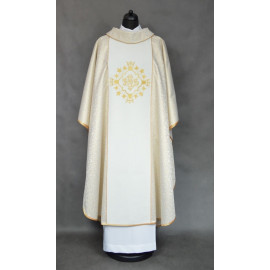
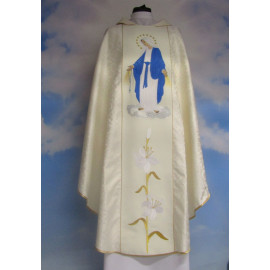
The 31 ecru chasubles are mostly classic full-cut designs. 6 are described as Gothic, with a broad yoke and a full drape, and 1 is semi-Gothic; the rest do not name a cut in the listing. 13 of the 31 are Marian chasubles with embroidered Marian symbols, which makes this the strongest colour collection for the feasts of Our Lady.
For the cuts see Gothic chasubles, semi-Gothic chasubles and Roman chasubles; for the Marian designs see our Marian chasubles.
Fabrics and Embroidery
The listings name jacquard on 4 models, brocade on 1, velvet trim on 2 and a polyester composition on 1; the rest are described as light, breathable fabrics suitable for standard washing and ironing. 13 models carry a cross or crucifix motif, 3 the IHS monogram and 3 a rosette; several of the Marian pieces add floral and Marian embroidery.
Ecru is a neutral ground that makes gold thread glow and silver thread look restrained, so it suits both festive and quieter celebrations. See the anatomy of the garment in our guide to the parts of a chasuble.
Sizes and Fit
The ecru collection contains two measured patterns: 8 listings give 127 × 158 cm (50 × 62.2 in), the modern Gothic pattern, and 7 give 130 × 160 cm (51.2 × 63 in), the older full-cut pattern. The remaining listings do not state dimensions. If the celebrant is unusually tall or short, contact us before ordering — sizes can often be adjusted because we work directly with the workshop. Our guide how to measure for a chasuble explains which measurements matter.
What Is Included
21 of the 31 ecru chasubles include a matching stole, and 15 describe it specifically as an inner stole; the other 10 listings do not mention a stole, so check the individual product page. These are chasuble-and-stole sets, not full Roman sets; for a maniple, burse or chalice veil see our Roman chasubles.
Ecru Chasuble Prices
Prices run from $141 for a simple ecru chasuble with an embroidered belt to $968 for the heavily embroidered Jesus on the cross model. The distribution across the 31 models:
| Price range | Models |
|---|---|
| $141–$199 | 11 |
| $200–$299 | 12 |
| $300–$399 | 4 |
| $400 and up | 4 |
Most of the collection sits below $300, which makes ecru one of the most affordable ways to add a white-family set. For a wider view see how much does a chasuble cost.
Care and Storage
Store the chasuble on a wide padded hanger or rolled flat, away from direct sunlight and damp. Ecru shows stains more readily than darker colours, so spot clean promptly with a soft cloth, avoid bleach, and never iron directly over embroidery. For deeper cleaning use a specialist dry cleaner. More in our guide how to care for embroidered vestments.
Made in Poland and Shipping
Our ecru chasubles are made in Poland, in our workshop in Lublewo Gdańskie. In-stock pieces are dispatched within 72 hours and reach the United States by FedEx in about 2–5 business days; made-to-order items add 3–14 business days. Orders over $100 ship free within the United States. See Made in Poland, the shipping information and the returns policy.
Frequently Asked Questions
Is ecru a liturgical colour?
No. Ecru is a shade of white, not a separate colour of the calendar. It is worn on the days when white vestments are prescribed, and the choice between white, ivory and ecru is aesthetic.
What does ecru mean?
The word comes from French and means "unbleached" or "raw". In vestments it describes the natural ivory tone of unbleached fabric, between white and cream.
Ecru vs white — what is the difference?
White is the pure liturgical colour; ecru is a warmer, softer ivory shade of the same family. Ecru hides marks better and reads more warmly under candlelight, while white is brighter and more formal.
When can a priest wear an ecru chasuble?
Whenever white is prescribed: Christmas, Easter, feasts of the Lord, Our Lady, the angels and non-martyr saints, and at weddings, baptisms, ordinations and religious profession.
Is ecru suitable for weddings?
Yes. Ecru is one of the most popular choices for wedding Masses because it is warm and ivory-toned rather than stark white, and it photographs well. See our wedding chasubles.
Is ecru suitable for funerals?
White vestments may be used at funeral Masses in the Roman rite, and ecru, as a shade of white, can serve the same purpose. Local custom varies, so follow the practice of the diocese or parish.
Are ecru chasubles Marian?
Many are. 13 of the 31 ecru chasubles in this collection are Marian designs with embroidered Marian symbols, which makes ecru a natural choice for the feasts of Our Lady.
What fabrics are ecru chasubles made of?
The listings name jacquard (4 models), brocade (1), velvet trim (2) and polyester (1); the rest are light, breathable fabrics suitable for standard washing and ironing. Check the individual product page for the exact composition.
How much does an ecru chasuble cost?
From $141 for a simple ecru chasuble with an embroidered belt to $968 for a heavily embroidered model. 11 cost under $200, 12 cost $200–$299, 4 cost $300–$399 and 4 cost $400 or more.
Is a stole included with ecru chasubles?
21 of the 31 listings include a matching stole, 15 of them described as an inner stole. Check the individual product page for the other 10.
Related Reading
- Complete Guide to Liturgical Colors: What to Wear and When
- How to Choose a Chasuble: Complete Guide for Priests and Sacristans
- The History of the Chasuble: From Ancient Rome to Modern Altars
- Parts of a Chasuble: Orphreys, Cross, Stole, Maniple and Burse Explained
- How Much Does a Chasuble Cost? Price Ranges Explained
- More from this family: all chasubles · Gothic · Roman · semi-Gothic
- Shop by colour: white · red · green · purple · black · pink · gold · ecru
