


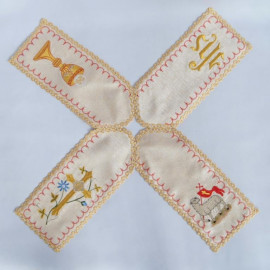
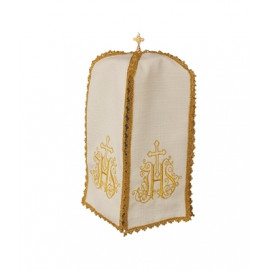
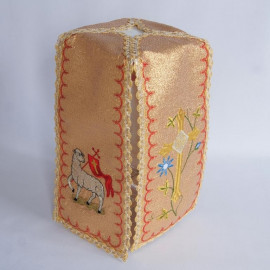
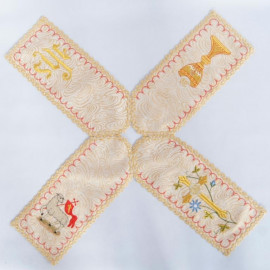
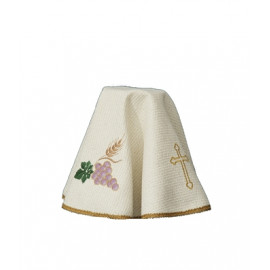
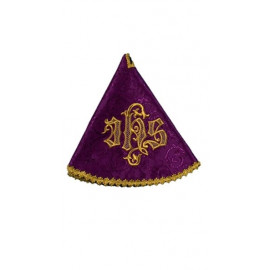
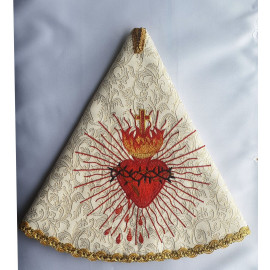
A ciborium veil that is too small will not cover the lid; one that is too large will bunch around the vessel and hide the embroidery. The right size is the one that covers the ciborium and falls naturally over the bowl without pulling. This guide explains how to measure a ciborium, what the standard sizes are, and how to choose a veil for a parish, chapel, or cathedral vessel.
Why the Right Size Matters
The veil is not a flat cloth laid on a table: it has to sit over a three-dimensional vessel. If the diameter is too small, the veil rides up on the lid and leaves the rim exposed. If it is too large, the fabric gathers in folds and the motif disappears. A well-sized veil covers the lid, falls evenly over the bowl, and leaves the embroidery visible from the front.
How to Measure a Ciborium
You need two measurements: the width of the bowl at its widest point and the width of the lid. Use a soft tape measure and measure across the centre, not around the circumference. If the lid is wider than the bowl, use the lid measurement. Then add enough allowance for the veil to fall over the sides; the veil should be wider than the vessel, not the same size.
If you already own the ciborium, measure it empty and with the lid on. If you are buying a ciborium and a veil together, check the dimensions in the ciborium listing and choose the veil from the same size group.
The Standard Sizes
| Veil diameter | Typical vessel | Notes |
|---|---|---|
| 24 cm (9.4 in) | Small or chapel ciborium | The Marian design is listed as 24 cm high |
| 29–30 cm (11.4–11.8 in) | Standard parish ciborium | The most common size in our collection |
| 45 cm (17.7 in) | Large ciborium | A wider drop for a deeper bowl |
| 53 cm (20.9 in) | Large or cathedral ciborium | For vessels that need a fuller drape |
Matching the Veil to the Vessel
A standard parish ciborium — the kind used for the Communion of the faithful on Sunday — usually takes a 29–30 cm veil. A smaller chapel ciborium may take a 24 cm cover. A large cathedral ciborium may need 45 cm or 53 cm. The number is the diameter of the veil, not the diameter of the vessel; the veil is intentionally larger so it can drape.
If you are unsure, compare the veil diameter with the vessel width: the veil should be wider by enough to fall over the rim. Our embroidered ciborium veils list the diameter in each product description, and the ciborium veil guide explains how the veil is used.
What If the Veil Is Too Small or Too Large
A veil that is too small can be used for a smaller vessel, such as a pyx or a chapel ciborium, but it should not be stretched over a larger one. A veil that is too large can be used for a larger vessel or for a ciborium with a deeper bowl; if it is much too large, it will gather and the embroidery will be less visible. If your ciborium falls outside the listed sizes, contact us before ordering and we will confirm whether a listed veil fits.
Frequently Asked Questions
Q: What size ciborium veil do I need?
A: Measure the ciborium at its widest point. A standard parish ciborium usually takes a 29–30 cm veil; larger vessels take 45 cm or 53 cm. Each listing states the veil diameter.
Q: How do I measure a ciborium for a veil?
A: Measure the width of the bowl and the lid across the centre, using the larger figure, and choose a veil wider than the vessel so it falls over the sides.
Q: What is the standard ciborium veil size?
A: For a standard parish ciborium, 29–30 cm (11.4–11.8 in) is the usual size. Smaller chapel ciboria may take 24 cm; larger vessels take 45 cm or 53 cm.
Q: Can a 53 cm veil fit a standard ciborium?
A: It can, but it will drape more fully and may gather around the vessel. A 29–30 cm veil is the better fit for a standard parish ciborium.
Q: Do you make custom sizes?
A: Our listings cover 24 cm to 53 cm. If your ciborium falls outside those sizes, contact us before ordering and we will confirm whether a listed veil fits; custom sizes are not standard.
Conclusion
Measure the vessel, choose the next size up, and check the listing. A well-sized ciborium veil covers the lid, falls evenly over the bowl, and keeps the embroidery visible. For the vessel itself, see our liturgical ciboria; for the other veils in the set, see our comparison guide.


