


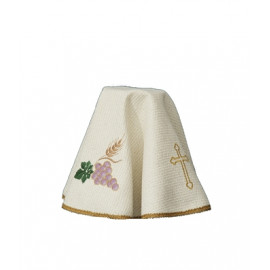
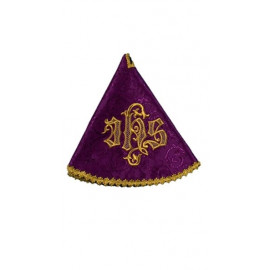
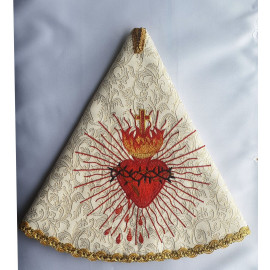
Three veils, three vessels. In a sacristy the ciborium veil, the chalice veil, and the monstrance veil are often stored together, and they are easy to confuse. They are not interchangeable: each is cut for a different vessel and used at a different moment in the liturgy. This guide explains what each veil covers, when it is used, how it is sized, and how to choose the right one for your parish.
What Each Veil Covers
The simplest way to tell them apart is to start with the vessel:
- The ciborium veil covers the ciborium — the lidded vessel that holds the consecrated hosts when the Blessed Sacrament is reserved in the tabernacle.
- The chalice veil covers the chalice prepared for Mass, together with the paten, pall, and purificator.
- The monstrance veil covers the monstrance, the vessel used to expose the Blessed Sacrament during adoration, procession, and Benediction.
All three are signs of reverence, but they serve different liturgical actions. The ciborium veil is connected with reservation; the chalice veil with the preparation of the gifts; the monstrance veil with exposition.
The Ciborium Veil
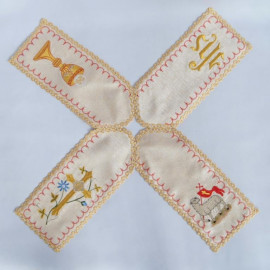
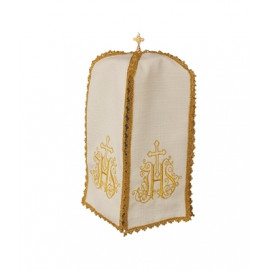
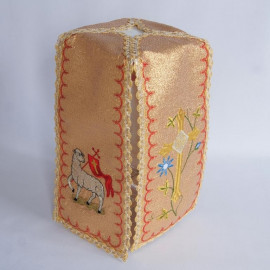
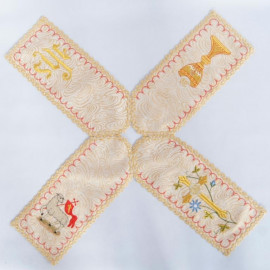
The ciborium veil is a small cover, usually square or circular, placed over the reserved ciborium inside the tabernacle. In the Latin rite it is traditionally white, with gold used on the most solemn occasions such as Holy Thursday. It protects the vessel from dust and veils it from direct view, continuing the older tradition of the tabernacle veil or conopaeum.
Our embroidered ciborium veils run from 24 cm to 53 cm and include IHS, PAX, Easter, Marian, and Eucharistic motifs. Most standard parish ciboria take a 29–30 cm veil; larger vessels take 45 cm or 53 cm. For a full explanation, see our ciborium veil size guide.
The Chalice Veil
The chalice veil covers the chalice before Mass and in procession. The General Instruction of the Roman Missal describes it as a praiseworthy practice and allows it to be either the colour of the day or white (GIRM 118). It is usually a square veil, often matching the chasuble and the burse, and it is removed at the preparation of the gifts.
Because it follows the liturgical colour, the chalice veil changes through the year: green in Ordinary Time, purple in Advent and Lent, red on Pentecost and martyrs' feasts, white or gold on solemnities. Our chalice veils are made in the same embroidered motifs as the ciborium veils, so a parish can keep a matching set.
The Monstrance Veil
The monstrance veil is longer and often fuller than the other two. It covers the monstrance during processions and outdoor adoration, and it may be used for Benediction. It is usually white or gold, and it is cut to clear the rays and the luna of the monstrance rather than to sit on a small vessel.
A monstrance veil is not a ciborium veil with a different name: the shape and drop are different. Our monstrance veils are designed for the monstrances in our chapel monstrance collection.
Side-by-Side Comparison
| Ciborium veil | Chalice veil | Monstrance veil | |
|---|---|---|---|
| Vessel | Ciborium | Chalice | Monstrance |
| When used | Whenever the Blessed Sacrament is reserved | Before Mass and in procession | Adoration, procession, Benediction |
| Typical colour | White; gold on solemnities | Colour of the day or white | White or gold |
| Typical size | 24–53 cm | Square, sized to the chalice | Longer, sized to the monstrance |
How to Choose the Right Veil
- Start with the vessel. If you are covering the reserved ciborium, choose a ciborium veil; if you are covering the chalice before Mass, choose a chalice veil; if you are covering the monstrance, choose a monstrance veil.
- Measure the widest point. A veil should be wider than the vessel so it falls naturally over the sides. For a ciborium, measure the bowl and the lid and use the larger figure.
- Match the colour to the use. Ciborium veils are traditionally white or gold; chalice veils follow the liturgical colour; monstrance veils are usually white or gold.
- Keep the set consistent. A parish that already owns embroidered vestments will usually want the veils to share the same motif and thread.
Frequently Asked Questions
Q: Is a ciborium veil the same as a chalice veil?
A: No. The ciborium veil covers the reserved ciborium in the tabernacle; the chalice veil covers the chalice prepared for Mass. They differ in size, shape, and colour customs.
Q: What colour is a ciborium veil?
A: Traditionally white, with gold for the most solemn occasions such as Holy Thursday. Some parishes use another colour as a local custom, but white remains the norm.
Q: Can I use a chalice veil on a ciborium?
A: A chalice veil is usually too small and is cut for a different vessel. Use a veil sized for the ciborium so it covers the lid and drapes over the bowl.
Q: Does a monstrance need a veil?
A: A monstrance veil is used for processions and outdoor adoration, and it may be used for Benediction. It is longer than a ciborium veil and is cut to clear the rays and the luna.
Q: How do I measure each veil?
A: Measure the widest point of the vessel and choose a veil that falls naturally over the sides. For ciboria, a standard parish vessel usually takes 29–30 cm; for chalices and monstrances, follow the dimensions of the vessel and the listing.
Conclusion
The three veils belong to one family but serve three different vessels. If you are equipping a sacristy, start with the ciborium veil, add a chalice veil in the liturgical colours you use most, and choose a monstrance veil for exposition. Our ciborium veils, chalice veils, and monstrance veils are made to be used together.


