

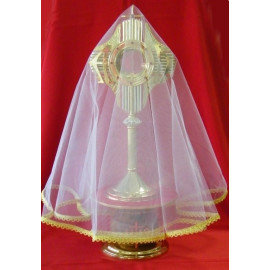
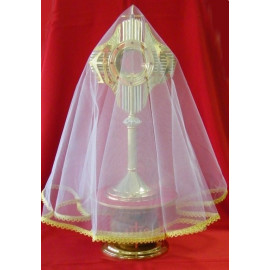
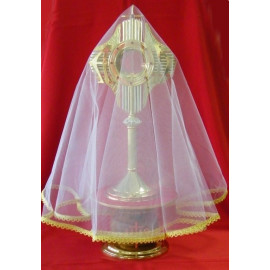
A monstrance veil that is too short looks stretched and leaves the base exposed. A veil that is too long pools on the altar and is harder to fold. The right length depends on the height of the monstrance and on how much drape you want. This guide explains how to measure and which of the four common lengths — 90, 100, 120 and 140 cm — fits your vessel.
Why the Length Matters
The veil is measured along the fabric, from edge to edge. It is not the diameter of the monstrance and it is not the height of the stand. A veil needs enough fabric to pass over the top of the sunburst, fall down the stem and reach the base with a natural drape. If the veil is short, it pulls across the metal and leaves the lower part of the monstrance uncovered. If it is very long, it hides the silhouette and can catch on the altar steps.
How to Measure a Monstrance for a Veil
- Measure the height. Place the monstrance on a flat surface and measure from the bottom of the base to the top of the sunburst.
- Add the drape. Add 10–20 cm for a normal drape. Add more if you want the veil to reach the altar cloth.
- Check the base width. A wide, stepped base needs a longer veil so that the hem clears the feet of the monstrance.
- Choose the next size up if you are between sizes. A slightly longer veil drapes better than a short one.
Size Chart
| Veil length | Monstrance height | Typical use |
|---|---|---|
| 90 cm / 35.4 in | up to about 60 cm | Small monstrances, chapels, home oratory |
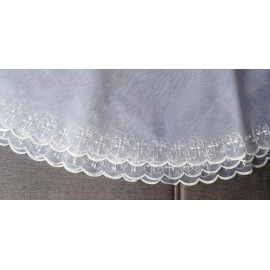
| 100 cm / 39.4 in | about 60–70 cm | Medium monstrances with an embroidered border |
| 120 cm / 47.2 in | about 70–85 cm | Most parish monstrances; the standard length |
| 140 cm / 55.1 in | above about 85 cm | Large church monstrances and solemn exposition |
90 cm: Small Monstrances and Home Oratory
The 90 cm veil is the shortest option in the standard range. It suits a compact monstrance up to about 60 cm high, a chapel with a low altar, or a home oratory where the vessel is smaller. The shorter length is easier to store and to place, and it does not overwhelm a small sanctuary.
If your monstrance is 60–70 cm high, the 90 cm veil can still work, but the drape will be tighter. Measure the base width before deciding.
100 cm: Medium Monstrances with an Embroidered Border
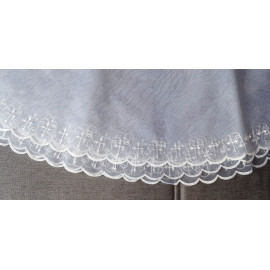
The 100 cm veil sits between the compact and standard sizes. It is a good choice for a medium monstrance when you want a visible embroidered border without the volume of a 120 cm veil. The extra 10 cm over the 90 cm size gives a more relaxed drape and covers the stem more fully.
120 cm: The Standard Parish Length
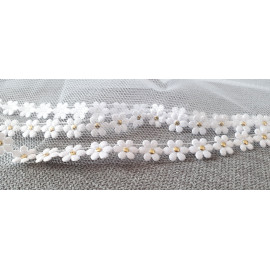
Most parish monstrances are between 70 and 85 cm high, and the 120 cm veil is the standard choice. It covers the sunburst, the stem and the base with enough fabric to fall in soft folds. It is also the length that works with the widest range of embroidery and flower borders.
If you are replacing a veil and do not have the old measurements, the 120 cm size is the safest starting point for a parish monstrance.
140 cm: Large Church Monstrances
The 140 cm veil is made for large monstrances above about 85 cm, and for solemn exposition where the veil should reach the altar cloth. It gives a full drape and covers the whole vessel, including a tall sunburst and a wide base. The extra fabric needs more space in storage and is easier to handle with two people.
What If You Are Between Sizes?
Choose the larger veil. A veil that is 5–10 cm too long still drapes naturally; a veil that is 5–10 cm too short pulls across the monstrance and leaves the base exposed. The only exception is a very tight sacristy shelf, where a shorter veil may be easier to store.
Width, Base and Shape
The length is the main measurement, but the width matters too. A monstrance with a wide, stepped base needs a veil that is wide enough to fall around the feet, not just over the top. If the veil is narrow, it will sit like a cone and leave the sides of the base visible. Check the width of the base and compare it with the width of the veil when it is opened flat.
Frequently Asked Questions
Q: How do I measure a monstrance for a veil?
A: Measure from the bottom of the base to the top of the sunburst, then add 10–20 cm for the drape. If the base is wide, add a little more so the hem clears the feet.
Q: Is a 120 cm monstrance veil a standard size?
A: Yes. A 120 cm veil fits most parish monstrances between about 70 and 85 cm high and is the most common length in the standard range.
Q: Can I use a 90 cm veil on a large monstrance?
A: Only if the monstrance is compact. On a large monstrance a 90 cm veil will pull across the sunburst and leave the base exposed. Choose 120 cm or 140 cm instead.
Q: Is the veil length the same as the monstrance diameter?
A: No. The length is measured along the fabric, edge to edge. The diameter of the monstrance is a separate measurement and does not determine the veil length on its own.
Q: Should the veil touch the altar?
A: It can, but it does not have to. A veil that reaches the altar cloth gives a fuller drape; a veil that ends above the altar is easier to fold and store.
Q: How do I choose between 100 cm and 120 cm?
A: Measure the monstrance height. If it is around 60–70 cm, the 100 cm veil gives a closer drape. If it is 70–85 cm, choose 120 cm for a standard fit.
Related Reading
See the full monstrance veil collection, the monstrances, and the comparison Ciborium Veil vs Chalice Veil vs Monstrance Veil. For care, read How to Fold, Iron and Store a Monstrance Veil.


