
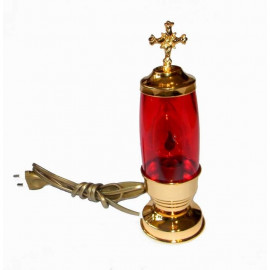
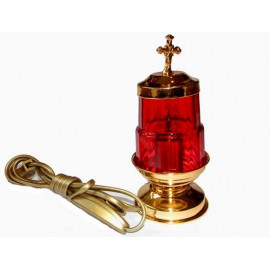
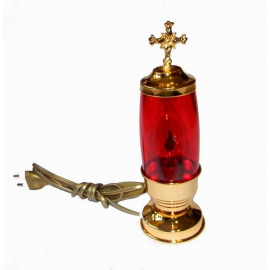
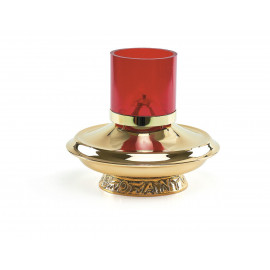
Where an open flame is not possible — or simply not practical — an electric sanctuary lamp keeps the eternal light burning before the tabernacle. Canon 940 requires that a lamp shine continuously before the Blessed Sacrament; it does not require that the lamp burn oil. Many dioceses accept electric and battery-operated lamps, and for chapels, adoration rooms, and modern churches they have become the standard solution. This guide explains how they work, what to look for, and how to choose the right one. You can browse our full sanctuary lamp collection — electric and oil-burning — or start with our explainer on what a sanctuary lamp is and why every Catholic church has one.
Why Choose an Electric Sanctuary Lamp?
Oil and wax lamps give a living flame, but they demand attention: reservoirs must be filled, wicks trimmed, and glass cleaned. An electric lamp burns indefinitely as long as power is connected, cannot be knocked over, and produces no smoke or soot on the sanctuary walls. That reliability matters — the lamp is supposed to be a continuous sign of the Real Presence, and a flame that quietly goes out at 3 a.m. sends the wrong message. Electric lamps are also the only option where fire codes, insurance policies, or building regulations prohibit open flames, and battery models cover processions, power outages, and outdoor adoration.
Types of Electric Sanctuary Lamps
Electric lamps follow the same forms as traditional oil lamps, so you can match any sanctuary:
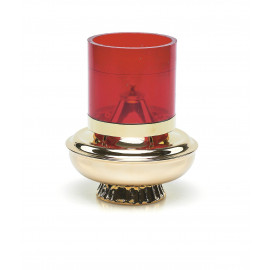
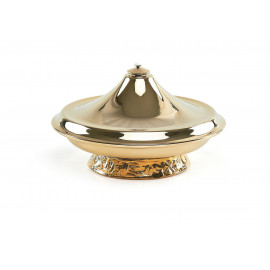
- Standing and table lamps — placed on a shelf, credence table, or altar step near the tabernacle; the most common choice for chapels and smaller churches.
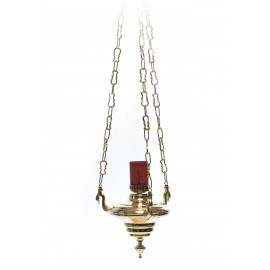
- Hanging lamps — suspended from the ceiling on a chain, usually directly in front of the tabernacle, with the bulb hidden inside a glass globe.
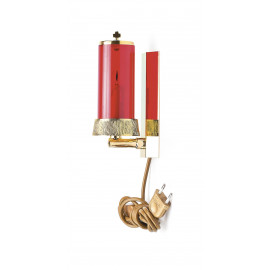
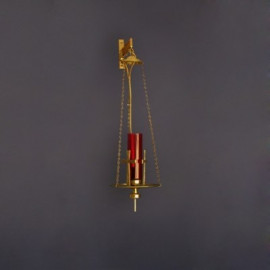
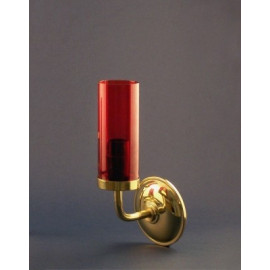
- Wall and ceiling-mounted lamps — fixed to a wall, pillar, or beam, ideal for side chapels and adoration corners.
- Battery-operated lamps — portable models with a warm LED flame for processions, temporary adoration, and home chapels.
All of them are available in our sanctuary lamp collection, in polished or satin brass, with red, amber, or clear glass globes.
Bulbs and LED Flames: What Fits
Most electric sanctuary lamps take a standard candle-shaped bulb — often an E14 or E12 candelabra base — hidden inside the globe so that only the glow is visible. Many parishes now use warm-white LED bulbs with a flicker effect, which imitate a candle flame, use a fraction of the electricity of an incandescent bulb, and last for years. When you order, check the fitting and bulb type, and keep a spare bulb in the sacristy: the simplest way to guarantee the lamp never goes dark is to have a replacement within arm's reach.
Battery-Operated Sanctuary Lamps
Battery models are the most flexible option. A candle-style lamp with a battery cartridge can be carried in a procession, placed on a home altar, or set before the tabernacle during a power cut. Rechargeable and cartridge versions typically run for days on a single charge or battery set, and modern LED flames look remarkably close to the real thing. They are also the safest choice wherever children, pets, or draughts make an open flame unwise.
Oil, Wax, or Electric? A Quick Comparison
If your diocese requires a living flame, choose an oil or wax lamp — olive oil is the most traditional fuel, echoing the Temple lamp of Exodus 27. If your priority is uninterrupted burning with minimal maintenance, choose electric. If you need portability, choose battery. Many churches actually keep both: an oil lamp at the tabernacle and a battery lamp for processions and Holy Thursday. Our guide to the sanctuary lamp covers the fuel question in more detail.
What Does an Electric Sanctuary Lamp Cost?
In our collection, electric standing and table lamps run from about $112 to $238, battery-operated models from $88 to $145, and electric hanging lamps from $181 upward, depending on size and finish. Larger ceiling-mounted lamps in cast brass reach $520 and more. Every lamp is made from solid brass castings, resistant to corrosion, and will serve a sanctuary for decades.
How to Choose: Size and Style
Match the lamp to the space. A 12–19 cm standing lamp suits a side chapel or adoration corner; 21–27 cm lamps hold their own in a parish sanctuary; hanging lamps of 38–40 cm are scaled for cathedral naves. Choose the finish to match your sanctuary furnishings — polished brass for bright interiors, satin or bronze for more subdued schemes — and remember that the red globe is the traditional sign Catholics look for. Whatever the size, the lamp should be clearly visible from the back of the nave.
Care and Maintenance
Electric lamps need very little: wipe the globe and metalwork with a soft dry cloth, check the fitting and cable at the start of each liturgical season, and keep a spare bulb on hand. Battery lamps should have their batteries or cartridges replaced before major feasts. If your lamp hangs over the sanctuary, have the chain and ceiling anchor inspected periodically by whoever maintains the building.
Frequently Asked Questions
Q: Are electric sanctuary lamps allowed by the Catholic Church?
A: Yes, in most places. Canon 940 requires a lamp that indicates and honors the presence of Christ before the tabernacle, but it does not specify oil or flame. Many dioceses and individual churches use electric lamps, particularly where fire regulations prohibit open flames. Local custom varies, so check with your diocese or pastor before ordering.
Q: What bulb does an electric sanctuary lamp use?
A: Most take a candle-shaped bulb with an E14 or E12 candelabra base, usually 5–15 watts or the LED equivalent. Warm-white LED bulbs with a flicker effect are popular because they mimic a living flame while lasting for years. Always check the fitting specified for your lamp before buying bulbs.
Q: How long do battery-operated sanctuary lamps last?
A: It depends on the model and the batteries. Candle-style lamps with battery cartridges typically burn for several days on a set of alkaline batteries, and rechargeable LED models run for many hours per charge. For continuous use, keep a spare set of batteries or a second cartridge ready so the light is never interrupted.
Q: Can an electric lamp replace an oil sanctuary lamp?
A: In many churches, yes — but not everywhere. Some dioceses prefer or require a living flame, in which case an oil or wax lamp should be used. Where electric lamps are accepted, they are valued for their safety and for burning reliably without daily attention.
Q: Where should an electric sanctuary lamp be placed?
A: Near the tabernacle, and clearly visible from the nave and the main entrance — traditionally in front of or beside the tabernacle. Standing and table lamps go on a shelf or step close to it; hanging and wall-mounted lamps are positioned at a height where the glow can be seen without obstructing the view of the altar.
The Bottom Line
An electric sanctuary lamp is a faithful, practical way to keep the sign of the Real Presence burning without fail. Choose standing, hanging, wall-mounted, or battery according to your church, check the bulb type, and keep a spare on hand. Browse our Catholic sanctuary lamps — electric and oil-burning, from $52 — and if you are setting up the whole sanctuary, our guide to setting up a Catholic church sanctuary walks through every element, from the altar to the tabernacle.
