


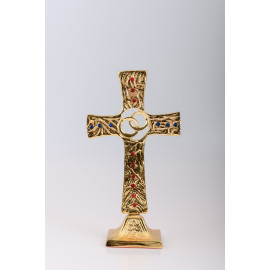
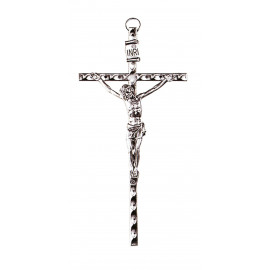
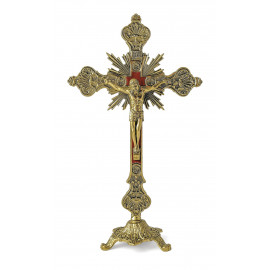

Walk into any Catholic church and you will meet at least three kinds of cross before you reach the pews: a processional cross, an altar crucifix, and the small crosses stitched into the vestments. This guide names the main types of Catholic crosses and crucifixes, explains what each is for, and shows how the shapes differ — from the familiar Latin cross to the Franciscan Tau.
The Four Main Types of Crosses
Four shapes account for most crosses you will see in Catholic use:
- Latin cross. The standard Western form: a long vertical beam crossed by a shorter horizontal one, with the lower arm longest. This is the shape of most crucifixes, altar crosses, and necklaces.
- Greek cross. Four arms of equal length. Common in Eastern iconography and in decorative church art; also the shape behind many church floor plans.
- Tau cross. Shaped like the letter T — no upper arm above the crossbar. It was St. Francis of Assisi's personal sign and remains the symbol of the Franciscan family. Read more in The Tau Cross: Meaning and Who Wears It.
- Papal cross. A cross with three horizontal crossbars, used as a heraldic symbol of the papacy. You will see it on papal coats of arms and on small devotional crosses.
Beyond these four there is a whole family of variants — Celtic, Maltese, patriarchal, Jerusalem — but for Catholic worship the four above cover nearly everything.
Types of Crucifixes by Place and Use
A crucifix is a cross with the corpus of Christ, and crucifixes are best grouped by where they live:
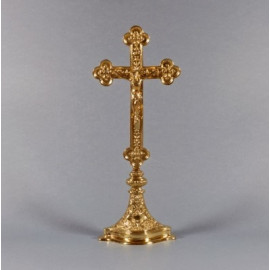
Altar crucifixes
Placed on or near the altar, often the principal ornament of the sanctuary. The General Instruction of the Roman Missal (no. 117) asks for a cross "with the figure of Christ crucified upon it," clearly visible to the congregation. Altar crucifixes are usually the largest crucifix in a church — 26 cm to well over a meter — and are often paired with candlesticks. See our guide to choosing an altar cross.
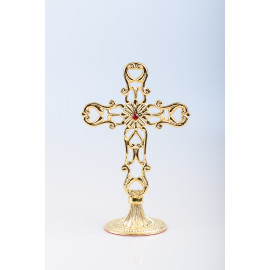
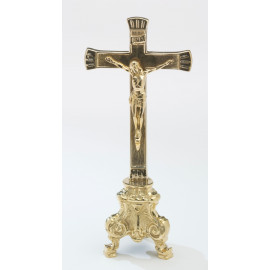
Standing crucifixes
Crucifixes with a weighted base, for altars, credence tables, desks, and shelves. A classic size is 19–32 cm; they are the natural centerpiece of a home altar.
Hanging (wall) crucifixes
The crucifix of Catholic homes: hung above doorways, beds, and in prayer corners. The traditional size is 20–30 cm, in wood or metal, with a ring or hook for wall mounting.
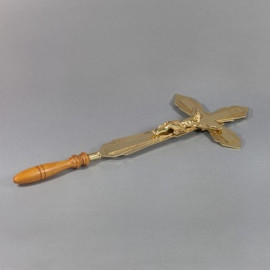
Hand crosses
A crucifix with a handle, held by a priest for blessings. Larger than a pocket cross and built to be raised comfortably — a piece of liturgical equipment more than decor.
The San Damiano Cross
The San Damiano cross is a special case: an icon cross rather than a realistic crucifix. It shows Christ triumphant — eyes open, robed, arms outstretched — surrounded by angels and saints. It is the cross before which St. Francis of Assisi prayed when he heard the call to rebuild the church, and it remains the model for Franciscan crosses. See The San Damiano Cross: Meaning and History.
Other Common Variants You Will Meet
- Celtic cross — a Latin cross with a ring at the intersection; common in Ireland and in cemeteries.
- Maltese cross — four arrowhead arms meeting at the center; the cross of the Knights of Malta.
- Patriarchal cross — two crossbars; used in Eastern Catholic and Orthodox contexts.
- Budded cross — arms ending in three buds or circles, recalling the Trinity; often seen on altar crosses and book covers.
- INRI plaque — not a cross type but a standard element: the title Pilate placed above the crucifix, Iesus Nazarenus Rex Iudaeorum.
Which Type Should You Choose?
Match the type to the place, not the other way around:
- Church altar: a large crucifix with corpus, proportionate to the altar; add candlesticks if the arrangement allows.
- Home prayer corner: a 20–32 cm standing crucifix or a wall crucifix above the little altar.
- Bedroom or doorway: a hanging crucifix, 20–30 cm.
- Gift: a San Damiano cross for Confirmation, a Tau cross for someone with Franciscan ties, a crucifix necklace or thong crucifix for everyday wear.
Browse real examples of nearly every type above in our Catholic crosses and crucifixes collection — 25 pieces from $4, most of them true crucifixes with the corpus.
Frequently Asked Questions
Q: What are the four main types of crosses?
A: The Latin cross (long lower arm), the Greek cross (equal arms), the Tau cross (T-shaped, Franciscan), and the papal cross (three crossbars).
Q: How many types of crosses are there?
A: Hundreds of named variants exist worldwide. For Catholic use, the four main shapes above plus a handful of regional variants (Celtic, Maltese, patriarchal) cover almost everything you will actually see.
Q: What is the difference between a Latin cross and a Greek cross?
A: The Latin cross has a longer lower arm; the Greek cross has four arms of equal length. The Latin form is standard in Western worship, the Greek form in Eastern iconography.
Q: What is a budded cross?
A: A cross whose arms end in three rounded buds or circles, traditionally read as a sign of the Holy Trinity. It appears on altar crosses, book covers, and vestments.
Q: Which type of cross is Catholic?
A: All of the main types are used by Catholics. The crucifix — any cross carrying the corpus — is the form required on or near the altar (GIRM 117).
Q: What is the difference between a cross and a crucifix?
A: A crucifix carries the figure of Christ; a plain cross does not. Full explanation in Cross vs Crucifix: What's the Difference?
Browse the collection: Catholic crosses and crucifixes.
