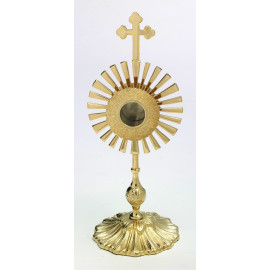
The history of the reliquary is the history of sacred art in miniature. For more than a thousand years, the finest goldsmiths, enamel workers, sculptors and architects were commissioned to make vessels for relics — and the results are among the most extraordinary objects in European art.
These famous reliquaries are not just museum pieces. They show how the Church has answered a practical question — how to protect and display a relic — with materials, forms and images that teach the faith.
The Shrine of the Three Kings, Cologne
The Shrine of the Three Kings in Cologne Cathedral is a gilded chasse made to hold the reputed relics of the Magi. It is over six feet long, shaped like a house with a sloping roof, and covered with figures, arches and enamel. The form is a chasse — a box reliquary in the shape of a church — and it shows how a reliquary can become architecture in miniature.
The shrine was made in the 12th and 13th centuries and remains one of the largest reliquaries in the world. Its message is clear: the relic is not hidden in a cupboard but presented as a sacred presence, with the craftsmanship of the whole community behind it.
The Reliquary of St Foy, Conques
The Reliquary of St Foy at Conques is a seated gold figure holding the relic of the young martyr. It is one of the most famous medieval reliquaries because it combines a portrait, a throne and a vessel in a single object. The faithful did not see a box; they saw the saint.
The figure was reworked over centuries, with later additions of crystal, stones and metal. That layered history is typical of reliquaries: they were repaired, enriched and adapted as devotion changed. A reliquary is not only an object; it is a record of the community that cared for it.
Sainte-Chapelle and the Crown of Thorns
The Sainte-Chapelle in Paris was built by King Louis IX in the 13th century to house the Crown of Thorns and other relics of the Passion. The building itself is, in a sense, a reliquary: a glass-walled shrine designed to elevate the relic and flood it with light.
The lesson is architectural. When the relic is of major importance, the vessel can become a chapel, and the chapel can become a vessel. The Sainte-Chapelle shows how light, colour and height can be used to create a sense of the sacred around a relic.
The Feretory of St Cuthbert, Durham
St Cuthbert’s shrine in Durham Cathedral was a feretory — a portable shrine, or the chapel that housed it — and one of the most visited pilgrimage sites in medieval England. The feretory form is designed for movement and public honor: the relics could be carried in procession and displayed to the faithful.
The word “feretory” reminds us that reliquaries were not always fixed. A portable shrine allowed the relic to travel, to be seen and to be venerated in different places.
Arm Reliquaries and Body-Shaped Shrines
Medieval goldsmiths often shaped a reliquary like the part of the body it contained: an arm for an arm bone, a head for a skull, a foot for a foot. The arm reliquary is the most familiar example. These forms were not anatomical curiosities; they made the saint present to the viewer and gave the relic a recognizable identity.
Today, body-shaped reliquaries are museum pieces. For a parish, the lesson is not to copy the shape but to respect the principle: the vessel should help the faithful recognize what it holds and why it matters.
What These Masterpieces Teach About Design
- Clarity: the relic should be visible and identifiable. A glass window, a clear frame and a stable base do more than ornament.
- Dignity: the materials and the finish should honor the relic without turning it into a spectacle.
- Durability: reliquaries were made to last for centuries, with repairable parts and replaceable glass.
- Context: the vessel should fit the place — an altar, a side chapel, a shrine or a home oratory.
- Restraint: the most effective reliquaries direct attention to the relic and, through it, to God, not to the goldsmith.
Our Catholic reliquaries follow the same principles in a contemporary workshop: brass and bronze bodies, gilded and silver-plated finishes, glass windows, weighted bases and sizes from a 4 cm capsule to a 40 cm display piece.
Frequently Asked Questions
Q: What is the most famous reliquary in the world?
A: The Shrine of the Three Kings in Cologne Cathedral is one of the most famous, a gilded chasse over six feet long made for the relics of the Magi. Other celebrated examples include the Reliquary of St Foy at Conques and the Sainte-Chapelle in Paris.
Q: Where is the Shrine of the Three Kings?
A: It is in Cologne Cathedral in Germany. The shrine is a large gilded chasse, shaped like a house with a sloping roof, and it dates from the 12th and 13th centuries.
Q: What is the Reliquary of St Foy?
A: It is a seated gold figure at Conques in France, made to hold the relic of St Foy, a young martyr. The figure combines a portrait, a throne and a vessel, and it is one of the most famous medieval reliquaries.
Q: Why was the Sainte-Chapelle built?
A: King Louis IX built the Sainte-Chapelle in Paris in the 13th century to house the Crown of Thorns and other relics of the Passion. The chapel is a glass-walled shrine designed to elevate and illuminate the relic.
Q: What is a feretory?
A: A feretory is a portable reliquary shrine, or the chapel in which such a shrine is kept. The word comes from the Latin feretrum, a bier. Feretories were designed for procession and public veneration.
Related Reading
Read Types of Reliquaries: Chasse, Theca, Arm and Cross Reliquaries and What Are Catholic Relics?, or browse our Catholic reliquaries.