





This glossary explains the textiles you will meet in a Catholic church, from the ambo fall on the reading desk to the purificator on the altar. Each entry gives a plain-language definition and, where useful, a link to the collection that carries it.
Textiles for the Ambo, Lectern, and Pulpit
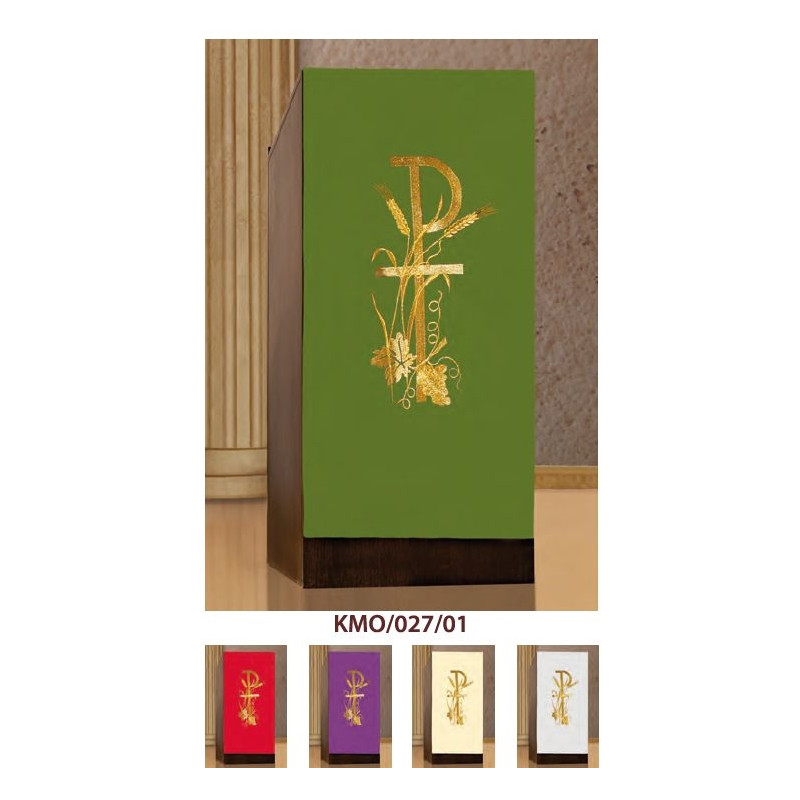
Ambo fall
The fabric panel that hangs on the front of the ambo, the reading desk where Scripture is proclaimed. It is usually embroidered and made in the liturgical color of the season. See our ambo covers and pulpit falls.
Pulpit fall
The hanging cloth on the front of a pulpit. In older inventories the same piece may be called a pulpit hanging or pulpit scarf. A pulpit fall is usually wider and longer than a Protestant pulpit scarf.
Pulpit scarf
A narrow, often reversible hanging used mainly in Protestant churches. In Catholic use the word is sometimes used loosely for a pulpit fall, but the proportions are different.
Lectern cover / lectern cloth
A cover for a standing reading desk. It may be a simple cloth or an embroidered panel matching the liturgical color. See our lectern covers.
Pulpit hanging
An older, broader term for a hanging on a pulpit. It may refer to a fall, a larger banner, or a canopy depending on the church.
Textiles for the Altar
Altar cloth
The white cloth that covers the altar for Mass. The Church requires at least one white cloth fitting the shape and size of the altar. See our altar tablecloths.
Antependium / altar frontal
A decorative hanging for the front of the altar, usually in the liturgical color of the season. It is not the same as a pulpit fall.
Fair linen
The white linen cloth that covers the top of the altar. It is the traditional altar cloth in Western use.
Corporal
A square white linen on which the chalice and host are placed during the Eucharistic prayer. It is one of the five sacred linens. See our chalice linen sets.
Purificator
A small white cloth used to wipe the chalice and the priest's fingers. It is one of the five sacred linens.
Pall
A stiffened square cover placed over the chalice during Mass. It is not the same as the pall that covers a coffin at a funeral.
Chalice veil
A cloth that covers the chalice before and after the Eucharistic prayer. It usually matches the liturgical color. See our chalice veils.
Ciborium veil
A veil that covers the ciborium, the vessel that holds the consecrated hosts. See our ciborium veils.
Monstrance veil
A veil used when carrying the monstrance in procession or exposing the Blessed Sacrament. See our monstrance veils.
Burse
A folded case, usually matching the chalice veil, used to carry the corporal to and from the altar.
Lavabo towel
A small towel used by the priest to dry his hands after the lavabo. It is part of the altar linen set.
Vestments and Paraments
Parament
A general term for the textiles used in the sanctuary: vestments, altar cloths, veils, falls, and hangings. A pulpit fall is a parament.
Chasuble
The outer vestment worn by the priest at Mass. It carries the liturgical color of the day. See our chasubles.
Stole
A narrow band worn over the shoulders by priests and deacons. It is the sign of ordained ministry and the liturgical color. See our stoles.
Cope
A long, cape-like vestment used for processions, Benediction, and other non-Eucharistic celebrations. See our copes.
Dalmatic
The outer vestment worn by deacons at Mass. It is related to the chasuble but has sleeves and a different cut.
Humeral veil
A long veil worn over the shoulders when carrying the Blessed Sacrament in procession or giving Benediction.
Furnishings and Sacred Objects
Tabernacle
The locked vessel or cabinet in which the Blessed Sacrament is reserved after Mass. It is usually placed in a noble, prominent part of the sanctuary.
Sanctuary lamp
The lamp that burns near the tabernacle to indicate the presence of the Blessed Sacrament. See our sanctuary lamps.
Pyx
A small vessel used to carry Communion to the sick or to reserve hosts. See our pyxes.
Reliquary
A container made to hold and display a relic. See our reliquaries.
Thurible
The censer used for burning incense during liturgical celebrations. See our thuribles.
Aspergillum
The instrument used to sprinkle holy water. See our aspergillum.
Frequently Asked Questions
Q: What is a parament?
A: A parament is a general term for the textiles used in the sanctuary — vestments, altar cloths, veils, falls, and hangings. A pulpit fall and an altar frontal are both paraments.
Q: What is the difference between an ambo fall and a pulpit fall?
A: They are the same kind of textile for different furniture: an ambo fall hangs on the ambo, a pulpit fall on the pulpit. The proportions may differ, so measure each piece separately.
Q: What is the difference between a chalice veil and a ciborium veil?
A: A chalice veil covers the chalice; a ciborium veil covers the ciborium, the vessel that holds the consecrated hosts. They are different sizes and shapes.
Q: What are the five sacred linens?
A: The corporal, purificator, pall, finger towel (lavabo towel), and the altar cloth or fair linen. They are the linens that come into direct contact with the Eucharist or the altar.
Q: Where can I buy these textiles?
A: Browse our lectern and pulpit covers, altar tablecloths, chalice linen sets, chalice veils, and ciborium veils.
Related Reading
Continue with What Is a Pulpit Fall?, How to Wash Liturgical Linens, and Ambo vs. Pulpit vs. Lectern.

